
Why Electric Vehicle Prototyping Is Critical: Overcoming Design and Manufacturing Challenges
Introduction: Prototyping as the Backbone of Modern EV Innovation
The electric vehicle market is changing at a rate that the conventional automotive markets have not. With the OEMs, Tier 1 suppliers and technology providers scurrying to introduce safer, efficient and cost effective electric vehicles, the role of Electric Vehicle Prototyping has evolved out of a supporting engineering role, to a business necessity. Compared to traditional cars, EVs incorporate complicated systems comprising of battery packs, power electronics, thermal control, and software-defined architectures. These complexities render EV Prototyping necessary in the course of validation of designs as well as decreasing the manufacturing risk and hastening the regulatory approvals and also commercially viable.
EV in the Automotive Prototyping is not just a form and fit check anymore. It has become a primary role in its ability to justify manufacturing readiness, supply chain viability and long term performance. Firms taking the initiative in the early phase of the systematic EV Prototype Development have a higher chance of addressing Electric Vehicle Design Challenges and to scale effectively in competitive global markets.
Understanding Electric Vehicle Prototyping in an Industry Context
Electric Vehicle Prototyping is the organized design and experimentation of the physical/digital EVs to production scale. These prototypes are of different stages of maturity and include the early concepts models to near production models that replicate the final manufacturing scenarios. Prototyping fills the gap between innovative design and production scale in EV Manufacturing.
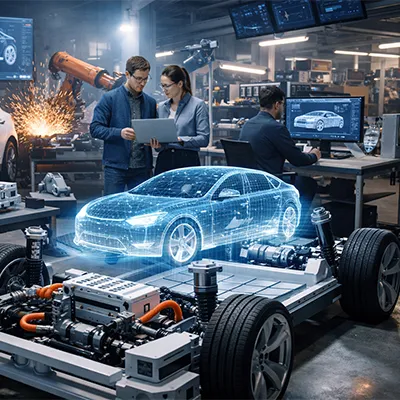
In the case of B2B stakeholders, engineering validation is not the sole aim of prototyping. It facilitates the cross-functional working of design engineers, manufacturing teams, suppliers and compliance experts. Prototyping automotive EV manufacturing digital twins and simulation tools with advanced materials testing solutions are progressively utilized in manufacturing to cut down on uncertainty throughout the development lifecycle.
Definition: EV Prototype Development
The formal approach to development of EV prototypes involves the design, construction, testing and development of electric vehicle parts or systems before mass production. It consists of mechanical, electrical, software, and manufacturing validations to perform, be safe, and manufacturable in the real world.
Why EV Prototyping Is More Complex Than Traditional Automotive Prototyping
EVs present a different collection of design and fabrication variables, which cannot be compared to internal combustion engine systems. Higher voltage architectures, energy density limitations in batteries and low mass materials have major implications on the complexity of development. The challenges of the Electric Vehicle Design are usually due to the interaction of sub systems and not due to the components.
Battery packs have a high probability of thermic runaway, power electronics have a high threat of electromagnetic interference, and battery enclosures demand structural verification through trial and error. EV Prototyping enables the manufacturer to detect system level failures at an early stage, avoiding expensive redesigns at late stages of the production process.
Moreover, there are ongoing regulatory requirements of EV safety, battery transportation, and dismantling worldwide. Prototyping gives a controlled compliance testing environment, which assists the manufacture to match the regional certification requirements before making a tooling investment commitment.
Overcoming Design Challenges through Structured EV Prototyping
Among the main EV Prototyping benefits, there is the fact that EV Prototyping allows to approach Electric Vehicle Design Challenges in a systematic way. Performance deviations discovered during prototype testing cannot be predicted by simulation. Such issues like vibration effects on battery modules, real-world charging characteristics and the way the material degrades with time can be observed only physically.
At this stage, Rapid Prototyping of Electric Vehicles is extremely important. Additive manufacturing and modular assembly models enable design teams to develop rapidly without disturbing schedule projections of the complete projects. Such agility allows OEMs and suppliers to investigate a variety of design options, compare the results of their performance, and choose the best options on the basis of data and not assumptions.
Manufacturing Readiness and EV Prototyping
EV Manufacturing needs a coordination of design intent and production capability never been witnessed before. Prototyping is a rehearsal of full-scale production, and demonstrates the bottlenecks in assembly processes, automatability and quality control processes.
Automotive Prototyping in an EV setting may involve pilot builds which simulate production line circumstances. These constructions confirm the precision of the tooling, the duration of cycles and manpower needs. Companies can also greatly cut the time-to-market and prevent the costly adjustments of the production line by spotting the manufacturing inefficiencies in a timely manner.
The prototyping solutions in automotive EV manufacturing are becoming more and more based on collaborative platforms ensuring the connection between OEM, contract manufacturing and technology providers. Changes in design in this ecosystem-oriented approach can be easy to be made and be economical during the development process.
Table: Role of Prototyping across the EV Development Lifecycle
| Development Phase | Purpose of EV Prototyping | Business Impact |
| Concept Validation | Evaluate feasibility of design concepts | Reduces early-stage investment risk |
| Engineering Development | Test subsystem integration and performance | Improves system reliability |
| Manufacturing Pilot | Validate production processes | Prevents scale-up delays |
| Pre-Launch Validation | Ensure regulatory and safety compliance | Accelerates market entry |
| Post-Launch Optimization | Refine design for cost and efficiency | Enhances long-term profitability |
The Role of Prototyping in Electric Vehicle Product Validation
Prototyping the product of an electric vehicle is not only a role that requires engineering accuracy but far much more. Prototyping helps in validation of the final product, to make sure that it is within the customer expectations, regulatory standards, and operational performance requirements. It is especially imperative in EV Manufacturing where product recall due to battery or power electronics malfunctions can be a devastating blow to the financial and reputational costs.
EV Prototype Development assists with validation, which occurs on several phases such as verification of component durability, system compatibility and real world conditions. Manufacturers can be assured of product strength by testing when subjected to extreme conditions like changes in temperatures, rapid charging and protracted wear, among others, before mass production.
Rapid Prototyping as a Competitive Advantage in EV Manufacturing
Rapid Prototyping of Electric Vehicles has become one of the strategic differentiators in a saturated marketplace. Flexibility in designs, i.e. being able to fasten adaptations of the design in response to the feedback of the prototype, provides a substantial benefit to some companies with regard to the pace of innovation and cost-efficiency. This is possible through rapid prototyping methods whereby decisions to freeze design are made much faster enabling the EV manufacturers to react positively to market trends and regulatory developments.
In the case of B2B suppliers, rapid prototyping also enhances alliances between suppliers and OEMs by showing technical flexibility and dependability. This cooperation is gaining more significance as EV platforms are developing into modular and software-based platforms.
Overcoming Design and Manufacturing Challenges in EV Prototyping
In order to address the design and production problematic issues of the EV prototyping, there will be need to employ a mix of digital, physical testing, as well as collaboration with a supplier. The piecemeal development cycle tends to cause disjuncture between design expectations and manufacturing facts.
Effective EV Prototyping plans focus on early engagement with suppliers, parallel engineering and also use of data in decision-making. Aligned product design validation and manufacturing limitations allow the company to reduce the amount of re-work and provide effective transition between prototype and manufacturing products.
Q&A: Industry Perspectives on EV Prototyping
Q: Why is EV Prototyping critical for scaling production?
EV Prototyping helps companies to identify the risks in manufacturing at the early stage and optimize the manufacturing processes to determine the manufacturing processes before making the high-volume production investments.
Q: How does prototyping impact cost control in EV Manufacturing?
Prototyping lowers late-stage changes which are costly to the production process because of their validation at an early stage.
Q: What role do suppliers play in EV Prototype Development?
The suppliers also provide specialized skills and technologies, which makes sure that the prototype design does not fail in meeting the real world manufacturing capacity.
Glossary: Key Industry Terms Explained
Electric Vehicle Prototyping can be defined as the design and production of EV models with the aim of ensuring that they are validated in terms of design, performance, and manufacturability.
EV Manufacturing refers to operations, technology, and processes of large-scale production of electric vehicles.
The wider usage of developing test models of vehicle systems, currently more targeted at electrification, is called Automotive Prototyping.
Conclusion: Prototyping as a Strategic Pillar of EV Success
Electric Vehicle Prototyping will always increase in strategic significance as the electric vehicle industry grows. In addition to technical validation, EV Prototyping can be regarded as the basis of the excellence in manufacturing, regulation, and competitiveness in the market.
Those companies that focus on the systematic EV Prototype Development and invest in high-quality Advanced Automotive EV manufacturing solutions to prototype are in a better position to solve complexity, mitigate risk, and produce high-quality electric vehicles at scale.
Under the modern conditions of accelerated innovation and high competition, prototyping has ceased to be a luxury. It is the very key to visionary EV design and profitable and sustainable EV Manufacturing.
 Media Pack Download
 Newsletters
 Industrial Events