
Key Technologies behind Fast and Functional Automotive Prototypes
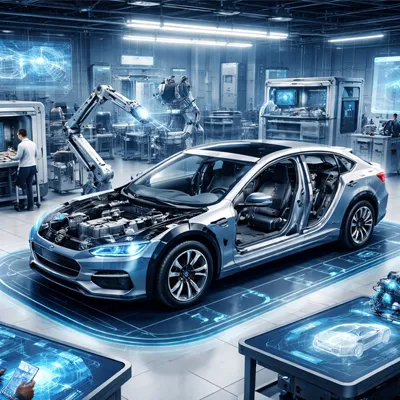
In the current competitive world in the automotive industry, the capacity to make the design ideas into practical prototypes within a short time is essential. Car manufacturers have been continuously pressured to be innovative yet quality, safety and performance were to be maintained. This has brought about the advancement of methods in automotive prototyping where speed and functionality are both crucial. This article discusses the technologies that are enabling rapid and practical automotive prototypes, how these solutions make the development process lean and what it alludes to the future of automotive engineering.
Understanding Automotive Prototyping
Automotive Prototyping is a process of designing early models of cars to test design ideas, functionality as well as manufacturability. These prototypes are also a transition phase between conceptual design phase and the full scale production as they allow the engineers and designers to test systems, ergonomics as well as structural integrity.
The prototypes of vehicles can be different in their complexity, and some of them are only simple mock-ups made to look good or more advanced prototype cars testing their performance and safety. Functional vehicle prototypes are very demanding, as they simulate the actual situation in the real world subjected to a range of operating conditions.
Glossary:
- Vehicle Prototypes: Prototypes of a vehicle that was to be tested and validated.
- Functional Vehicle Prototypes: Prototypes which can be tested in the way of a production car and will have a chance to test its performance, handling and durability.
- Rapid Automotive Prototyping: This is the process of obtaining prototype parts or complete cars and being able to turn them around.
- Automotive Prototype Development: Company-wide process, including designing of automotive prototypes, manufacturing them, testing and re-testing.
The Role of Automotive Engineering in Prototyping
Auto engineering forms the central part of prototype development. To design a prototype, engineers have to take into account structural Integrity, materials, aerodynamics, and manufacturability. Prototyping has been transformed because of the integration of digital tools such as Computer-Aided Design (CAD) and Computer-Aided Engineering (CAE).
CAD software enables one to model components and assemblies in 3D and hence parts fit accurately. CAE tools provide an opportunity to simulate stress, heat, vibration, and aerodynamic forces on virtual prototypes and eliminate the necessity to go through numerous physical iterations. The integration of mechanical, electrical and software engineering is necessary to develop working vehicle prototypes that can work under the actual circumstances.
Step-by-Step Insight:
- Conceptualization: The designers and engineers will develop initial drawings and CADs.
- Simulation and Analysis: CAE systems simulate the virtual prototype in terms of its strength, performance and safety.
- Rapid Prototyping: Prototyping technologies are highly developed using them to create physical components.
- Assembly and Functional Testing: A vehicle that is already complete (with prototype parts) is put into performance validation.
- Iteration and Optimization: Test results are used to make better designs to be prototyped or produced further.
Technologies Enabling Rapid Vehicle Prototype Development
Rapid prototyping of automotive solutions demands technologies that minimize lead time, and provide a high quality result. The following innovations are important and allow fast turnaround and functional testing:
1. Additive Manufacturing (3D Printing)
Additive manufacturing is one of the most radical technologies of the automotive prototyping. The complex geometries can be created without any tooling at all because of 3D printing whereby complex geometries are built in layers. This has been particularly useful in the creation of working prototypes of engine parts, fittings of the interior, and even structural parts.
Benefits:
- Quickens the process of producing prototypes.
- Reduces material waste.
- Facilitates intricate shapes that cannot be made up to date.
Additive manufacturing of automobiles may take place in the form of polymers and resins, high-strength metals, and may yield both aesthetic and functional prototypes.
2. CNC Machining
CNC (Computer Numerical Control) machining has been a main-stay in the creation of accurate metal and plastic parts to use in functional vehicle prototypes. It is also precise and as such, prototypes can be made close to production-level components which is essential in functional testing. CNC machining is capable of producing single prototypes and small batch components to use in testing.
Advantages:
- There is high precision and repeatability.
- Perfect in use as functional components with need of strength and durability.
- Works with a large variety of materials.
3. Rapid Tooling
Rapid tooling is additive manufacturing that involves the use of standard casting technology to create prototype molds in a short period of time. This technology helps automotive engineers to test components which are to be injection molded or otherwise produced in high volume without having to wait until conventional tooling is available.
Use Cases:
- Trims and plastic dashboards, interior panels.
- Functional testing of low-volume production runs.
4. Virtual Prototyping and Simulation
The improved simulation tools are now necessary in saving the physical prototyping time. Virtual prototyping allows the engineers to test the aerodynamics and crashworthiness as well as thermal performance without a physical vehicle.
Key Technologies:
- Structural simulations based on Finite Element Analysis (FEA).
- Aerodynamics Computational Fluid Dynamics (CFD).
- Engine and battery-thermal analysis software.
5. Mechatronic and Software Prototyping
The sophisticated electronic devices incorporated in the modern vehicles include Advanced Driver-Assistance Systems (ADAS), infotainment units and autonomous navigation units. Software-in-the-loop (SIL) and hardware-in-the-loop (HIL) testing have become available as part of solutions of Rapid prototyping and enable developers to test electronic and software systems before full-scale vehicle manufacture.
Advanced Prototyping Solutions for the Automotive Industry
Advanced Automotive Manufacturing is a strategy that incorporates a blend of additive manufacturing, CNC machining, rapid tooling and automated assembly to cut the lead times of prototypes. Lots of OEMs and Tier-1 suppliers have their own prototyping center to shorten the product development cycle.
Functional Vehicle Prototypes are often the end goal of these technologies. They enable:
- Mechanical, electrical and software systems validation in real world.
- Early detection of design and production obstacles.
- Pre-production-scale investment regulatory compliance testing.
Table 1: Comparison of Prototyping Technologies
| Technology | Primary Use | Advantages | Limitations |
| 3D Printing | Rapid component production | Complex geometries, fast turnaround | Material limitations for structural components |
| CNC Machining | Precision parts | High accuracy, functional testing | Slower for complex parts, high cost |
| Rapid Tooling | Low-volume molding | Quick mold creation, functional testing | Limited lifespan of molds |
| Virtual Prototyping & Simulation | Pre-production testing | Reduces physical iterations, cost-effective | Cannot fully replicate real-world performance |
| Mechatronic/Software Prototyping | Embedded electronics & ADAS testing | Validates software-hardware integration | Requires sophisticated simulation infrastructure |
Step-by-Step Guide to Fast Automotive Prototype Development
The process of developing quick and practical vehicle prototypes must be integrated. Efficiency: A formalized work process is efficient:
- Ideation and Digital Design: CAD allows engineers to work together in finalizing designs.
- Material Selection: Appropriate materials are selected to be 3D printed, CNC machined or injection molded.
- Rapid Component Fabrication: Additive or subtractive or hybrid methods are used to manufacture components.
- Assembly of Functional Prototype: Part assemblies are made to build a working prototype vehicle.
- Testing and Validation: They are tested regarding performance, safety and reliability.
- Iterative Improvement: It involves the introduction of the changes in design and repeating of the process until the prototype is complete to meet all the requirements.
Key Benefits of Rapid Automotive Prototyping
The rapid prototyping technologies strategy has a number of advantages to the auto companies:
- Reduced Time-to-Market: Faster development cycles enable automakers to introduce products at a faster rate.
- Cost Efficiency: Additive manufacturing and virtual testing minimizes wastage and redesigning which is expensive.
- Enhanced Innovation: The designers can experiment with bold designs and material but not need to spend a lot of money on tools.
- Improved Collaboration: The electronic devices facilitate the interaction between the foreign design and the engineering division.
Frequently Asked Questions (FAQ)
Q1: What differentiates functional vehicle prototypes from concept models?
Functional prototypes are developed such that they can act as production vehicles allowing performance testing, safety testing and the integration of real-world systems. The concept models tend to be beautiful and non-functional.
Q2: Can 3D-printed components be used in final vehicles?
Even though 3D printing has mostly been used in prototyping, high-volume vehicles are under low-volume manufacturing vehicles that are being 3D-printed with high-strength components.
Q3: How do virtual prototypes reduce costs?
The virtual simulation does not make use of physical models suggesting that the material cost, labor and time of production are reduced to the minimum.
Q4: What industries benefit most from automotive prototyping?
The automotive electronics and materials, as well as components suppliers, are also reaping the rewards of the quick prototyping technologies to test their products besides the automotive OEMs.
Future Trends in Automotive Prototype Development
The car prototyping environment is changing at a fast rate. Emerging trends include:
- AI-Driven Prototyping: Artificial intelligence programs can be employed to streamline designs based on their performance, weight and manufacturability before the real production.
- Hybrid Prototyping: Additive manufacturing combined with traditional methods in more functional and stronger prototyping faster.
- Sustainable Materials: More focus should be given to recyclables and lightweight in the prototype of eco-friendly vehicles.
- Integration with Autonomous Vehicle Testing: Functional prototypes Autonomous systems have been now combined with Autonomous Vehicle Testing to be tested in the field.
Checklist for Successful Automotive Prototyping:
- Make sure that there is cross-functional design, engineering and manufacturing teams.
- Use virtual simulation to decrease physical repetitions.
- Adopt the rapid manufacturing techniques to speed up the production of prototypes.
- Comparison of aesthetics and functionality.
- Revise fast and effectively on the basis of tests.
Conclusion
The speed and efficiency of creating automotive prototypes on a short timeline is no longer a luxury - it is a prerequisite of competitiveness in the world of the contemporary automotive industry. Additive manufacturing, CNC machining, rapid tooling, virtual simulations, and mechatronic testing are some of the most important technologies which enable engineers to design, create and test vehicle prototypes efficiently.
Automotive prototyping stands on the border of innovation, engineering accuracy and modern technologies of manufacturing. Through these innovations, the automotive companies can minimise the development cycles, costs, and release high quality vehicles in the market within a short time. With the ever increasing advancement in technology, the pace, functionality and sophistication of automotive prototypes will keep on increasing to make the industry evolve towards a future where there are no boundaries in the innovation.
 Media Pack Download
 Newsletters
 Industrial Events