
Types of Automotive Electrical Connectors and Their Functions
The electric connectors in cars are also significant in the new vision of automobile technology that aims at ensuring smooth communication between various systems in a car. Controlling power distribution, sensor data transmission, and so forth, each modern car is based on a complicated web of wires, connectors, and terminals. The more vehicles are electrified and digitalized, the more people need to know about the kind of electric car connector and how it is used, particularly those in the manufacturing industry, technicians, and even EV engineers who want to create a reliable and efficient system.
The Heart of Vehicle Electrical Systems
All the electrical signals or current in an automobile pass through automotive electrical connectors. These parts serve as connectors among circuits, namely, energy or data flows are not interrupted. In contrast to the previous generations of cars, which had a simple wiring design, modern cars are fitted with complex modules, sensors, infotainment, and driver-assistance technologies. The complexity requires a strong and well-developed automotive wiring harness connector.
Each individual modern car may have more than 1,500 personal connectors that are located in different parts - the engine bay and dashboard, the lighting systems, and EV charging modules. The connectors are required to satisfy special specifications of temperature resistance, waterproofing, voltage rating, and vibration resistance. That is where special-purpose solutions, such as waterproof car connectors, high-temperature car connectors, and high-voltage EV connectors, are involved.
Understanding the Types of Automotive Electrical Connectors
Speaking about the categories of car electrical connectors and their applications, one should be aware that the connectors may be different depending on their structure, pin arrangement, and resistance to the environment. The key product lines are multi-pin automotive connectors, sealed automotive connectors as well and quick disconnect connectors.
Multi-pin automotive connectors are normally employed where a series of circuits must be connected at the same time, such as in control units, lighting systems, or infotainment units. They permit compact, although high-density connections, and they are commonly used in engine management systems.
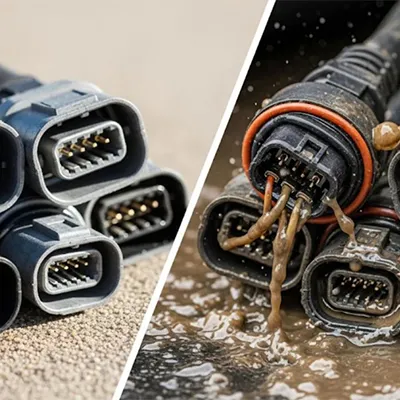
In the meantime, a sealed automotive connector is designed to withstand dust, water, and oil. These are the most suitable car waterproof connectors, which make it reliable even in extreme conditions like rain, mud, or a car wash. Unlike the loose sealing, they are tight and prevent corrosion and short circuit between components, thus being long-lasting in their lifespan.
In the case of maintenance and repair operations, quick disconnect connectors allow disconnection and reconnection without breaking the harness. They are frequently used as battery connections, lighting connections, and safety connections where there is a need to service or replace parts.
Automotive Wire Terminals: The Foundation of Electrical Reliability
The reliability of each connector is dependent on its terminal. The most important points of contact between the electricity, and wire, and the connector housing are the automotive wire terminals. They can be of different types, ring, spade, bullet, or blade, and each is used for a particular purpose.
In high-vibration set-ups like engines, a secure connection is essential. Crimped faults or corroded crimped automotive wire terminals may cause a voltage drop, intermittent signal, or even failure of the entire system. In order to sustain high levels of performance, manufacturers adopt the sophisticated technologies of crimping and plating. Gold or tin-plated terminals such as these offer a higher conductivity level and oxidation resistance.
Tasks related to the work with terminals are sometimes supported by automotive connector pin removal tools, which help remove and replace pins without harming the housing. These devices have become invaluable in contemporary workshops and assembly lines, namely, as small multi-pin automotive connectors have become more and more popular.
Waterproof and Sealed Connectors: A Necessity, Not a Luxury
Waterproof car connectors are among the most crucial in automotive electrical connectors since they have enhanced durability and reliability of automotive electronics. These connectors protect circuits against rain, humidity, and splashes, starting with underbody sensors up through headlamps and tail lights.
Multiplexing an adequate moisture ingress barrier, rubber or silicone gaskets are usually used as the best waterproof connectors in car wiring, to provide a barrier against moisture ingress. These sealed automotive connectors are commonly found not only in conventional automotive applications but have also become a standard in electric vehicles (EVs), where a minimal amount of water can enter the connector, resulting in short-circuiting or battery damage.
Sealed automotive connectors frequently within the tests of the manufacturers are frequently subjected to harsh environmental conditions salt spray, vibration, and thermal shock, and long-term reliability is determined. New cars have waterproof connectors that can survive a car submergence due to the advances in polymerized materials and the area of sealing technology, so they can be used on off-road cars and commercial cars.
High-Temperature and High-Voltage Connectors in Modern Vehicles
The automotive connectors are also high-temperature and thus have become more important since they are applied in more difficult conditions by using engines and electrical systems. They are made especially to work in harsh conditions, which may be over 150degC like in the presence of turbochargers, exhausts, or high power inverters.
The connected materials of the automotive connectors, which are necessary in high temperatures (like PEEK or PTFE), guarantee that the connectors can sustain mechanical strength and dielectric properties even in high temperatures. This guarantees system uniformity, such as the engine sensors, alternators, and power distribution units.
Conversely, electric mobility leaders are high-voltage EV connectors. Electric vehicles are powered by voltages between 400 V and 800 V, which require high current-carrying connector types that can withstand high current loads without overheating. These connectors of EV have multi-layered shielding to deter the electromagnetic interference, a safety lock to prevent unintended disconnection, and flame-retardant material to ensure additional protection.
High-temperature automotive connectors combined with the high-voltage EV connectors mean that both standard and electric cars will operate in a stable environment in high demand.
Automotive Plug and Socket Types: The Connection Interface
Although we commonly think of connectors as a whole, there are actually two parts to them, which include the plug and the socket. The types of automotive plug and socket identify the way the electrical continuity is provided.
An example is sensor applications using circular plugs and dashboard and control modules using rectangular plugs. All automotive plug and socket combinations are manufactured so as to be stable in a mechanical manner, align correctly, and also have locking in place. The accuracy with which these interfaces are designed determines the signal transmission quality and mechanical strength under mechanical stress.
There are multi-pin automotive connectors today that combine color coding, polarization, and keying to ensure that the connector is not fitted to the wrong connector, which has markedly decreased errors in wiring during assembly lines.
Automotive Wiring Harness Connectors: The Nervous System of the Vehicle
Those car automotive wiring harness connectors play a similar role to the central nervous system of a car, linking all the car components, including the powertrain, to the infotainment components. These connectors belong to the complex network of wiring harness - a collection of cables, transmitting power and information.
Each automotive wiring harness connector should be thermally and space optimized, as well as be mechanically sound. With increased sensor and electronic control unit (ECU) use, the requirement for high-density multi-pin automotive connectors in the harness systems has shot up.
Indeed, as market studies and research conducted by the most prominent research firms indicate, the automotive electrical connectors market is expected to exceed 25 billion by 2030, and, to a significant degree, it will be due to the use of electric vehicles and the emergence of advanced driver-assistance systems (ADAS). High-voltage EV connectors, sealed automotive connectors, and other connectors used in the rapid electrification of transport are undergoing innovation, and manufacturers are competing to create compact, lightweight, and efficient connectors.
Quick Disconnect Connectors: The Unsung Heroes of Maintenance
Quick disconnect connectors are essential in the maintenance and aftermarket service sector. These connectors enable the technicians to quickly replace the parts of the battery, lights, or sensors without cutting and fusing wires.
Quick disconnect connectors for automotive have brought a revolution in the process of servicing vehicles. As an example, in the case of diagnostic testing or parts replacement, these connectors reduce downtimes and provide a secure way of attaching and reconnecting them. Together with the automotive connector pin removal tools, they offer flexibility and safety in the manufacturing industry as well as in repairs.
Recent models of quick disconnect connector automotive are engineered with superior locking mechanisms, tactile response, and non-corrosive substances - features that have earned them an industry plunder.
Comparative Overview of Automotive Connector Types
| Connector Type | Primary Use | Environmental Resistance | Voltage Capacity | Service Ease |
| Sealed automotive connectors | Engine bay, sensors | High (Water/Dust proof) | Medium | Medium |
| High voltage EV connectors | Electric vehicles | High | Very High (400–800V) | Complex |
| High-temperature automotive connectors | Powertrain, exhaust sensors | Very High | High | Moderate |
| Multi-pin automotive connectors | Control units, infotainment | Medium | Medium | Moderate |
| Quick disconnect connectors automotive | Battery, lighting | Moderate | Medium | High |
This table shows the variations of various forms of car electrical connectors and uses depending on the application, voltage needed, and the environment. Each of these types has its purpose, and thus, despite the complexity of the electrical architecture of a car, there is an established connector, which could be relied on.
Future Outlook: Smarter, Smaller, and Stronger Connectors
The way of automotive electrical connectors to the future is miniaturization and intelligence. Connectors will also be smaller, lighter, and have built-in diagnostic capabilities as vehicles become autonomous and fully electric.
Automobile manufacturers are investing in smart automotive wiring harness connectors that are able to tell when it is getting hot, corroded, or voltage is not normal. These innovations, together with high-voltage EV connectors and the best waterproof connectors on car wiring, are redefining the reliability standards.
The concept of sustainability is also becoming a major trend. Plug and socket automotive fittings are currently being introduced with eco-friendly materials and recyclable polymers that are less damaging to the environment. Equally, automotive wire terminals are being designed with less resistance materials that enhance efficiency and reduce power.
Conclusion
Since the early days of simple ignition circuits in early automobiles, electric vehicle networks are now appearing, and automotive electrical connectors have become highly specialized to determine performance, safety, and durability. It could be waterproof automobile connectors to enable strength during unpleasant weather, high voltage EV connectors with the ability to power the future of mobility, or fast disconnect connectors with the automotive industry making life easier; every connector has a very important use.
Understanding the kinds of car electrical connections and applications can make engineers, suppliers, and enthusiasts understand how complicated but critical these tiny mechanisms are. Essentially, as cars are becoming smarter, the common connector still remains to be the quiet driver of innovation, efficiency, and connectivity in the automotive world.
 Media Pack Download
 Newsletters
 Industrial Events