How OEM Telematics is Connecting Vehicles, Drivers and Digital Services?
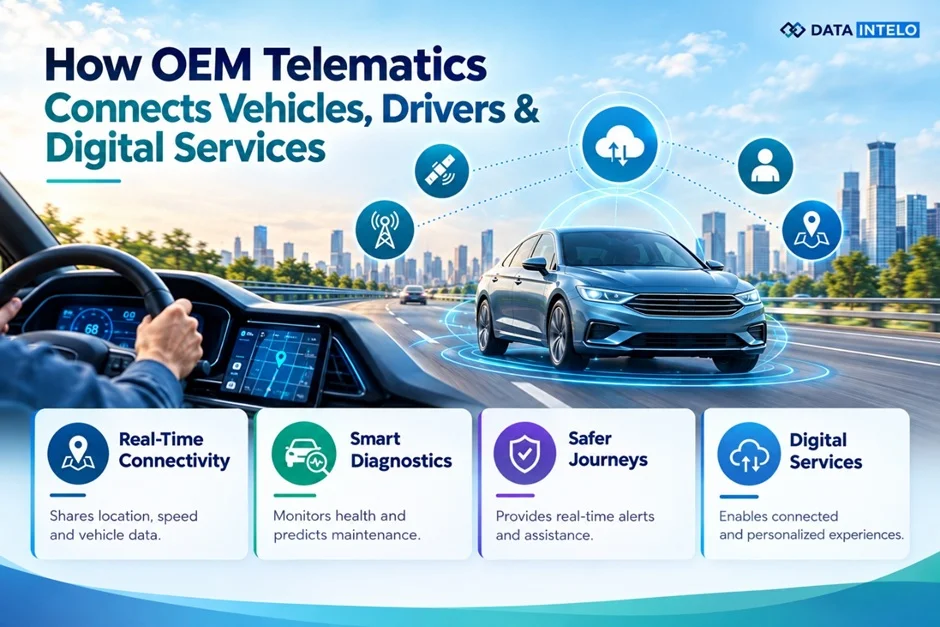
The OEM telematics enacts the transformation of an automobile to a service that is constantly connected and provides information exchange. The devices that come with a car, telematics devices, use cellular, GPS and sensor communication along with diagnosing the automobile in order to facilitate the flow of information from cars, clouds, drivers and road infrastructure. The US Department of Transport was able to test the connected vehicles over a 300–400-meter distance in a field experiment.
New cars generate location, speed, battery level, fuel consumption, faults on the vehicle and driving style information. OEM telematics lets some of this information be analysed during the journey or shortly after it.
How OEM Telematics Collects and Sends Vehicle Data
An OEM telematics system collects data from electronic control units and various sensors. The telematics regulations from the government provide information on mileage, hours of the engine, fuel efficiency, speed, duration of speeding, hard acceleration, harsh braking, total idle time, use of seatbelts, triggering of airbags, accidents happened and fault codes.
Trip data consists of starting and stopping time, geographic sites in latitude and longitude, length of the journey, travelled route, fuel consumed and days without trips. When an accident occurs a vehicle can transmit data every second while normal usage data requires transmission only once a day or month.
Research by the Federal Highway Administration studied hard acceleration alongside hard braking and included data on location, speed, seatbelt use, and windshield wiper operation. In one study area of less than 4 square kilo meters, the number of incidents of hard braking ranged from 10 events to as many as 299. The average speed of travel in this area was usually between 20 and 80 kph.
Connecting Drivers with Real-Time Information
The OEM telematics has links to real-time information. There are telematics systems to help users find their way; to help them in case of an emergency; to inform them about their car's condition; and other telematics-related conveniences.
According to a 2025 field test of the USDOT in Oakland County, Michigan, traffic signal prioritization can reduce the time spent at the intersection by 10 seconds when the vehicle passes. The same project tested vulnerable road user detection and alerts with a total latency of approximately 1.8 seconds.
Notably, the aforementioned 1.8 seconds was compared to the target level of the safety application of 300 milliseconds. This speaks to the rationale behind the varying technical requirements for different services. A maintenance alert may take seconds or even minutes to be transmitted while a signal alert to a pedestrian has to be transmitted in a very quick way.
OEM Telematics and Vehicle Diagnostics
Vehicle diagnostics is an application of telematics, where information is collected in advance of the mechanical problems that cause roadside breakdowns.
The Department of Energy determined that battery voltage, oil condition, coolant temperature, tire pressure, and diagnostic trouble codes are reliable indicators of a vehicle's need for maintenance. Telematics can also provide information on the car's mileage and engine hours in order to ensure that maintenance notifications are based on exact usage.
The influence of driving behaviour is another measurable factor. According to the reports of the Department of Energy, driving behaviour that improves can reduce the fuel consumption of aggressive drivers by 5-20%. Newer reports of the Department of Energy indicate that fuel consumption can be reduced by up to 10-25% through slow driving, avoiding idling and another practices.
These statistics illustrate that telematics is far more involved than simply identifying problems. Research from Dataintelo shows that the value of the global auto OEM telematics industry stood at $40.8 billion in 2025 and will rise to $105.1 billion by 2034.
Telematics Information and Communication with Vehicle Technologies
Data requires its specified intervals of collection and digital services. There could be continuous, periodic or event-driven data sources.
| Telematics Data | Example Measurement | Typical Digital Use |
| Vehicle location | Latitude/longitude | Navigation and tracking |
| Vehicle speed | km/h | Safety analytics |
| Hard braking | Event count | Safety analysis |
| Engine hours | Hours | Maintenance planning |
| Fuel consumption | Per trip | Efficiency analysis |
| Battery state of charge | Percentage | EV range management |
| Charging energy | kWh | Energy reporting |
| Diagnostic codes | Event-based | Maintenance alerts |
| Collision events | Event-based | Emergency response |
| Trip distance | Miles/km | Utilization analysis |
These statistics demonstrate how telematics goes beyond simple malfunctioning detection. In a report from Dataintelo, it is indicated that the worldwide telematics market for automotive OEM in the year 2025 reached $40.8 billion, while it was anticipated to rise to $105.1 billion throughout the year 2034.
Telematics Information System and Vehicle Communication Technologies
Electric vehicles take telematics a step further by incorporating energy-based metrics. The Department of Energy defines several parameters such as state of charge, distance travelled, energy consumption, and charging activity as relevant parameters for telematics used for fleet management.
Charging information encompasses the date of charging and its location, duration of the charging, beginning and the ending charge status, and finally, total kWh added to the vehicle. These metrics link vehicle performance with energy consumption.
As an illustration, when the vehicle starts with 80% charge yet completes its journey having only 30% left, it shows a loss of 50 percentage points. When combined with the distance travelled and temperature and charging information, we can interpret its efficiency.
According to the DOE recommendations, it is useful to keep track of other statistics such as the number of days travelled and miles driven. This way, a fleet of 100 EVs can analyze their energy consumption for thousands of trips made.
V2X: Linking Vehicles With the Road
Vehicle-to-everything communication means taking connectivity beyond a vehicle to encompass not only vehicle-to-vehicle communication, but also vehicle-to-infrastructure and vehicle-to-pedestrian communication.
USDOT field studies provide evidence for measurable outcomes, such as that traffic signal priority led to an average of approximately 10 seconds of time saved during each passage through an intersection. Vulnerable road user detection showed an average latency of 1.8 seconds compared to the 300 milliseconds that was the target for the system. Moreover, testing of the system revealed stable connection at approximately 400 meters under certain settings.
Research from the FHWA focused on analysis of events of hard braking in 4-square-kilometer areas with counts of events ranging between fewer than 10 and more than 299 in the examined places. Average speed of vehicles was between 20 and 80 km/h, which data shows can provide useful information on places where repetitive braking or acceleration is occurring.
Technology for Digital Services and Cloud
The cloud transforms basic vehicle data into digital services by identifying which information needs storing, processing, sharing or acting on. A connected vehicle generates information periodically; thus, certain events may require prompt actions while others can wait for the next report.
Federal telematics reports state that the first event needed to claim the beginning and end of a trip, distance travelled, a route taken, consumed fuel, and average distance travelled have an important role to play. Driver behavior indicators include excessive speed occurrences, time spent speeding, a percentage of harsh acceleration, a percentage of harsh braking, and an idle time.
The importance of combining variables is supported by FHWA research. Harsh acceleration and harsh braking have been investigated along the seat belt use and windshield wipers status. One of the analyses included 70.4% of events recorded with the seatbelt buckled and 29.6% with the seatbelt unbuckled.
In the dataset, harsh acceleration events reached above about 340 km/h confirming that the measurements are context-sensitive.
Cybersecurity and Governance of Data
The higher the connectivity, the more systems that need protecting. NHTSA is reported to have evaluated more than 75 cases of vehicle cybersecurity over a period of around a decade. These cases range from occurrence of incidents involving either telematics-related or wireless connection technology.
The NHTSA study on firmware updates. It mentions a number of wireless methods like Bluetooth, Wi-Fi, RFID, NFC, DSRC or cellular communication.
Using over-the-air updates provides yet another level of protection. NHTSA recommendations include securing OTA servers, the relay system and the firmware updating procedure.
Some important protective measures include:
- Network separation for critical vehicle systems
- Authentication and cryptographing of the connection
- Secure OTA update procedure
- Constant monitoring and response to incidents
The security challenge extends across the vehicle, network and cloud.
What Changes for Digital Service Design
Connected car technology is transforming the way digital services are delivered. A collision alert requires processing in just a few hundred milliseconds, while reporting mileage could be done either daily or monthly.
The USDOT evaluation in the field found that the average time taken to detect vulnerable road users was 1.8 s compared to the target of 300 ms. In contrast, federal fleet reporting can be performed at monthly intervals.
The emphasis of real time applications is on speed and dependability, the focus of event-driven systems is on fault detection, while the priority of periodic systems is on data retention.
Basic location services make use of all three determining factors like longitude, latitude and time whereas advanced telematics solutions integrate all available data and utilizes it.
The OEM Telematics Road Ahead
The drivers of the next phase will likely revolve around the integration of vehicle data and cloud technology with advanced connected transportation systems.
The proof is evident in several areas. Connected vehicle communication has already been tested at the distance of about 400 meters. A DOT evaluation estimated about 10-second savings in travel time from traffic signal priority. Applications for vulnerable road users have experienced about 1.8 seconds latency in comparison to the target of 300 milliseconds.
Fleet studies have shown measurable results in operations as well. DOE guidance notes improvements of 5% to 20% in fuel use for very aggressive drivers and the current guidance shows the possibility of lowering fuel use even more by 10% to 25% due to better driving behavior. FHWA study describes hard braking events of under 10 to more than 299 in specific 4-square-kilometer areas.
The figures show that OEM telematics systems no longer only serve the purpose of location tracking anymore. The system can connect data from the diagnostics, driver performance, energy consumption, road information and cloud services. Development in this direction will rely on proper information, connectivity, security of software, and proper management of information.
Reference:
- U.S. Department of Energy — Telematics for Federal Fleets
- Federal Highway Administration — Connected Vehicle Data Research
- USDOT ITS Joint Program Office — V2X Deployment
- USDOT ITS Deployment Evaluation — Connected Vehicle Field Evaluation
- NHTSA — Automotive Cybersecurity
- NHTSA — Cybersecurity Best Practices for Modern Vehicles
- Automotive OEM Telematics Market Size, Share & Forecast Report 2025 to 2034
 Media Pack Download
 Newsletters
 Industrial Events



Author Bio:

Ashish Kolte
Marketing Manager, Dataintelo
Ashish Kolte is a Marketing Manager at Dataintelo with expertise in marketing, market intelligence, and business strategy. He combines marketing insights with industry research to analyze market trends, identify growth opportunities, and provide data-driven perspectives on emerging industries and global business developments.