

Smart Seating Systems: How AI and Sensors Are Personalizing Passenger Comfort
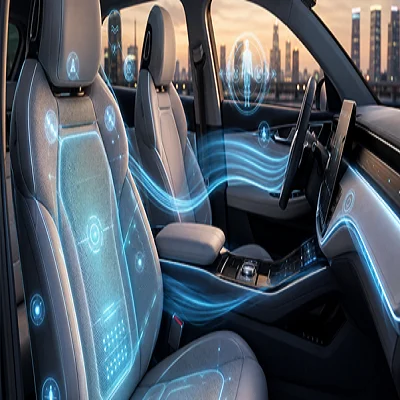
Think about the last time you got into someone else's car. The seat was probably wrong for you — too far back, too upright, the lumbar support jabbing you in the wrong spot. You spent the first five minutes of the drive fiddling with buttons instead of paying attention to the road. That small annoyance is exactly the problem automakers are racing to solve, and the solution has a name: Smart Seating Systems.
These aren't just seats with more buttons. They're an entirely new category of automotive technology that blends AI automotive seating intelligence with real-time sensor data to create a cabin experience that adjusts itself around the person sitting in it, rather than forcing the person to adjust around the seat.
What Are Smart Seating Systems, Exactly?
At their core, smart seating systems are seats equipped with embedded sensors, connected software, and machine learning models that work together to detect who's sitting in the seat, how they're sitting, and what they need — then respond automatically. It's a shift from static, mechanically adjustable seating to dynamic, responsive passenger comfort technology that learns and adapts over time.
| Also Read: Modular and Reconfigurable Seating Architectures for Autonomous Mobility |
A traditional car seat is a piece of furniture with a few motors attached. An intelligent vehicle seat is closer to a wearable device that happens to be shaped like a chair. It's constantly gathering information — pressure distribution, posture angle, temperature, even heart rate in some premium implementations — and feeding that information into an AI system that decides how the seat should respond.
The Sensors Doing the Heavy Lifting
None of this personalization works without the hardware underneath it. Automotive seat sensors are the unsung heroes of this whole category, and they've gotten remarkably sophisticated in a short time.
Modern seats can include:
- Pressure-mapping sensors woven into the seat cushion and backrest that detect weight distribution and shifting posture
- Capacitive sensors that sense occupancy even before someone fully sits down
- Thermal sensors that read skin temperature to fine-tune heating and cooling
- Biometric seat sensors capable of picking up heart rate and breathing patterns through the seat fabric itself, without any wearable device required
- Position and motion sensors that track how far someone has reclined, rotated, or shifted during a drive
Together, these sensors don't just report data — they create a continuous feedback loop. The seat "feels" the passenger, and the AI layer interprets what that feeling means.
Where AI Comes In
Sensors collect raw data, but it's the AI layer that turns that data into meaningful action. This is where AI-powered seat adjustment becomes genuinely impressive rather than gimmicky.
Instead of a passenger manually sliding a seat forward or tilting a headrest, machine learning models trained on large datasets of body types, posture patterns, and comfort preferences can predict the ideal seat configuration almost instantly. Over repeated trips, the system refines its understanding of an individual's preferences — firmer lumbar support on long drives, a slightly reclined position for city traffic, extra warmth in the morning commute.
This is also where adaptive seating systems distinguish themselves from older "memory seat" buttons. A basic memory seat recalls one saved position. An adaptive system continuously recalculates the ideal position based on live conditions: how long the trip has been, whether the passenger has been shifting uncomfortably, or whether posture has slouched after an hour on the highway. It's less "remember this setting" and more "notice what's happening right now and respond."
Occupant Monitoring: Comfort Meets Safety
Occupant monitoring systems were originally developed primarily for safety — think airbag deployment calibration or seatbelt reminders. But that same sensor infrastructure has quietly become the backbone of comfort personalization too.
An occupant monitoring system can determine a passenger's approximate size, weight, and seating position, which allows the seat and airbags to respond appropriately in a collision. The comfort application layers naturally on top of that same data: if the system already knows a passenger is a smaller-framed adult sitting slightly forward, it can also use that information to adjust lumbar pressure or seat bolster width for a more supportive fit.
This overlap between safety and comfort is one of the more compelling reasons intelligent occupant detection has scaled so quickly across mid-range and premium vehicles alike. Automakers get a two-for-one benefit from a single sensor investment: better crash response and better everyday comfort.
From Ergonomics to Emotion: The Human-Centric Shift
There's a broader philosophy driving all of this, often described as human-centric automotive design. It's the idea that vehicles should be built around human physiology and behavior first, with technology serving that goal rather than existing for its own sake.
Ergonomic automotive seating used to mean a well-shaped foam cushion and a lumbar knob. Today it means a system that understands spinal alignment changes over the course of a two-hour drive and makes micro-adjustments before discomfort even registers consciously. Some systems monitor subtle shifts in weight distribution as an early signal of fatigue and respond with small positional changes designed to keep circulation flowing and posture engaged.
This matters more than it might sound. Musculoskeletal discomfort from poor seating posture is a well-documented contributor to driver fatigue, and fatigue is a well-documented contributor to accidents. Comfort technology, in this sense, isn't just a luxury feature — it has a genuine safety dimension.
Personalization That Follows You
One of the more practical innovations in this space is how personalized in-car comfort now extends beyond a single vehicle. Seat preferences tied to a driver profile — height, preferred recline angle, lumbar firmness, seat heating threshold — can sync to a cloud account and follow that person into a rental car, a different family vehicle, or a next-generation model from the same brand.
Combined with facial recognition or a smartphone key, the car can identify who's approaching, unlock, and pre-configure the seat before the person even sits down. It's a small moment, but it's the kind of small moment that makes a vehicle feel like it was built specifically for the person driving it, rather than for an average of millions of anonymous drivers.
Memory Seat Technology, Reimagined
It's worth pausing on how far memory seat technology has actually come. The original version — a couple of buttons labeled "1" and "2" that saved a static seat position — was genuinely useful in the 1980s and 1990s but hasn't fundamentally changed for decades in most vehicles.
The new generation of memory seating is dynamic rather than static. Instead of one saved configuration, the system stores a range of contextual profiles: a "highway cruising" setting, a "city stop-and-go" setting, a "passenger nap" recline mode. AI models blend these profiles intelligently based on real-time trip data rather than requiring the driver to manually select a preset. The button hasn't disappeared — it's just been quietly replaced by a system smart enough not to need it most of the time.
Why This Matters for the Auto Industry
For automakers, smart seating systems represent a meaningful differentiator in an increasingly crowded and feature-saturated market. As more vehicles converge around similar infotainment screens and driver-assistance features, comfort and personalization are emerging as one of the clearer ways to create a distinct, premium feel.
There's also a strong connection to the shift toward autonomous and semi-autonomous driving. As drivers spend less time actively steering and more time simply occupying the cabin, seating comfort takes on a bigger role in the overall experience. A seat that can recline further, rotate, or provide massage functions becomes far more valuable when the person in it isn't required to keep both hands on the wheel.
Common Questions About Smart Seating Systems
Do smart seating systems require a wearable device to work?
No. Most biometric seat sensors are embedded directly in the seat cushion or backrest and can read metrics like heart rate and posture through contact alone, without any external wearable.
Are these systems only available in luxury vehicles?
They started there, but sensor costs have dropped enough that adaptive seating features are increasingly appearing in mid-tier trims, not just flagship luxury models.
Can smart seats actually improve safety, or is it just about comfort?
Both. Occupant monitoring systems that support comfort personalization also feed data that improves airbag deployment accuracy and posture-related fatigue detection, giving these systems a real safety function alongside comfort.
Will my seat settings transfer if I switch vehicles?
Increasingly, yes. Many automakers now tie seat preferences to a cloud-based driver profile that can sync across compatible vehicles, including rentals and loaner cars from the same brand ecosystem.
The Road Ahead
Smart seating systems are a good example of a technology category that sounds minor on paper but changes something people experience every single day. A seat that quietly senses fatigue, redistributes pressure, and remembers preferences across vehicles isn't flashy in the way a new infotainment screen is — but it's arguably a bigger contributor to how a car actually feels to live with.
As sensor costs keep falling and AI models get better at interpreting subtle biometric and postural signals, expect adaptive, intelligent seating to move from a premium differentiator to a baseline expectation — the same way heated seats went from a luxury feature to something drivers simply assume will be there.
 Media Pack Download
 Newsletters
 Industrial Events