
Modular and Reconfigurable Seating Architectures for Autonomous Mobility
For most of automotive history, a car's interior was a fixed proposition. Two rows, forward-facing seats, a steering wheel commanding the front. That layout made sense when every vehicle needed a driver. But as autonomous mobility solutions move from pilot programs to real deployments, the entire logic of cabin design is being rewritten — and seating is where the change is most visible.
When nobody has to sit behind a wheel, the question stops being "how do we fit seats around the controls" and becomes "what do people actually want to do inside this space." That single shift is driving one of the most interesting engineering challenges in the industry right now: building modular vehicle seating that can adapt to work, rest, socializing, or cargo, sometimes all in the same trip.
| Also Read: Safety Innovations in Autonomous Vehicle Seating: Balancing Comfort with Crash Protection |
Why Fixed Seating No Longer Fits Autonomous Vehicles
A traditional cabin is designed around one assumption — someone is driving. Remove that assumption, and a lot of the old constraints disappear along with it. There's no need for every seat to face forward. There's no need for a dashboard to dominate the front of the cabin. There's no need for the same layout on a solo commute as on a family road trip.
This is why autonomous mobility solutions are being paired so closely with interior redesign. Robotaxis, autonomous shuttles, and self-driving delivery-passenger hybrids all face the same problem: the vehicle might carry one commuter at 7 a.m., a group of four at lunch, and a stack of packages at midnight. A fixed bench seat can't serve all three use cases well. A reconfigurable vehicle interior can.
What Modular Vehicle Seating Actually Means
"Modular" gets used loosely in marketing, so it's worth being precise. In this context it refers to seating systems built from independent units — seats, panels, or modules — that can be:
- Repositioned along the cabin floor
- Folded flat or stowed to free up floor space
- Rotated or swiveled to change orientation
- Removed and reinstalled for different vehicle configurations
- Reconfigured in minutes, not through a workshop retrofit
This is different from adjustable seating, which just means a seat slides or reclines. Modular seating changes the entire cabin geometry, not just one seat's position. Think of it less like adjusting a chair and more like rearranging a small room.
Reconfigurable Interiors: From Commute Mode to Lounge Mode
Reconfigurable vehicle interiors are built around scenarios rather than a single default layout. A vehicle might ship with several preset "modes" that a passenger — or the vehicle itself — can select:
Commute mode keeps seats forward-facing and compact, optimized for solo riders who want a quick, low-friction trip, often with a fold-down work surface.
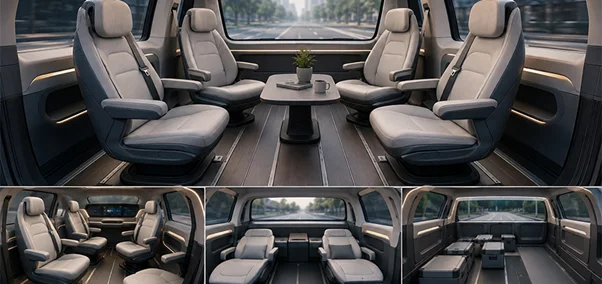
Lounge mode rotates seats inward to face each other, turning the cabin into a small conversation space for group rides or family trips.
Cargo mode folds or removes rear seating entirely, converting the vehicle into a flexible hauler without needing a separate vehicle class.
Rest mode reclines seats further than a standard vehicle would ever allow, since there's no driver posture to accommodate.
This flexibility is why flexible automotive seating is increasingly treated as a core product feature rather than an accessory. It effectively lets one vehicle platform behave like several different vehicles, which matters enormously for fleet operators trying to maximize utilization from a limited number of vehicles.
Autonomous Vehicle Interior Design Is a Systems Problem
It would be a mistake to think of this as just a seating question. Autonomous vehicle interior design touches structural engineering, safety systems, materials, and software all at once.
Structurally, a seat that moves needs a track or rail system embedded in the floor, which changes how crash loads are distributed through the chassis. Safety systems have to work regardless of seat position or orientation — airbags, seatbelt pretensioners, and occupant sensors all need to adapt dynamically rather than assume a fixed seating position.
Materials have to hold up to more frequent movement and, in shared or fleet vehicles, more frequent cleaning and wear. And software has to tie it all together, tracking seat position, occupant presence, and weight distribution in real time.
This is also where the line between hardware and software design starts to blur. A seat that can move is only useful if the vehicle knows where it is, whether someone is sitting in it, and how to keep that occupant safe no matter which way they're facing. That's a sensor and software problem as much as a mechanical one.
Multi-Functional Vehicle Cabins as a Design Philosophy
The broader trend here is the rise of multi-functional vehicle cabins — interiors designed to support several distinct activities without requiring a different vehicle for each one. Rather than owning a commuter car, a family SUV, and a delivery van, an operator (or eventually a household) could rely on one platform that reconfigures itself for the job at hand.
This isn't just a convenience play. For fleet operators running autonomous shuttles or robotaxis, every idle hour is lost revenue. A cabin that can shift from passenger transport to light cargo delivery between peak hours keeps the vehicle earning instead of sitting empty. For urban planning purposes, fewer single-use vehicles on the road also means less congestion and parking demand overall.
Intelligent Seating Systems: Where Software Meets Furniture
The word "intelligent" isn't just marketing polish here. Intelligent seating systems typically include occupancy sensors, position memory, weight detection, and automated adjustment tied into the vehicle's broader control system. A seat might automatically return to a safe forward-facing position when the vehicle detects it's about to move, or adjust recline angle based on trip duration and road conditions.
Some systems go further, learning individual passenger preferences across rides — similar to how a phone remembers a user's settings — so a returning passenger's seat, temperature, and lighting preferences load automatically. In shared or fleet-owned vehicles, this kind of personalization is becoming a meaningful differentiator between operators.
Swivel and Rotating Car Seats: The Most Visible Innovation
Of all the changes happening inside autonomous vehicles, swivel and rotating car seats are probably the easiest to picture and the one most people ask about first. Instead of every seat facing forward, seats can rotate to face each other, face rearward, or angle toward a shared table or screen.
This isn't a new idea in isolation — minivans and RVs have experimented with rotating captain's chairs for years. What's new is the scale and integration. In an autonomous vehicle, rotating seats aren't a novelty option; they're a core part of how the cabin is meant to be used, because there's no longer a fixed "front" that everyone needs to face.
Engineering a rotating seat for a passenger vehicle is harder than it looks. The seat base needs a locking mechanism that's reliable under crash loads, the rotation needs to be smooth enough to not feel gimmicky, and the whole assembly needs to integrate with seatbelt anchoring points that were traditionally designed for one fixed orientation.
Adaptive Cabin Architecture: The Structural Backbone
None of this seating flexibility works without what's often called adaptive cabin architecture — the underlying floor, rail, and mounting system that makes reconfiguration physically possible. This typically includes a flat, reinforced floor with embedded rail or anchor points, a modular power and data network so seats can carry sensors, heating, and lighting regardless of position, and a structural design that keeps crash safety consistent across multiple seat layouts, not just the default one.
This is arguably the least glamorous part of the whole trend, but it's the part that determines whether reconfigurable seating is actually safe and durable, or just a nice-looking concept car feature that never survives regulatory testing.
Future Vehicle Interior Design: What's Coming Next
Looking ahead, future vehicle interior design is likely to keep moving in a few consistent directions. Cabins will increasingly be designed around activities rather than driving postures, with layouts that shift based on time of day, trip purpose, or passenger count. Materials will need to handle more frequent reconfiguration and, in shared vehicles, faster cleaning cycles between riders. And personalization will deepen, with cabins that recognize returning passengers and load their preferred configuration automatically.
Regulation will also shape how fast this moves. Safety standards built around a fixed, forward-facing seating assumption will need updates before rotating and repositionable seats can become standard across passenger vehicles rather than niche fleet applications.
Frequently Asked Questions
What is modular vehicle seating?
Modular vehicle seating refers to seat systems built as independent, repositionable units that can be moved, folded, rotated, or removed to change a vehicle's interior layout, rather than being fixed in one configuration.
Why does autonomous mobility require reconfigurable interiors?
Without a driver, there's no need for a fixed forward-facing layout built around vehicle controls. Reconfigurable interiors let the same vehicle serve different purposes — commuting, group travel, rest, or cargo — without needing separate vehicles for each.
Are swivel seats safe in a moving vehicle?
Swivel and rotating seats are engineered with locking mechanisms and reinforced anchor points designed to meet crash safety standards in their locked positions. Regulations are still evolving to fully address non-forward-facing seating during vehicle motion.
What makes a seating system "intelligent"?
Intelligent seating systems combine sensors, automated adjustment, and software integration — tracking occupancy, position, and passenger preferences, and often adjusting automatically based on trip conditions or safety requirements.
Final Thought
Modular and reconfigurable seating isn't a side detail of autonomous mobility — it's one of the clearest signs of how differently these vehicles are being designed from the ground up. Once the driver's seat stops dictating the rest of the cabin, everything about how people sit, move, and spend time inside a vehicle becomes an open question again. The answers taking shape now, through flexible seating, adaptive architecture, and intelligent systems, are likely to define what "normal" looks like inside a car a decade from now.
 Media Pack Download
 Newsletters
 Industrial Events