
Safety Innovations in Autonomous Vehicle Seating: Balancing Comfort with Crash Protection
For more than a century, car seats did one job: hold a person in place during a crash while staying comfortable enough for a daily commute. That equation is now being rewritten. As self-driving technology moves from concept to commercial reality, engineers are discovering that the humble car seat may be one of the hardest problems in the entire vehicle to solve. Autonomous Vehicle Seating sits at the intersection of biomechanics, materials science, and artificial intelligence — and getting it right could determine whether the next generation of vehicles is truly safe.
Why Traditional Seat Design No Longer Works
Every safety assumption built into a modern car seat rests on one idea: the driver sits upright, facing forward, hands on the wheel, eyes on the road. Seat belts, airbags, and headrests are engineered around that single, predictable posture.
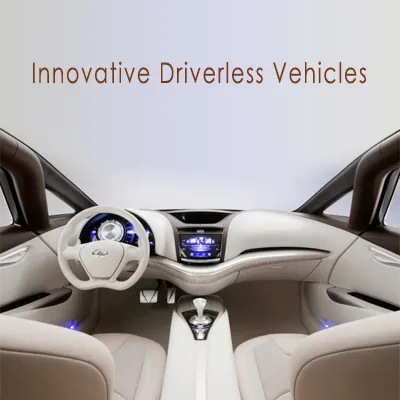
Autonomous vehicles break that assumption completely. Once a car can drive itself, why would passengers sit facing forward the entire trip? Manufacturers are already prototyping cabins where seats swivel to face each other, recline into near-flat positions, or fold away entirely to create open lounge space. That flexibility is wonderful for comfort — and a nightmare for Automotive Seat Safety engineers, because a body in a reclined or rotated position behaves completely differently in a collision than a body sitting upright.
This is the central challenge driving innovation across the industry: how do you protect a passenger who might be facing sideways, lying back, or turned toward a companion when a crash happens in a fraction of a second?
The New Physics of Autonomous Vehicle Crash Safety
In a conventional crash, occupant protection relies on a well-understood chain of events — the seat belt locks, the airbag deploys, the crumple zone absorbs energy, and the body decelerates in a predictable arc. Autonomous Vehicle Crash Safety research has shown that reclined or repositioned occupants experience very different loading patterns. A passenger leaning back 45 degrees, for example, can slide forward under the lap belt in a crash — a phenomenon engineers call "submarining" — which traditional restraint systems were never designed to prevent.
To address this, safety researchers are rethinking restraint systems from the ground up rather than simply adapting existing hardware. This has led to breakthroughs in four major areas: seat structure, restraint systems, sensing technology, and material science.
Crash-Optimized Vehicle Seats: Rebuilding From the Frame Up
The foundation of any safe seat is its structure, and this is where some of the most significant redesign work is happening. Crash-Optimized Vehicle Seats now incorporate reinforced frames that can manage energy absorption regardless of the seat's angle or orientation. Instead of a single fixed mounting point, many next-generation designs use multi-directional load paths that redistribute crash forces evenly across the seat structure, whether the occupant is upright, reclined, or rotated.
Engineers are also experimenting with deployable structural elements — seat backs that stiffen automatically on crash detection, or bases that lock into a safer position within milliseconds of an impending collision. These Next-Generation Seat Structures essentially give the seat itself an active role in the safety system, rather than treating it as passive furniture that restraints and airbags work around.
Smart Seat Belt Systems: Restraints That Adapt in Real Time
Perhaps no component illustrates this shift better than the seat belt. Smart Seat Belt Systems are emerging that use sensors to continuously track occupant position, size, and posture, adjusting belt tension and geometry accordingly. Some prototypes include dynamically routed belts that reposition themselves based on where a passenger is sitting, rather than assuming a fixed upright posture.
Pre-tensioning technology has also become far more sophisticated. Rather than a single tensioning event at the moment of impact, modern systems can apply graduated tension in the seconds before a predicted collision, based on data from the vehicle's collision-avoidance sensors. Combined with adaptive airbags that adjust their deployment angle and force based on occupant position, these systems represent a fundamental shift from one-size-fits-all restraint to individualized protection.
AI-Powered Occupant Protection: The Cabin That Watches and Responds
This is where autonomous vehicles offer something no traditional car ever could: constant, intelligent awareness of what's happening inside the cabin. AI-Powered Occupant Protection systems use interior cameras, weight sensors, and pressure mapping to build a real-time picture of every passenger's position, size, and posture.
If the system detects a child seat, it can adjust airbag deployment force accordingly. If it senses a passenger has reclined for a nap, it can pre-position restraints and headrests before a predicted hazard even materializes. Machine learning models trained on thousands of crash simulations allow these systems to predict the safest response for a specific occupant configuration in real time, rather than relying on generic settings designed for an "average" adult.
This predictive capability is arguably the biggest leap forward in Occupant Protection Systems in decades. Instead of reacting to a crash after it happens, the cabin can begin preparing for it in the seconds leading up to impact, using data from radar, lidar, and camera systems that already power the vehicle's driving functions.
Advanced Automotive Seating Systems: Comfort as a Safety Feature
It might seem counterintuitive, but comfort and safety are becoming deeply intertwined rather than opposing goals. Advanced Automotive Seating Systems now use pressure-mapping foam and dynamic bolstering that adjusts in real time — not just for lumbar support on a long drive, but to keep occupants properly positioned relative to restraint systems even as they shift or relax.
Adaptive Automotive Seating takes this further by using motorized components that respond to driving conditions. If the vehicle detects hard braking or a sudden evasive maneuver, the seat can automatically adjust the occupant's position — tightening bolsters, altering recline angle, or repositioning headrests — within milliseconds, well before human reflexes could react. This blurs the line between comfort feature and safety system, since a well-positioned, properly supported occupant is inherently safer in a collision.
Materials Science and Vehicle Crashworthiness
None of these innovations matter without the right materials. Vehicle Crashworthiness depends heavily on how seat structures and cabin components absorb and dissipate energy during impact. Engineers are increasingly turning to advanced composites, energy-absorbing foams, and lightweight high-strength alloys that can flex and deform in controlled ways, channeling crash forces away from the occupant.
Some manufacturers are exploring 3D-printed lattice structures within seat cushions and backs — designs that would be impossible to manufacture with traditional methods but offer superior energy absorption while reducing overall weight. Lighter seats mean better vehicle efficiency, but only if crashworthiness isn't compromised, which is why so much current research focuses on maximizing protection per gram of material.
Passenger Protection Technology: Looking Beyond the Seat Itself
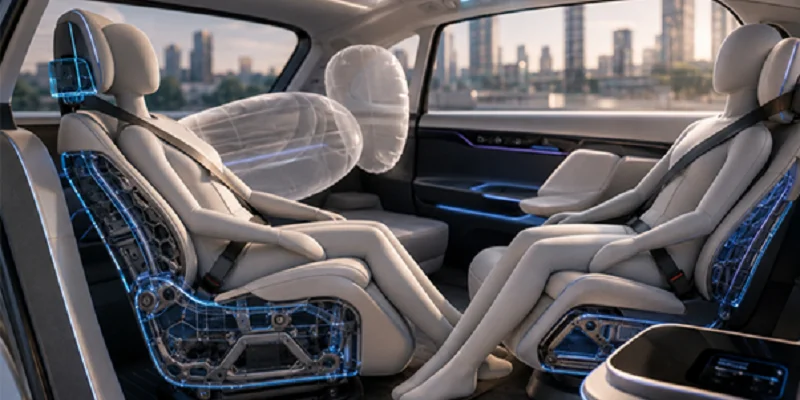
Passenger Protection Technology in autonomous vehicles increasingly extends beyond the seat to the entire cabin environment. Interior surfaces are being redesigned with softer, more energy-absorbing materials since passengers facing sideways or toward each other may contact different parts of the cabin than in a traditional forward-facing layout. Some designs incorporate deployable cabin airbags that protect against side-impact scenarios in configurations where passengers face one another.
Regulatory bodies, including the National Highway Traffic Safety Administration and Euro NCAP, have begun updating testing protocols to account for these new seating configurations, recognizing that crash testing standards built around forward-facing occupants no longer capture the full picture of autonomous vehicle safety.
Frequently Asked Questions
What makes autonomous vehicle seating different from traditional car seats?
Autonomous vehicle seating must protect passengers who may not be seated upright or facing forward, since self-driving cars allow for reclined, rotated, or lounge-style seating arrangements that traditional restraint systems weren't designed to handle.
How do smart seat belts improve occupant protection?
Smart seat belt systems use sensors to track passenger position and adjust tension, routing, and pre-tensioning in real time, offering personalized protection instead of a fixed, one-size-fits-all restraint.
Can AI actually predict a crash before it happens?
AI-powered systems use radar, lidar, and camera data already present in autonomous vehicles to detect potential hazards seconds before impact, allowing restraint systems and seat positioning to adjust proactively rather than only reacting after a collision occurs.
Are reclined or rotated seats in autonomous vehicles safe?
Manufacturers are actively developing crash-optimized structures, adaptive restraints, and AI-driven positioning systems specifically to make non-traditional seating configurations safe, though this remains an active area of engineering and regulatory development.
The Road Ahead
The shift toward autonomous vehicles is forcing the automotive industry to rethink one of its most fundamental components from first principles. Autonomous Vehicle Safety can no longer rely solely on decades-old assumptions about occupant posture and position. Instead, it requires a genuinely integrated approach — seats that sense, restraints that adapt, materials that perform better under stress, and AI systems that anticipate danger before it arrives.
The seat of the future won't just be a place to sit. It will be an active participant in keeping passengers safe, constantly adjusting, predicting, and protecting in ways that today's vehicles simply cannot. As autonomous technology matures, this convergence of comfort and crash protection will likely be remembered as one of the defining engineering challenges of the era — and one of its most important safety achievements.
 Media Pack Download
 Newsletters
 Industrial Events