
Predictive Maintenance and Quality Control in Vehicle Seat Manufacturing Using AI
What if your line could tell you a machine was about to fail, days before it did?
That is now realistic. AI in automotive seat manufacturing combines camera-based inspection with machine health monitoring, so plants can spot defects the moment they appear and fix worn equipment before it hurts quality. Here is how it works, and how to start.
A car seat is one of the most complex components in a vehicle. It combines foam, fabric or leather, metal frames, airbags, heating elements, sensors, and motors, and it has to be comfortable, safe, and flawless to look at. Manual checks and fixed maintenance calendars struggle to keep up. This guide explains how AI quality control and AI predictive maintenance work together, and how you can start using them.
What is AI in automotive seat manufacturing?
AI in automotive seat manufacturing means using machine learning, computer vision, and sensor data to inspect seats automatically, spot defects in real time, and predict machine failures before they happen.
It works in two connected areas:
- Quality control: cameras and algorithms inspect every seat, not just a sample.
- Predictive maintenance: sensors and models watch equipment health and warn you before something breaks.
The link between them matters. Many quality problems are really machine problems in disguise. A drifting cutter or a worn press shows up in defects first, so fixing the machine early protects quality as well.
Why is automotive seat manufacturing quality control so hard?
Seat quality control is hard because a seat has many materials, many variants, and many places for small defects to hide, and human inspectors get tired.
Common problems include:
- Uneven or crooked stitching
- Wrinkles, puckering, or misaligned patterns
- Scratches, stains, or color mismatch on leather and fabric
- Foam density or shape issues
- Weld defects on frames
- Missing clips, trim, or fasteners
Human inspectors are skilled, but after hours of repetitive work, attention drops. Two inspectors may also judge the same flaw differently. With dozens of trim levels and colors on one line, consistency becomes a real challenge, and this is where automated quality inspection in automotive plants earns its place.
How does computer vision automotive seat inspection work?
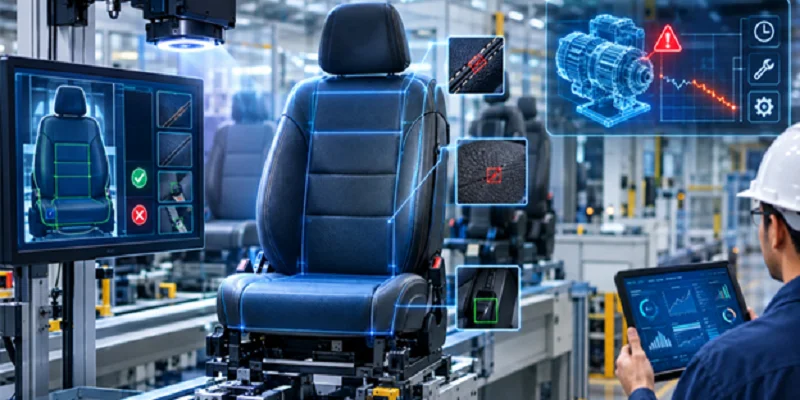
Computer vision seat inspection uses high-resolution cameras and trained AI models to compare each seat against what "good" looks like, flagging anything that deviates.
The process is simple to follow:
- Image capture. Cameras with controlled lighting photograph the seat from several angles as it moves down the line.
- Analysis. A deep learning model examines the images for stitching, surface, alignment, and assembly issues.
- Decision. The system classifies the seat as pass, fail, or "needs review," often in a fraction of a second.
- Feedback. Results go to the operator or the MES system, and defect data is logged for analysis.
This is what people mean by AI visual inspection in automotive plants. Traditional machine vision automotive quality inspection relied on rigid rules, such as "reject if this measurement is off by X." Modern AI learns from examples, so it handles natural variation in leather grain or fabric texture much better and produces fewer false alarms.
What defects can AI seat inspection detect?
AI seat inspection can detect surface, stitching, assembly, and dimensional defects, including many that are easy for the human eye to miss.
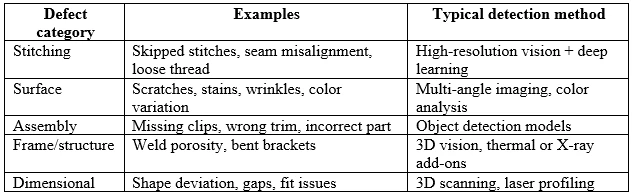
This is the heart of automotive seat defect detection: catching the flaw at the station where it happens, when a fix costs cents, instead of at final audit, when it costs hours.
What is predictive maintenance in automotive manufacturing?
Predictive maintenance in automotive manufacturing uses real-time machine data and machine learning to forecast when equipment will fail, so repairs happen just in time instead of too late or too early.
Most plants still use one of two approaches:
- Reactive: fix it when it breaks (expensive and disruptive).
- Preventive: service it on a fixed schedule (safer, but often wasteful, since you replace parts that still had life left).
AI predictive maintenance in manufacturing adds a third option. Sensors track vibration, temperature, motor current, pressure, and cycle counts. Machine learning models learn what "healthy" looks like for each machine, then flag subtle changes that signal trouble ahead, sometimes days or weeks early.
How does machine learning predictive maintenance apply to a seat production line?
On a seat line, machine learning predictive maintenance monitors the critical machines, such as cutters, sewing machines, foam injection systems, welding robots, and conveyors, to prevent unplanned stops.
Here are practical examples:
- Industrial sewing and stitching machines: vibration and motor-load patterns can reveal needle wear or tension problems before seams go bad.
- Cutting tables: blade dullness shows up as changes in cutting force and edge quality.
- Foam pouring and molding: temperature and pressure drift can signal nozzle or mixing issues.
- Welding robots: current and voltage signatures reveal electrode wear.
- Conveyors and motors: bearing wear appears in vibration data long before a failure.
Predictive maintenance on the production line also helps with spare parts planning. When you know, a component will likely need replacing next week, you order it now instead of paying for rush shipping.
How do predictive maintenance and quality control work together?
They work together by sharing data: machine health signals explain why defects appear, and defect trends reveal which machines need attention.
This is the biggest opportunity most plants miss. Consider this illustrative scenario:
- The vision system notices stitching defects creeping up on one line.
- The maintenance model sees rising vibration on a specific sewing machine.
- The two signals combine, and the system alerts the team: "Machine 7 is likely drifting. Inspect before the next shift."
Instead of scrapping seats and searching for the cause, the team fixes one machine in ten minutes. Connecting these two systems turns automotive seat manufacturing quality control from a checking activity into a prevention activity.
What are the benefits of AI in automotive seat manufacturing?
The main benefits are fewer defects, less unplanned downtime, lower scrap and rework, faster root-cause analysis, and better audit traceability.
- Consistency: every seat is inspected the same way, on every shift.
- Speed: inspection keeps pace with the line without slowing it down.
- Lower cost of quality: defects are caught earlier, so scrap, rework, and warranty risk drop.
- Less downtime: planned repairs replace emergency stoppages.
- Traceability: every inspection image and result is stored, which helps with customer and IATF 16949 audits.
- Better use of people: inspectors move from repetitive checking to judgment-based work, like handling flagged exceptions and improving processes.
Results vary by plant, so run a pilot and measure your own baseline instead of trusting generic percentages.
How can a plant get started with AI quality control?
Start small: pick one high-cost problem, collect data, pilot on one line, measure results, then scale.
- Choose a painful, measurable problem. Recurring stitching defects or a machine that keeps stopping the line are good candidates.
- Check your data. You need labeled defect images for vision, and sensor or maintenance history for predictive models. Even basic PLC data helps.
- Fix the lighting and camera setup first. Poor imaging is the most common reason vision projects underperform.
- Pilot on one line for 8 to 12 weeks. Compare false rejects, missed defects, and downtime against your baseline.
- Keep humans in the loop. Let operators review and correct AI decisions. That feedback improves the model.
- Integrate, then scale. Connect results to your MES/ERP and roll out to other lines.
Common pitfalls: launching too many use cases at once, ignoring change management, and treating AI as a plug-and-play product. Operators who understand and trust the system make it work.
Frequently asked questions
What is AI visual inspection in automotive manufacturing?
It is the use of cameras and machine learning to automatically inspect parts and assemblies for defects, replacing or supporting manual visual checks.
Is AI better than human inspectors for seat inspection?
AI is more consistent and faster on repetitive checks. Humans are still better at judging unusual cases. The best results come from combining both.
How much data does AI defect detection need?
It depends on the defect, but many projects begin with a few hundred to a few thousand labeled images per defect type. Rare defects can be supplemented with synthetic or augmented data.
Can predictive maintenance work on older machines?
Yes. You can retrofit older equipment with low-cost vibration, temperature, or current sensors without replacing the machine.
What is the difference between preventive and predictive maintenance?
Preventive maintenance follows a fixed schedule. Predictive maintenance uses real-time condition data to decide when service is actually needed.
How long does implementation take?
A focused pilot typically takes two to four months, depending on data readiness and integration needs.
Final thoughts
AI quality control and predictive maintenance are practical tools that plants are already using to catch problems earlier and keep lines running. In vehicle seat manufacturing, where comfort, safety, and appearance all matter, the payoff is a steadier line, fewer surprises, and seats that are right the first time.
Start with one line, one problem, and one clear metric. Prove it there, then grow.
 Media Pack Download
 Newsletters
 Industrial Events