
AI-Powered Occupant Safety Systems: Enhancing Protection Through Intelligent Seating
A practical guide for OEM engineers, Tier-1 teams and sourcing leads
In short: AI-powered occupant safety systems combine seat sensors, in-cabin cameras or radar, and machine learning to work out who is in a vehicle, where they are sitting and how they are positioned. That lets airbags, belt pretensioners and alerts respond to the actual person in the seat, not to a worst-case assumption. Intelligent seating systems are the foundation of this approach.
Why the "one-size-fits-all" safety model is running out of road
For decades, vehicle restraint systems were designed around a handful of reference dummies. Airbags deployed with fixed force. Seat belt reminders were simple on/off switches tied to a buckle. It worked well enough, and it saved a great many lives.
But real passengers are not reference dummies. They are a 150 cm teenager slouching with feet on the dashboard, a toddler in a rear-facing child seat, a driver who has dozed off for two seconds, or a dog on the front seat. A fixed response to such different situations will always be a compromise.
This is the gap that AI-powered occupant safety systems are built to close. If you work in vehicle architecture, seating or safety electronics, you have probably felt the pressure from three directions at once: tougher regulations, higher consumer expectations and new cabin layouts (reclining seats, swivel seats, shared mobility) that break old assumptions.
What are AI-powered occupant safety systems?
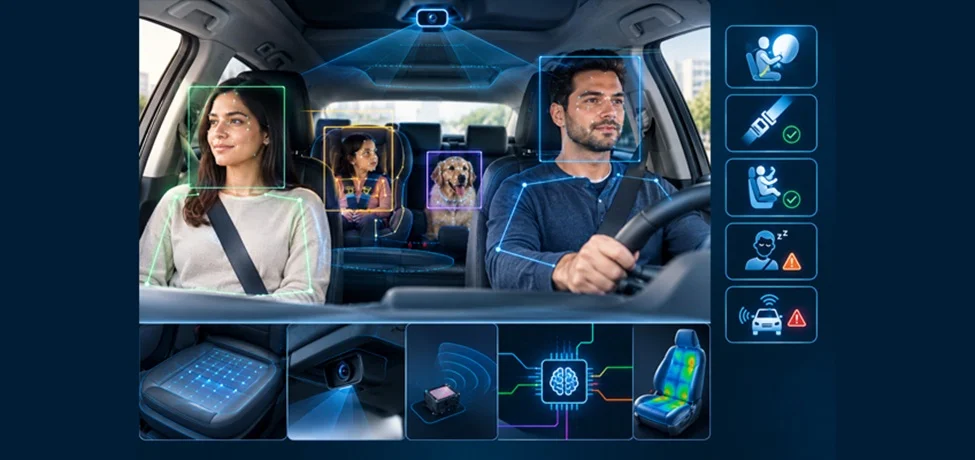
An AI-powered occupant safety system is a connected set of sensors and software that continuously perceives the cabin and adapts protection in real time. Most architectures have four layers:
1. Sensing: seat sensors, cameras, radar and sometimes capacitive or ultrasonic elements.
2. Perception: machine learning models that detect, classify and track occupants.
3. Decision logic: rules and models that translate perception into safety actions.
4. Actuation: airbags, pretensioners, seat position, alerts and, increasingly, post-crash or emergency messaging.
The important shift is that the system is no longer just reacting to a crash pulse. It understands the cabin before, during and after an event.
Intelligent seating systems: the quiet hero of the cabin
Cameras get the headlines, but the seat is where the occupant and the vehicle physically meet. That makes it a very reliable place to gather data.
Intelligent seating systems integrate sensing directly into the seat structure or cushion. Typical inputs include pressure or load distribution, seat position, belt buckle status, backrest angle and, in some designs, capacitive or bioelectric signals that help distinguish a person from an object.
Why does this matter? Because seat-level data is:
- Privacy-friendly. Pressure and capacitance do not capture faces or images.
- Robust. They are less affected by lighting, sunglasses, blankets or occlusion.
- Complementary. They give a strong second opinion to camera or radar data.
An AI-powered automotive seating platform takes this further. Instead of using a fixed weight threshold, a trained model reads the pattern across many sensing points to tell an adult from a child, a person from a bag of shopping, or a normal sitting posture from an out-of-position one.
From simple detection to true classification
It helps to separate three capabilities that are often mixed up.
Occupant detection answers the question, "Is someone there?" A seat occupancy detection system is the simplest form, and it supports seat belt reminders and basic airbag logic.
Occupant classification answers, "Who or what is it?" An occupant classification system sorts occupants into categories such as adult, child, child seat or empty, which is essential for airbag suppression and depowering decisions.
Occupant monitoring answers, "What are they doing right now?" An AI occupant monitoring system tracks posture, position, attention and condition over time.
Modern automotive occupant detection and classification stacks combine all three. A good occupant detection system for vehicles no longer stops at a yes/no flag. It outputs a confidence-weighted picture of every seat.
How AI in-cabin sensing actually works
AI in-cabin sensing blends multiple sensor types, because no single sensor is perfect.
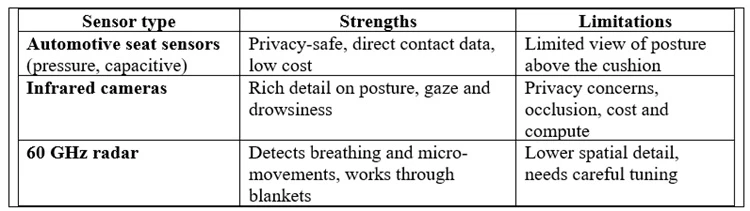
The real intelligence comes from sensor fusion. When a radar sees a faint breathing pattern, the seat shows a small, light load and the camera sees a child seat shape, the system can classify with far higher confidence than any one input could deliver alone. Fusion also builds in redundancy, which matters when a safety function is involved and you need to demonstrate functional safety (ISO 26262) and safe behaviour under uncertainty (SOTIF).
What intelligent protection looks like in practice
Here is where the technology turns into real-world value.
Adaptive airbag deployment. Knowing occupant size, position and seating posture allows deployment force, timing or suppression to be tuned. This reduces injury risk for smaller or out-of-position passengers, which is a long-standing issue with fixed-force systems.
Smarter seat belt reminders. Instead of nagging about a bag on the front seat, the system knows when a real person is unbuckled, and can escalate warnings intelligently.
Child presence detection. Detecting a child or pet left behind is now a major safety and regulatory topic. Euro NCAP has been rewarding child presence detection in its assessments, and regulators in several markets are moving in the same direction. Seat-level sensing combined with radar is an effective, low-false-alarm approach.
Driver and passenger state monitoring. Detecting drowsiness, distraction or a medical event lets the vehicle warn, prepare restraints or trigger assistance.
Post-crash response. Knowing how many people are in the car, and where, can help emergency services prioritise once an automatic crash alert has been sent.
Why this matters now: regulation, ratings and new seating layouts
Three forces are pushing intelligent vehicle safety systems from "nice to have" to "design-in from day one."
1. Regulation and ratings. Child presence detection, driver monitoring and seat belt reminder requirements keep expanding across Europe, the US and Asia. Always check the current text of the relevant standards for your target markets, since timelines and thresholds change.
2. Changing cabins. Reclining seats, rotating seats and lounge-style layouts in electric and autonomous vehicles create sitting positions that legacy restraint designs never assumed.
3. Brand expectations. Buyers now compare safety technology the way they compare infotainment. Visible, well-explained protection is a differentiator.
The challenges nobody should skip over
Honest engineering conversations include the hard parts.
- Edge cases. Unusual postures, thick winter clothing, cargo that resembles a person, and mixed child-seat types can fool simple models. Your training data and test coverage need to reflect this.
- False positives and negatives. In a safety function, both are costly. One causes nuisance and distrust, the other causes harm.
- Privacy and data governance. Camera-based monitoring needs clear data handling rules, on-device processing where possible, and compliance with regional laws such as GDPR.
- Validation effort. AI models need explainability, traceability and robust verification to satisfy functional safety expectations.
- Cost and integration. Every new sensor adds weight, wiring and software complexity. Seat-integrated sensing often offers a better cost-to-benefit ratio than adding another camera.
How to choose occupant monitoring system suppliers
If you are shortlisting occupant monitoring system suppliers, the spec sheet is only the start. These questions tend to separate strong partners from risky ones:
1. Can they show multi-sensor fusion experience, not just a single-sensor demo?
2. How was the AI trained and validated? Ask about dataset diversity across age, body size, clothing, seating postures and climates.
3. What is their functional safety track record, including ISO 26262 process maturity and SOTIF analysis?
4. How do they handle privacy by design? On-device processing and minimal data retention are good signs.
5. Can the solution scale across platforms? Look for modular software and sensors that fit multiple seat architectures.
6. What support exists after SOP? Over-the-air updates, field data feedback and regulatory change support all matter.
7. Will they integrate with your seat supplier and restraint partners, or force a parallel development track?
A useful tip: ask for a joint workshop between your seating, restraint and electronics teams and the supplier early. Most integration problems with occupant safety technology are organisational before they are technical.
Where the technology is heading
Expect the next few years to bring several shifts:
- Deeper fusion of seat, radar and camera data into a single cabin model.
- Personalised restraint that adapts to individual body characteristics and posture.
- Health sensing such as heart and respiration monitoring for driver wellbeing.
- Software-defined safety, where models improve over time through validated updates.
- More seat-embedded intelligence, as seat makers become electronics and software integrators.
The winners will not necessarily be those with the most sensors. They will be those who turn the right data into the right action at the right moment, reliably and with respect for the people in the cabin.
Frequently asked questions
What is an AI occupant monitoring system?
An AI occupant monitoring system uses sensors such as cameras, radar and seat sensors, together with machine learning, to detect and track people inside a vehicle. It can identify who is present, where they sit, their posture and sometimes their alertness, so that safety systems can respond appropriately.
How does an occupant classification system work?
An occupant classification system reads data from seat sensors, often pressure or capacitive, and increasingly combines it with other sensors. Software then categorises the seat as empty, child, child seat or adult, which determines whether an airbag should deploy, be suppressed or be adjusted.
What is the difference between occupant detection and occupant monitoring?
Occupant detection confirms presence. Occupant monitoring goes further by tracking behaviour, posture and condition over time. Detection supports basic functions like belt reminders, while monitoring supports advanced features like drowsiness alerts and adaptive restraints.
Are seat sensors better than cameras for occupant detection?
Neither is universally better. Automotive seat sensors are privacy-friendly and robust, while cameras offer richer posture and attention data. Most advanced systems combine them through sensor fusion for higher accuracy and redundancy.
Why are intelligent seating systems important for vehicle safety?
The seat is the main physical interface with the occupant, so it provides reliable, direct data. Intelligent seating systems enable adaptive airbags, smarter belt reminders and child presence detection while keeping privacy concerns low.
Final thought
AI-powered occupant safety systems are not about adding technology for its own sake. They are about a simple idea: protect the real person in the seat, not an average one. Intelligent seating, supported by AI in-cabin sensing, makes that idea practical, scalable and increasingly expected by regulators and buyers alike.
If you are planning your next platform, now is the time to bring seating, sensing and safety teams to the same table.
 Media Pack Download
 Newsletters
 Industrial Events