Next-Generation Seat Belt Technologies for Autonomous Vehicle Occupants
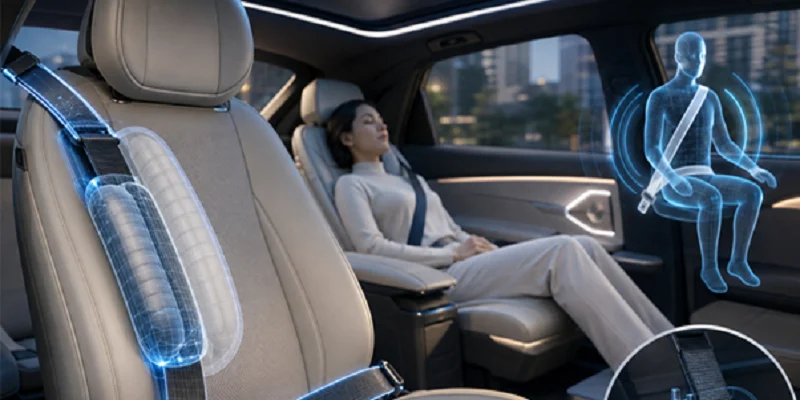
For more than sixty years, the seat belt has done one job and done it well: keep you anchored to your seat when things go wrong. But as cars start driving themselves, that single job is turning into a much bigger one. Next-generation seat belt technology is no longer just about holding a body in place during a crash — it's about sensing who's in the seat, predicting how they're sitting, and adjusting restraint in real time to match a completely new kind of driving experience.
This shift matters because autonomous vehicles change everything about how people sit in cars. Passengers recline. They turn to face each other. They work on laptops, nap, or watch a movie instead of gripping a steering wheel and facing forward. A restraint system designed for a 1970s driving posture simply isn't built for a 2030s passenger lounge on wheels. That's why engineers, safety regulators, and automakers are racing to reinvent one of the oldest safety devices in the car.
| Also Read: Challenges of Crash Testing Non-Traditional Seating Configurations in Autonomous Vehicles |
Why Autonomous Vehicles Need a Different Kind of Seat Belt
Traditional seat belts were engineered around a single assumption: the occupant sits upright, faces forward, and has their hands on the wheel. Autonomous vehicle seat belts have to throw that assumption out the window.
In a self-driving car, people might be:
- Leaning back in a semi-reclined position
- Sitting sideways to talk with other passengers
- Positioned with their knees up, feet on a console, or shifted toward a window
- Distracted by a screen instead of watching the road
Every one of these positions changes how a crash force travels through the body. A belt that performs perfectly for an upright, forward-facing passenger can actually cause injury to someone reclined 45 degrees, because the load path across the pelvis and chest is completely different. This is the central problem driving innovation in autonomous vehicle safety: restraint systems need to protect a person no matter how they're sitting, not just how they're "supposed" to sit.
What Makes a Seat Belt "Intelligent"
Intelligent seat belt systems use sensors, software, and real-time data to understand the occupant and the situation before, during, and after a crash. Instead of a fixed strap with a single tension setting, these systems constantly gather information and adjust accordingly.
Key components typically include:
Occupant sensing. Cameras, weight sensors, and pressure mats built into the seat detect a person's size, weight, posture, and even seating position down to the centimeter.
Real-time posture tracking. Infrared or optical sensors monitor whether someone is upright, reclined, twisted, or leaning, updating that data multiple times per second.
Pre-crash activation. When onboard radar or cameras detect an unavoidable collision is seconds away, the system can pre-tension the belt, adjust seat position, or even move the seatback to a safer angle before impact happens.
Adaptive load limiting. Instead of one standard tension, the belt can loosen or tighten its restraint force based on the occupant's body mass and the severity of the crash, reducing rib and chest injuries in smaller occupants while still protecting larger ones.
This is what separates a smart system from a traditional one — the belt is no longer static hardware. It's an active safety participant that reacts to the person and the moment.
Advanced Seat Belt Systems: The Core Innovations
Several concrete technologies are converging to define advanced seat belt systems for the autonomous era.
1. Multi-Point and Reconfigurable Belts
Some prototypes move beyond the standard three-point design entirely, using four- or even six-point harness-style configurations that can reconfigure based on seat orientation — useful for vehicles where seats rotate to face each other.
2. Inflatable and Airbag-Integrated Belts
Belt-integrated airbags spread crash force across a wider area of the chest and shoulder rather than concentrating it along a narrow strap. This reduces the risk of rib fractures, which is especially important for older or more fragile occupants who may increasingly rely on autonomous ride services.
3. Automatically Adjusting Anchor Points
Rather than a fixed anchor at the shoulder, some systems use motorized tracks that let the belt's anchor point move up, down, or sideways depending on the occupant's height, seating angle, or recline position.
4. Pre-Crash Seat and Belt Coordination
In vehicles with active safety sensors, the seat, headrest, and belt can work as one coordinated system. Moments before an unavoidable impact, the seat may straighten, the headrest may reposition, and the belt may tighten — all automatically, all without human input.
Adaptive Restraint Systems: Personalizing Protection
Adaptive restraint systems take personalization even further by treating every occupant as a unique data profile rather than a generic passenger. A restraint system might account for:
- Body weight and height, adjusting tension accordingly
- Pregnancy, using belt routing that protects both occupant and unborn child
- Age-related bone density differences between a teenager and an elderly passenger
- Real-time posture, correcting for someone who has fallen asleep in an unsafe position
The goal is to move away from the "one-size-fits-most" restraint philosophy that has dominated automotive safety for decades. Instead, the belt calibrates itself to the person in the seat, in the same way a smartwatch calibrates to an individual's heart rate rather than applying a population average.
The Role of AI in Restraint Design
AI-powered restraint systems are where much of the recent progress is happening. Machine learning models trained on millions of crash simulations and real-world collision data can predict, within milliseconds, how a specific body in a specific position will move during impact.
This allows the system to:
- Select the optimal belt tension and airbag deployment sequence for that exact scenario
- Adjust in real time as a crash unfolds, rather than relying on a single pre-set response
- Learn from fleet-wide data, continuously improving predictive accuracy over time as more vehicles report crash and near-miss data back to manufacturers
Some automakers are also pairing AI restraint logic with biometric monitoring — heart rate, muscle tension, even eye movement — to detect if an occupant is asleep, distracted, or in a vulnerable physical state seconds before a potential collision, adjusting restraint response accordingly.
Smart Seat Belt Technology in Everyday Use
It's worth noting that smart seat belt technology isn't only about crash response. Day-to-day, these systems quietly improve comfort and compliance:
- Reminding rear-seat passengers to buckle up through more accurate seat-occupancy detection
- Automatically loosening slightly during long rides to reduce discomfort, then re-tensioning if sudden braking is detected
- Syncing with a vehicle's health app to flag unusual posture patterns over a trip
- Reducing false alarms and belt chimes by distinguishing between a person and a bag left on the seat
These small, everyday improvements matter because they build trust. A restraint system people find comfortable and unobtrusive is one they're more likely to actually keep fastened — which, ultimately, is the single biggest factor in seat belt effectiveness.
Occupant Protection Systems as a Whole-Vehicle Strategy
Seat belts don't work in isolation, and modern occupant protection systems are increasingly designed as one integrated safety net rather than a collection of separate parts. Belts, airbags, seat structures, and even the vehicle's structural crumple zones are now engineered together, with software coordinating the timing of each element in milliseconds.
In fully autonomous vehicles, this integration becomes even more critical because there's no driver to react instinctively. The car itself must anticipate danger, communicate that risk to every restraint system in the cabin, and execute a protective sequence — all without human intervention. This is a fundamental shift in how safety engineers think about the cabin: not as a driver's compartment with passenger seats attached, but as a fully symmetrical, multi-occupant safety environment.
What This Means for Future Automotive Safety Systems
Looking ahead, future automotive safety systems will likely treat the seat belt as one node in a much larger, connected safety network rather than a standalone device. Expect to see:
- Cabin sensors that detect occupant state (asleep, distracted, unwell) and adjust restraint readiness accordingly
- Belts that communicate with external vehicle sensors to begin pre-crash tensioning based on data from surrounding traffic, not just the vehicle's own trajectory
- Regulatory frameworks evolving to test restraint systems across reclined, rotated, and non-standard seating positions, not just the traditional forward-facing crash test dummy posture
- Restraint systems tailored to shared and robotaxi fleets, where occupant demographics vary trip to trip and the vehicle has seconds to identify and adapt to each new passenger
Final Thoughts
The seat belt is quietly undergoing one of the most significant redesigns in its history. As autonomous vehicles change what it means to be a "driver" and a "passenger," the humble belt is evolving into a sensor-rich, AI-informed, endlessly adaptive piece of safety engineering. The cars of the near future won't just protect occupants who happen to be sitting the "right" way — they'll protect people exactly as they are, wherever and however they choose to sit.
That shift, small as it might sound, represents a genuine reimagining of automotive safety for a world where the person in the seat is no longer expected to be paying attention to the road at all.
Frequently Asked Questions
What is next-generation seat belt technology?
It refers to advanced restraint systems that use sensors, AI, and real-time data to adjust belt tension, positioning, and response based on an occupant's size, posture, and the specifics of a crash, rather than relying on a single fixed setting.
Why do autonomous vehicles need different seat belts than regular cars?
Because passengers in autonomous vehicles often sit reclined, sideways, or in non-traditional positions, standard forward-facing restraint designs can't guarantee the same level of protection, requiring adaptive systems built for varied postures.
How does AI improve seat belt safety?
AI models trained on crash data can predict how a specific occupant will move during a collision and adjust belt tension, timing, and airbag deployment accordingly, often within milliseconds of detecting a crash risk.
Are smart seat belts available in cars today?
Elements of these systems — such as pre-tensioning, load-limiting belts, and occupant-sensing technology — are already in many modern vehicles, while fully adaptive, AI-coordinated systems are still emerging as autonomous vehicle technology matures.
 Media Pack Download
 Newsletters
 Industrial Events