
Challenges of Crash Testing Non-Traditional Seating Configurations in Autonomous Vehicles
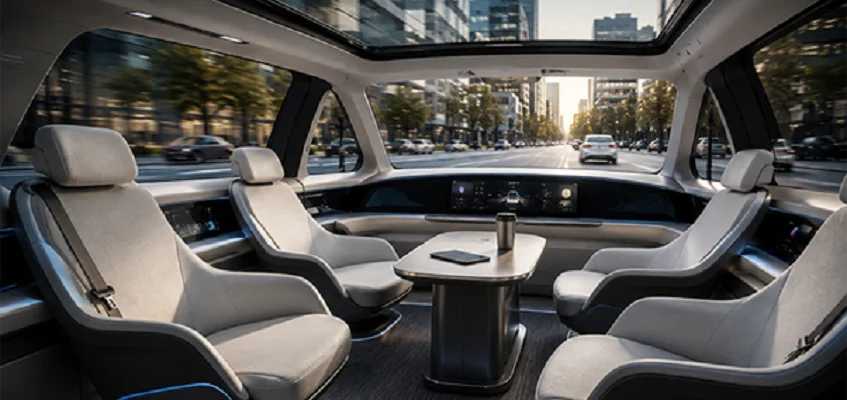
For more than half a century, crash safety has rested on one quiet assumption: the person in the seat is facing forward. Every dummy, every airbag, every seatbelt algorithm was built around that idea. Autonomous vehicles are now breaking it on purpose. Seats face each other around a small table. Some recline flat. Others rotate to create a lounge-style cabin. It's a genuine shift in what a car interior can be — but behind every one of those swiveling, reclining, face-to-face seats sits a problem that engineers are still scrambling to solve: how do you crash test something that was never supposed to exist in a crash in the first place?
Autonomous vehicle crash testing was built, quite literally, around the assumption that a human is sitting upright, facing forward, hands near a wheel. Remove the driver, and you don't just remove a task — you remove the entire geometric logic that decades of safety engineering was built on. That's the core tension driving one of the most difficult problems in modern automotive safety: how to protect people who are no longer required to sit the way we've always assumed they would.
Why Traditional Crash Testing Doesn't Translate
Every crash test dummy, every airbag timing algorithm, every seatbelt pretensioner on the road today was designed around forward-facing occupants. The physics of a frontal collision assumes the body moves forward and down in a fairly predictable arc. Side airbags assume a person is seated at a known distance from the door. Even the placement of crumple zones assumes occupants aren't sitting sideways or facing the rear of the vehicle.
Now introduce non-traditional vehicle seating — rear-facing chairs, rotating captain's seats, bench seating arranged in a circle, or fully reclined "sleeper" positions for long autonomous trips — and almost every one of those assumptions collapses. A person facing backward in a frontal crash doesn't move forward into a seatbelt and airbag system designed to catch them; they get thrown backward into a seat structure that was never engineered to absorb that kind of force. A passenger reclined flat during a highway crash experiences submarining risk — sliding underneath the lap belt — in ways standard restraint systems were never built to prevent.
This is the core of why crash testing autonomous vehicles is so much harder than crash testing conventional cars. It's not one new problem. It's dozens of old problems reappearing in new geometries, all at once.
| Also Read: AI, Simulation, and Digital Twins: The Future of Autonomous Vehicle Safety Testing |
The Occupant Protection Puzzle
Occupant protection in autonomous vehicles has to account for a much wider range of human positions and postures than any previous generation of vehicle safety design. Think about it from a real-world use case: if a robotaxi is designed for a family to sit facing each other during a 40-minute commute, kids might be leaning, sleeping, or twisted sideways at the moment of impact. Adults might have laptops or bags on their laps. None of this fits neatly into the standard 50th-percentile male dummy testing that has dominated crash labs for decades.
Regulators and engineers are now grappling with several layered challenges:
- Multi-directional impact modeling. A rear-facing or side-facing occupant needs entirely different restraint geometry, airbag deployment timing, and structural crush zones depending on which direction the crash comes from.
- Variable seating positions. If seats can rotate or recline on demand, the vehicle's safety systems theoretically need to adapt in real time — sensing seat orientation and adjusting airbag deployment and belt tensioning accordingly.
- Diverse occupant sizes and postures. Reclined sleeping positions, children in unconventional seats, and mixed-age passenger groups all demand a broader set of test dummies and simulation models than the industry currently has standardized.
- Interior obstacles. Tables, screens, and face-to-face seating layouts introduce new secondary-impact hazards — objects and even other passengers can become projectiles in a way that never applied to a traditional forward-facing cabin.
Autonomous vehicle occupant protection isn't a single design fix. It's a moving target that has to be re-solved for every new interior layout a manufacturer dreams up.
Reconfigurable Seating Adds a Whole New Layer
Perhaps the trickiest wrinkle in all of this is that many next-generation AV interiors aren't just non-traditional — they're reconfigurable vehicle seating systems, meaning the layout itself can change mid-trip. A seat that faces forward for highway cruising might rotate to face a companion seat once the vehicle reaches slower urban speeds. A bench that acts as a couch during a long commute might need to snap back into a "crash-ready" position before city streets.
This raises a genuinely difficult engineering and regulatory question: which configuration do you test? Do you test every possible position independently? Do you test worst-case transition moments, when a seat might be mid-rotation during an unexpected collision? There's no dummy, no lab protocol, and — in most countries — no regulation yet that fully answers this.
Some manufacturers have proposed "safe zones," where seats can only fully recline or rotate below a certain speed threshold, automatically returning to a forward-facing, crash-ready position above that threshold. It's a reasonable compromise, but it adds mechanical complexity, sensor dependency, and yet another point of failure that has to be crash-tested in its own right — what happens if the seat doesn't complete its transition in time?
Alternative Seating Configurations and the Regulatory Gap
Alternative seating configurations have outpaced the regulatory frameworks meant to govern them. Federal Motor Vehicle Safety Standards in the U.S. and similar frameworks internationally were largely written with forward-facing seating as a baseline assumption. Regulators including NHTSA have acknowledged this gap publicly, and updated guidance has slowly started to emerge — but standardized test protocols for rotating, reclining, or rear-facing configurations in production vehicles are still very much a work in progress.
This creates a strange in-between period for the industry. Automakers building genuinely novel cabin layouts often have to design their own internal test protocols, run extensive computer simulations, and negotiate directly with regulators on a case-by-case basis, because there isn't yet a universal rulebook to follow. That's expensive, slow, and creates inconsistency across manufacturers — one company's "safe" rear-facing seat might not match another's internal safety bar at all.
Why Simulation Alone Isn't Enough
Given the cost and complexity of physical crash testing every seating permutation, much of the industry has leaned heavily on computer modeling and simulation. Finite element analysis can model thousands of virtual crash scenarios far faster and cheaper than building physical prototypes for each one. That's genuinely useful — but it's not a full substitute.
Simulations are only as good as the human body models feeding them, and most crash simulation software was calibrated using data from forward-facing occupant crashes. Applying those same biomechanical models to sideways or rearward-facing bodies introduces real uncertainty. Until more physical validation testing catches up — and until dummies designed specifically for non-standard postures become widely available — simulation results for unconventional seating layouts have to be treated as a strong starting point, not a final answer.
Automotive Crash Test Innovation Is Racing to Catch Up
The good news is that automotive crash test innovation is genuinely accelerating to meet this challenge. Research labs are developing new generations of crash test dummies — some capable of representing reclined postures, others built to model rotated or lateral seating. Advanced sensor suites in prototype vehicles are being used to capture real-time occupant position data, feeding into adaptive restraint systems that adjust belt tension and airbag timing based on where a person is actually sitting, rather than assuming a fixed position.
Some manufacturers are experimenting with distributed airbag systems built into seats themselves rather than the dashboard or door panels, so protection travels with the seat regardless of its orientation. Others are exploring inflatable seatbelts and structural reinforcements around table and console areas, since those secondary interior features become genuine injury risks once occupants are seated in circular or face-to-face arrangements.
What Future Vehicle Safety Testing Needs to Look Like
Looking ahead, future vehicle safety testing will almost certainly need to move away from a single standardized test and toward a more modular, scenario-based approach. That likely means:
- A broader family of crash test dummies representing varied postures, ages, and seating orientations.
- Dynamic testing protocols that account for seats in transition, not just fixed end-states.
- Closer collaboration between regulators and manufacturers to build shared, updated safety standards before novel interiors reach mass production, rather than after.
- Continued investment in simulation tools validated against real physical crash data for non-standard postures.
None of this is a small lift. It requires new investment, new research, and — frankly — a willingness from regulators to move faster than they historically have. But the payoff is significant: cabins that genuinely reflect how people want to travel in a world where nobody needs to watch the road.
The Bottom Line
Autonomous vehicle safety has always been framed around the idea of removing human error from driving. What's becoming clear is that removing the driver also removes a huge set of assumptions baked into decades of crash testing. Non-traditional and reconfigurable seating isn't just a design trend — it's a genuine engineering frontier, and one where the testing standards, dummies, and regulations are still playing catch-up to the ambition of the vehicles themselves.
The vehicles of the near future may look more like living rooms than driver's cabs. Making sure those living rooms are actually safe in a crash is one of the defining engineering challenges the autonomous vehicle industry has yet to fully solve.
Frequently Asked Questions
Why is crash testing harder for autonomous vehicles with non-traditional seating?
Because most existing crash test standards, dummies, and restraint systems were designed around forward-facing occupants. Rotating, reclining, or rear-facing seats change how the body moves during a collision, requiring new testing methods that don't yet fully exist.
What is reconfigurable vehicle seating?
It refers to seats that can rotate, recline, or shift position during a trip — for example, turning to face other passengers or a table. This flexibility improves comfort but complicates occupant protection, since safety systems must adapt to multiple possible seating positions.
Are there current safety regulations for alternative AV seating configurations?
Regulatory frameworks are still evolving. Agencies like NHTSA have acknowledged the gap, but comprehensive, standardized rules for rotating or rear-facing seating in production autonomous vehicles are not yet fully established in most countries.
How are manufacturers addressing occupant protection in unconventional AV cabins?
Through a mix of advanced simulation, new crash test dummy designs for varied postures, seat-integrated airbags, adaptive restraint systems, and, in some cases, automatic seat repositioning below certain speed thresholds.
What does the future of vehicle safety testing look like for AVs?
It's likely to involve a broader, more modular set of test protocols and dummies representing multiple postures and seating orientations, combined with closer collaboration between automakers and regulators to keep pace with rapidly evolving cabin designs.
 Media Pack Download
 Newsletters
 Industrial Events
Author Bio:
For more than half a century, crash safety has rested on one quiet assumption: the person in the seat is facing forward. Every dummy, every airbag, every seatbelt algorithm was built around that idea. Autonomous vehicles are now breaking it on purpose. Seats face each other around a small table. Some recline flat. Others rotate to create a lounge-style cabin. It's a genuine shift in what a car interior can be — but behind every one of those swiveling, reclining, face-to-face seats sits a problem that engineers are still scrambling to solve: how do you crash test something that was never supposed to exist in a crash in the first place?