AI, Simulation, and Digital Twins: The Future of Autonomous Vehicle Safety Testing
Self-driving cars promise to make roads safer, but there's an uncomfortable math problem hiding behind that promise. Researchers at RAND Corporation have estimated that an autonomous driving system would need to log around 150 million miles on public roads just to prove, with statistical confidence, that it's safer than a human driver. At normal fleet speeds, that would take decades and cost more money than any single company could justify.
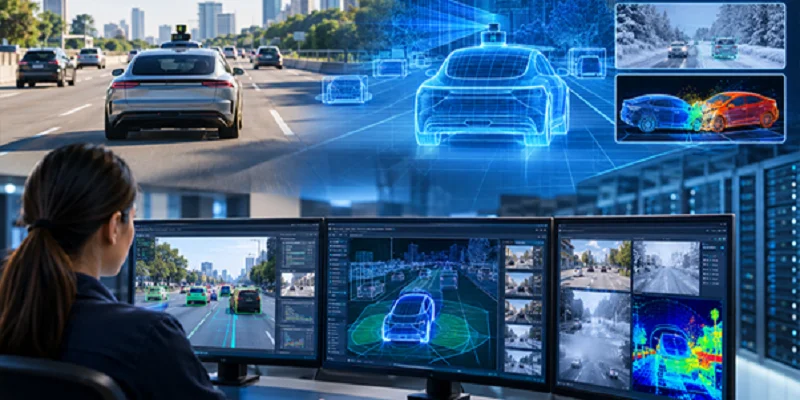
This is exactly why the industry has turned to a different approach. Instead of waiting years for real-world miles to accumulate, engineers are building virtual worlds where a car can "drive" millions of miles in an afternoon. Autonomous Vehicle Safety Testing has quietly shifted from something that happens mostly on test tracks to something that happens mostly inside data centers - powered by AI, simulation software, and a technology called the digital twin.
What Is a Digital Twin, and Why Does It Matter for Cars?
A digital twin is a live, data-fed virtual replica of a physical object or system. In the automotive world, that means a computer model of a vehicle - its sensors, its software, its physics, sometimes even its individual components - that behaves the way the real car would, because it's continuously updated with real sensor and performance data.
Digital Twins in Automotive are no longer a research curiosity. Industry surveys suggest that roughly three-quarters of businesses across sectors already use some form of digital twin, and a 2026 industry survey found that the vast majority of companies deploying automotive digital twins report a strong return on investment, with many seeing gains of 20% or more. Automakers like BMW, Ford, GM, and Tesla have each applied versions of this idea - from spotting production-line bottlenecks to running predictive maintenance and virtual worker training.
For autonomous vehicles specifically, a Digital Twin for Autonomous Vehicles goes a step further. It doesn't just mirror the car - it mirrors the car and the road, the weather, the traffic, and the unpredictable humans sharing the street with it. That combination is what makes modern safety validation possible at scale.
Why Real-World Testing Alone Isn't Enough
Public-road testing will always matter. It's how engineers confirm that a virtual model actually reflects reality. But it has hard limits:
- It's slow. Rare but dangerous scenarios - a child darting between parked cars, a tire blowout on a highway, and a sudden whiteout in snow - might occur once in millions of miles.
- It's expensive. Fleets, safety drivers, insurance, and instrumented test vehicles all cost money before a single mile is logged.
- It's risky. You cannot ethically stage a real pedestrian collision to see how the car reacts.
- It's narrow. A test fleet driving the same city streets every day won't naturally encounter the diversity of road layouts, weather, and traffic cultures a global deployment will face.
This is the gap that Autonomous Vehicle Simulation was built to close.
How AI-Powered Simulation Changes the Equation
Modern simulation platforms don't just replay pre-scripted scenes. They use AI in Automotive Safety systems to generate new, statistically realistic driving situations on the fly - pulling from real-world traffic data, then procedurally varying vehicle speed, driver behavior, road geometry, and weather to create thousands of unique test cases from a single starting scenario.
Recent academic work illustrates the point well. Simulation systems built on digital twin traffic-flow modeling extract real vehicle trajectory data - timestamps, positions, speeds, lane changes - and use it to drive both background traffic and the autonomous "twin" vehicle inside a continuously evolving virtual environment. Rather than testing against a handful of hand-designed scenes, engineers get an endless, data-grounded stream of situations that mirror how real traffic actually behaves.
This is where AI-Powered Crash Simulation comes in. Instead of physically wrecking a vehicle to see how its structure and sensors respond, engineers can model thousands of collision variants - different impact angles, speeds, and vehicle types - inside a physics-based simulator. The AI layer doesn't just render the crash; it can also evaluate how the vehicle's perception and decision-making software would have responded milliseconds before impact, revealing software flaws that a purely mechanical crash test could never surface.
Virtual Crash Testing: Safer, Faster, and Far More Scalable
Traditional crash testing destroys a physical car to gather one data point. Virtual Crash Testing flips that model. Using finite element analysis and AI-enhanced physics engines, engineers can simulate structural deformation, sensor occlusion, airbag timing, and software response across an enormous range of impact conditions - without spending six figures on a single destroyed prototype.
This matters more with autonomous vehicles than with traditional cars, because there are now two systems to validate simultaneously: the physical structure and the software making split-second decisions. A crash test dummy tells you what happens to a human body. A digital twin tells you what the car's cameras, radar, and decision algorithm were "seeing" and "thinking" in the moments before, during, and after the same event.
Inside a Modern Virtual Vehicle Testing Pipeline
A typical Virtual Vehicle Testing workflow looks something like this:
- Data collection - Real-world driving data, sensor logs, and even accident reports feed into the simulation environment.
- Scenario generation - AI systems use that data to build a base library of scenarios, then algorithmically generate variations, including rare "edge cases" that are dangerous or impossible to test on real roads.
- Digital twin execution - The vehicle's actual software stack is run against these scenarios inside the twin, reacting exactly as it would on the road.
- Outcome analysis - Every run is scored for safety margins, near-misses, rule violations, and comfort metrics, with failures automatically flagged for engineers.
- Iteration and re-testing - Fixes are pushed back into the twin and re-validated instantly, rather than waiting for the next physical test window.
Recent market analysis suggests a large majority of autonomous vehicle developers already lean on simulation platforms for validation, with many companies now replicating tens of thousands of real-world driving scenarios virtually before a vehicle ever touches public roads. Some estimates suggest virtual validation now covers a large share of total testing, meaningfully cutting the amount of physical road testing required.
Automotive Digital Twin Technology: The Bigger Picture
It's worth stepping back to see how Automotive Digital Twin Technology fits into the wider vehicle lifecycle, because safety testing is only one piece of it:
- Design and engineering - Twins let teams test structural and aerodynamic changes before building a physical prototype.
- Manufacturing - Production-line twins catch bottlenecks and defects before they become costly recalls.
- In-service monitoring - Once a car is on the road, its twin can track wear, predict maintenance needs, and feed real performance data back into future safety models.
- Regulatory validation - Increasingly, regulators are open to accepting simulation-based evidence alongside physical testing, provided the digital twin can demonstrate it faithfully represents real-world behavior.
The market reflects how quickly this is scaling. Analysts tracking the autonomous vehicle simulation space put the market in the range of roughly $1.3 billion in 2026, with projections showing continued strong double-digit annual growth over the next several years, driven largely by AI-driven simulation demand, cloud-scale computing, and tightening regulatory requirements for validation evidence.
Autonomous Driving Safety Technology: What's Changing Next
Several trends are pushing Autonomous Driving Safety Technology further:
- Cloud-scale simulation - Instead of running scenarios on local servers, companies now spin up thousands of parallel simulations in the cloud, compressing years of virtual driving into days.
- Synthetic data generation - AI models generate photorealistic sensor data (camera, radar, lidar) for scenarios too rare or too dangerous to capture naturally.
- Closed-loop testing - The vehicle's actual onboard software, not just a simplified model of it, is now looped directly into the simulation, so what's tested virtually is exactly what will ship.
- Cross-industry standardization - Shared scenario libraries and open simulation formats are starting to let manufacturers, suppliers, and regulators speak the same technical language.
Frequently Asked Questions
What is a digital twin in the context of autonomous vehicles?
It's a continuously updated virtual replica of a vehicle - and often its surrounding environment - that mirrors real-world sensor data and physics closely enough to be used for testing, prediction, and validation without needing the physical car on hand.
Why is simulation replacing some physical crash testing?
Because it's faster, cheaper, safer, and far more scalable. A single physical crash test yields one outcome; a virtual crash test can explore thousands of variations of the same event, including situations too dangerous or expensive to stage in real life.
Can virtual testing fully replace real-world autonomous vehicle testing?
Not entirely. Regulators and engineers generally treat simulation as a complement to, not a replacement for, real-road testing. Physical testing remains essential for validating that the digital twin itself is accurate.
How does AI improve crash simulation accuracy?
AI models can generate realistic, data-grounded scenario variations, predict how sensors and software will respond under stress, and flag edge cases that human engineers might never think to test manually.
Is digital twin technology only useful for safety testing?
No. It's also used in vehicle design, manufacturing quality control, predictive maintenance, and in-service performance monitoring throughout a vehicle's life.
The Road Ahead
The path to safer autonomous vehicles doesn't run entirely through test tracks anymore - it runs through data centers, simulation engines, and digital twins that can compress a lifetime of driving into a weekend of computing. Autonomous Vehicle Safety Testing built on AI and digital twin technology won't eliminate the need for real-world validation, but it's rapidly becoming the backbone of how the industry finds problems before they ever reach a public road. As simulation fidelity keeps improving and regulators grow more comfortable accepting virtual evidence, the gap between the test track and the real world will keep narrowing - and that's good news for everyone sharing the road with these vehicles.
 Media Pack Download
 Newsletters
 Industrial Events