
How Progressive Die Stamping Increases Efficiency in Auto Production
The automotive industry is faced with a continuous pressure to produce faster, at low production cost and the quality of production should always be the same throughout the millions of parts produced. With the changes in the design of vehicles and the increased demand of lightweight and high-performance part, the manufacturers are turning to use new advanced manufacturing technologies in order to streamline their operations. Progressive die stamping is one of the most useful inventions that make the manufacturing of automotive components very productive.
Automobile Stamping Progressive Die Stamping has now become an institution of modern automotive stamping since it facilitates mass production of complex metal components with high speed, and a high degree of automation, with unparalleled precision. This is done through brackets and structural reinforcements, connectors and interior parts to enable manufacturers to create high volumes of parts with ease with minimal wastage and labor expenses.
This article explains the advantages of progressive die stamping process in enhancing efficiency in the production of automotive products, reasons stamping dies are used in the production of automotive products and the reasons why automobile companies apply high volume metal stamping in the production of automotive products.
The Role of Metal Stamping in Automotive Manufacturing
Metal stamping is one of the most popular methods of production, it is the transformation of flat metal into specific shapes by cutting, bending and shaping. Metal stamping in the automotive industry is necessary in the manufacture of a wide range of parts, such as body panels, mounting brackets, structural parts and electrical connectors.
Automobile companies need process that can generate thousands or even millions of the same components in the tightest tolerances. The conventional methods of forming can require several machines or disjointed processes that can make the production process more time-consuming and complicated to perform. To overcome these issues, the manufacturers have introduced automotive stamping technologies which integrate several operations into one automated workflow.
At this point Progressive Die Stamping in Automotive Production is of great value. Progressive stamping saves a lot of production time through several stamping cycles in one press cycle and minimizes the use of manpower.
Understanding the Progressive Die Stamping Process
Progressive die stamping process is a manufacturing process where a metal strip is subjected to a sequence of stamping die stations. The stations have a certain operation like punching, bending, forming or trimming. The strip is slightly changed into the final component as the strip advances with the press stroke.
Compared to the conventional stamping that involves the use of a different die and a different machine to perform each stamping operation, progressive stamping combines all these steps into one tool. The strip of metal is fastened to the carrier strip until the last phase when the finished strip is cut off.
Definition: Progressive Die Stamping
Progressive Die Stamping is a fast metal forming process in which a metal strip goes through several stations of one press through a die. The various stations execute varied operations and thus finished parts can be produced in a single flow.
It is especially able to be used in high volume metal stamping of automotive parts where consistency and speed are important factors.
Automotive Stamping Dies: The Core of the Process
Automotive stamping dies are also a very important part of the success of progressive stamping, because their design and accuracy are highly important. These dies are special purpose tools which are designed to carry out several processes in one stamping cycle.
A die is made of several stations, punches, and forming elements that form the metal strip during the process of pressing through the die. The complexity of the die design dictates the operations that it is capable of making in one tool.
Automotive die manufacturing firms put significant investment in advanced design software, simulation software as well as precision machining technologies to create high-performance dies that can yield a repeatable performance through millions of production cycles.
The modern dies are also to be adapted to automated feeding systems, rapid tool change over, and incorporated quality monitoring systems. The capabilities will ensure the smooth operation of the progressive die stamping process even when it is operating at high speed.
How Progressive Die Stamping Increases Efficiency in Automotive Production
The question most manufacturers will ask is: How progressive die stamping will make automotive production efficiency. The solution is in the set of automation, accuracy of tooling, and constant processing.
Continuous Production Flow
Under progressive stamping, several operations are performed at the same time as each press stroke. This has done away with the process of moving parts between machines of various processes. Consequently, the production process becomes smooth and unbroken.
The flow in production is of great importance to minimize the cycle time so that the manufactures can produce in high quantities of components within a smaller period. This is an important requirement in automotive assembly plants that are relying on a consistent supply of stamped components.
Reduced Labor Requirements
Secondary stamping process can involve several operators to meet material transfers, machine working, and inspection of the parts. On the contrary, high speed automotive stamping systems with progressive dies have limited human interference.
Raw material is fed into the stamping press by automated coil feeding systems and defects or process deviations are measured by sensors and monitoring systems. Such degree of automation will decrease the labor expenses and enhance the safety of the working place.
High Production Speeds
Progressive stamping presses are capable of running at very high rates, many parts per minute. This velocity edge is what renders the process ideal when it comes to high volume stamping of metal in automotive parts like clips, brackets, connectors and fasteners.
This is due to the fact that the machine can produce a steady output at elevated rates with no need to incorporate more space and equipment in the factory.
Cost-Effective Progressive Stamping for High-Volume Auto Components
In automotive manufacturing, cost efficiency is a very important factor. The automakers are always trying to find out some means of cutting the costs of production without compromising the quality as well as the performance. High-volume auto parts having high volume stamping which are cost-effective contribute significantly towards this balance.
Material utilization is one of the best cost benefits of progressive stamping. Due to continuous processing of the metal strip, scrap is reduced. The modern die design method enables the manufacturer to maximize strip design and minimize waste.
Tool consolidation is another factor which saves costs. Progressive stamping incorporates several machines and dies into one tool, unlike incorporating them into several separate tools. This saves equipment cost, maintenance, as well as factory floor area.
In the long production cycle, the savings may greatly reduce the unit cost of the automotive components.
Precision and Consistency in Automotive Stamping
The consistency of quality in the production of cars is very vital since the slightest changes could have an impact on the safety of the cars and the performance. Progressive stamping offers a very high repeatability because automotive stamping dies are very precise, and the metal strip is moved under control.
The progressive die is used to make each piece in the same forming path, guaranteeing the same dimensions and quality of the surface. This uniformity is especially critical with components that have to fit into complicated assemblies.
High-speed presses also have sensors that check on force, set, and flow of materials. Such systems identify defects at the initial stages and do not allow defect parts to get to the subsequent operations.
Integration with Automotive Manufacturing Automation
The automation in modern automotive plants is used to enhance the productivity and minimize the risks in the operations. The progressive stamping would be suitable to large-scale manufacturing of vehicles as it fits perfectly well with the automated manufacturing systems.
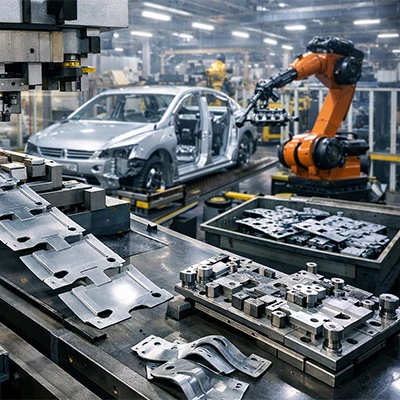
Automated systems are used to feed the coils of metal to stamping press and robotic systems are used to convey the finished parts to packaging or assembly lines. This integration enables high speed automotive stamping processes to be operated within a completely automated production setup.
The automation compatibility also adds efficiency to Progressive Die Stamping in the Automotive Production process where the manufacturers take the advantage of producing products at consistent rates with minimal human input.
Comparison of Stamping Methods
Progressive stamping has benefits of efficiency that are more evident as compared to other stamping methods that are popular in the automotive industry.
| Stamping Method | Key Characteristics | Typical Applications |
| Progressive Die Stamping | Continuous operations across multiple stations | High-volume automotive components |
| Transfer Die Stamping | Parts transferred between stations by mechanical arms | Large automotive body panels |
| Single-Stage Stamping | One operation per press cycle | Low-volume or simple parts |
All the methods have their role to play in manufacturing though the progressive stamping method is the most effective when it comes to high volume production of smaller components.
The Importance of Automotive Die Manufacturing
Stamping systems that are progressive in nature are closely dependent on automotive die manufacturing. Manufacturers of dies need to be aware of the fact that tools have to be able to sustain high loads in production and at the same time be dimensionally accurate.
Complex components of the die are manufactured using advanced methods in machining like CNC machining, wire EDM cutting and precision grinding. The simulation software is also used in enabling the engineer to forecast the flow of the material, stresses, and forming behaviour of a material before constructing a tool.
Such innovations allow die manufacturers to create very optimized tools that can be able to support a high speed stamping operation of automobiles without prejudicing the reliability.
Common Automotive Components Produced Using Progressive Stamping
Progressive stamping is used to make many critical automotive parts due to its capacity to give fine details of intricate shapes.
Common uses are electrical connectors, brackets, mounting plates, clips, and structural reinforcements. These parts might seem tiny in comparison with body parts, yet, they serve very crucial functions in a vehicle assembly and functioning.
Since these components are needed in large number depending on the number of vehicles that are manufactured, metal stamping which is needed in high volumes due to the high number of vehicles manufactured becomes crucial in the manufacturing of automobiles. The progressive stamping makes these components to be manufactured fast and in high production.
Operational Checklist for Progressive Stamping Efficiency
To have the most out of progressive stamping, the manufacturers need to have high standards of operation. The correct maintenance of tools, correct alignment of presses and the quality of the material should be maintained to ensure stable production.
To avoid unplanned downtime, manufacturers can use predictive maintenance programs to track the die wear and manage it. Frequent checks and re-adjustments of the stamping press would make sure that the stamping press has remained at optimal levels of performance.
Through these standards, companies will be able to guarantee the cost-effective progressive stamping of high-volume auto parts to be reliable and efficient during long production cycles.
Future Trends in Automotive Stamping Technology
The automotive sector is also changing at a high pace whereby companies are embracing digital technologies and sophisticated production lines. The changes are also affecting the development of automotive stamping process.
Intelligent stamping presses that have IoT sensors are facilitating real-time measurement of production parameters. Data analytics applications develop the analysis of press performance and detect the possibilities to enhance the efficiency.
The artificial intelligence is also applied in the automotive die production to optimize the tool design and forecast the behavior of materials during forming process. Such inventions are set to expand capabilities of progressive die stamping process even more in the future.
FAQ: Progressive Die Stamping in Automotive Production
What makes progressive die stamping ideal for automotive manufacturing?
The process enables many operations to be conducted at once in one press cycle and thus large quantities of parts to be produced in a very high speed with a consistent quality.
How does progressive stamping reduce manufacturing costs?
It is able to combine various processes into a single tool, less labor, less material wastage, and more production.
What role do automotive stamping dies play in the process?
Stamping dies used in the automotive industry are manufactured with precision with specifications that allow the dies to carry out consecutive processes to the metal strip as per the stamping press.
Is progressive stamping suitable for all automotive components?
It is best applied in smaller high-volume parts like brackets, connectors, and clips instead of body panels that are large.
Conclusion
The increasing intricacy of vehicle design and the requirement of accelerated production cycle has placed the importance of efficiency as a priority concern in the manufacturing of vehicles. Automotive Production Progressive Die Stamping has become one of the best solutions to the challenges.
The progressive die stamping process allows farmers to stamp large quantities of precision components in a short period of time and with a high degree of consistency by integrating several forming operations into one automated operation. The combination of sophisticated automotive stamping dies, high speed presses, and automated material handling systems has resulted in smooth running production lines that are efficient.
With the current advancement in the automotive die manufacturing technologies, progressive stamping will be relatively more used in facilitating high-speed automotive stamping and high-volume metal stamping used in the automotive industry. This process continues to be one of the most important productivity, quality and competitive advantage drivers in the global automotive industry among manufacturers who want to use progressive stamping that is cost effective in high volume auto parts.
 Media Pack Download
 Newsletters
 Industrial Events