How 3D Printing Is Transforming Automotive Prototyping
Introduction: A Structural Shift in Automotive Prototyping
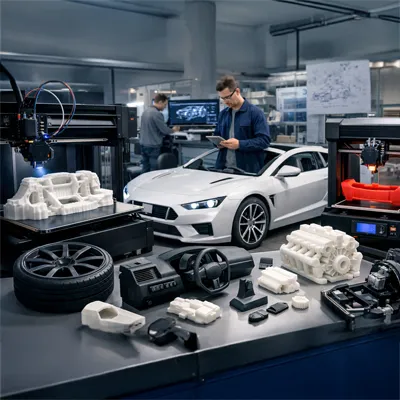
The automotive business is experiencing a radical change due to the sense of compressed product cycles, increasing customization needs, electrification, and digital production. The key element of this transformation is 3D printing in the automotive prototyping, which has long since grown beyond its initial purpose as a visual modeling tool. Additive manufacturing in an automotive setting today is redefining the manner in which concepts are validated, components tested and product taken to the market.
Automobile 3D printing is no longer an experimental tool to OEMs, Tier 1 suppliers, and engineering service providers. It is a strategic facilitator of quicker decision-making, cost-effectiveness and design creativity. With the increasing competition, the rapid prototyping of automotive products is now important in minimizing the time-to-market without sacrificing the performance and quality standards.
Definition: Automotive Prototyping in the Additive Era
Automotive prototyping can be defined as the manufacturing of models of either functional or non-functional design of a part or a system used in a vehicle to test design functionality, fit, performance and manufacturability prior to production in large quantities. In additive manufacturing, this process is also digital-first, iterative and much faster than more traditional machining or tooling-based processes.
Evolution of Automotive Prototyping Methods
The conventional car prototyping involved the use of CNC machining, clay modeling, and soft tooling. Although these techniques were precise, they were time-consuming, costly and rigid in the event that design modification was a requirement. These limitations were intensified with development cycles becoming shorter with the complexification of vehicle architecture.
Automatic 3D printing in the automotive industry helped overcome these problems since it gave the engineers an opportunity to transfer directly to the physical prototype of the CAD model. Design modifications that required weeks could now be done in hours and days. This flexibility has redefined the product development processes of automotive companies in terms of concept validation, functional testing and pre-production planning.
The Role of 3D Printing in Rapid Automotive Product Development
The application of 3D printing in the quick development of automotive products is essentially associated with velocity and repetition. Additive manufacturing enables engineering teams to test numerous design variants at the same time, and makes decisions faster at the earliest design stages when they are the least expensive to change.
In concept development, designers apply the automotive prototype design with 3D printing technology in order to test the ergonomics, aesthetics, and packaging limitations. Late prototyping within the framework of additive manufacturing assists with airflow testing, thermal tests and vibration tests, as well as mechanical stress testing.
The fast iteration feature allows automotive firms to detect design flaws sooner and lower the costs of reworking it late in the design process and the risk of downstream production.
Short Table: Traditional Prototyping vs. Automotive 3D Printing
| Aspect | Traditional Prototyping | Automotive 3D Printing |
| Lead Time | Weeks to months | Hours to days |
| Design Iterations | Limited | High |
| Tooling Requirement | Mandatory | Not required |
| Cost Per Iteration | High | Significantly lower |
| Design Complexity | Restricted | Virtually unlimited |
Additive Manufacturing in Automotive: Materials and Technologies
Interior parts, housings and fixtures are also usually made of automotive grade plastics like ABS, nylon, and polycarbonate. In terms of functional testing, fiber-reinforced composite has high-strength-weight ratios.
Lightweight structural components, thermal components, and engine brackets can be produced with the help of metal additive manufacturing, such as selective laser melting and electron beam melting. These features enable automotive 3D printing to transition to form-and-fit models to performance prototyping.
With the development of material science, the demarcation between prototyping and low-volume production is more than ever blurred, paving the way to new possibilities of flexible approaches to manufacturing.
Benefits of Additive Manufacturing for Automotive Prototyping
Speed is not the only advantage of additive manufacturing to automotive prototyping. One of the key factors is cost optimization, especially when there is need to do several design revisions. Through the eradication of tooling expenses, manufacturers will be able to invest additional in innovation as opposed to infrastructure.
Another important advantage is the freedom of design. Complex number of geometries and internal channels, lattice designs and light weight designs are all capable of being prototyped without constraints of manufacturing. This feature helps in the performance based engineering and in the case of the electric cars the thermal control and weight losses are essential.
Also additive manufacturing helps in localized and decentralized prototyping where engineering teams globally can collaborate digitally and manufacture prototypes that are closer to the development centres.
Automotive Product Development and Cross-Functional Collaboration
As in the contemporary automotive product development, the teams of design, engineering, manufacturing, and procurement cannot and must work together. Bridging these functions is done through Automotive 3D printing. The same prototype can be used to visualize ideas quickly as well as test performance by the designers and evaluate producibility by the manufacturing teams.
This physical reference aids the communication process, minimizes misunderstanding of the digital models and hastens the process of inter-stakeholder alignment. Consequently, the period of decision making becomes shorter and the risks involved during development are reduced.
Step-by-Step Flow: Automotive Prototyping Using 3D Printing
Automobile prototypical instructions made attainable through additive manufacturing normally start with computer-made and simulation designs. CADs are also additive manufacturing-optimized and transformed into printable format. Prototypes are made and then tested in their final form, fitting, and functionality. The testing feedback is quickly utilized in design corrections and then reprinted and revalidated.
The iteration process works as a closed loop, providing a way of achieving design objectives that makes projects developed in this manner take a much shorter time than one developed in a sequential fashion.
Business Impact for OEMs and Tier Suppliers
Automobile 3D printing provides quantifiable business value, in B2B perspective. OEMs have the advantage of quicker vehicle releases and lower development expenses whereas Tier suppliers have the advantage of swiftness in reacting to design modifications and market demands.
To suppliers, the capacity to produce fast prototypes will enhance customer relations and competitiveness of the supplier in the RFQ and validation processes. Additive manufacturing also helps the suppliers demonstrate the ability to innovate making them a strategic partner and not a commodity supplier.
Quality, Validation, and Compliance Considerations
Although 3D printing as a method of automotive prototyping is fast, quality control is of primary importance. Prototypes should be dimensional accurate, material and testing standards that are in accordance with automotive standards. The major manufacturers are using the additive manufacturing to add to the quality management systems to be able to provide the traceability, repeatability, and validation.
With the maturity of additive manufacturing technologies, regulatory acceptance is on the rise especially in functional prototyping of products and tooling uses within automotive production settings.
FAQ Summary: Common Industry Questions
One of the most common questions in the industry is whether or not automotive 3D printing can completely be used to substitute the traditional prototyping. Additive manufacturing does not replace the traditional approach to things but rather works in tandem with it. It is superior in initial validation and iterative production testing, but conventional methods continue to be used in final tooling of production and large-scale validation.
The other issue is associated with cost. Although individual component unit costs might be more expensive when 3D-printing is used, the total project costs can be lower because of lower tooling costs, shorter development times, and fewer design mistakes.
Glossary of Key Terms
- Additive Manufacturing in Automotive can be described as the production of components on a layer-by-layer basis, via digital models, allowing the prototyping of components to be flexible and fast.
- Automotive prototyping refers to production of test parts to confirm design and performance prior to production.
- Rapid prototyping of automotive refers to the process of creating prototypes through digital manufacturing process at a high rate.
- Automotive product development also involves the full cycle of designing, testing, validating and introduction of vehicle components and systems.
Strategic Outlook: The Future of Automotive Prototyping
The 3D printing of automotive prototyping will only grow as digital twins, AI-driven design optimization, and intelligent manufacturing become a single entity.
The use of prototypes as a form of data-rich validation tools will become more common as opposed to a fixed test object. In the case of automotive organizations, it is no longer a choice to invest in additive manufacturing capabilities. It is a strategic need to be competitive in an industry that is characterized by speed, innovation and customization.
Conclusion: A Competitive Advantage in the Making
In prototyping of automotive products, 3D printing has become an essential element of present-day automotive product development. Automotive 3D printing enables manufacturers to be innovative without fear since it allows rapid iteration, cost reduction and collaboration with cross functions.
To both OEMs and suppliers, strategic use of additive manufacturing in automotive prototyping is much more than faster prototypes. It is regarding the creation of resilient, agile and future-oriented development environments that can support the need of a fast evolving mobility environment.
 Media Pack Download
 Newsletters
 Industrial Events