
EV & Advanced Braking Technologies: Driving Safety and Efficiency Forward
The birth of electric vehicles (EVs) has caused a revolution in the manner in which the automotive sector is approaching mobility, sustainability, and safety. One of the most crucial inventions that has caused this change is braking technology. More than the usual disc and drum systems, new multi-levels of performance and efficiency are opening up in EVs due to the advanced brake technologies. The energy recovery braking systems are turning into smart braking technology for EVs, and the industry is also experiencing a paradigm shift that will combine safety with sustainability.
This article goes in-depth on the manner in which the braking systems are becoming better, why the benefits of regenerative braking can be considered a major point of discussion, and which vehicles are regarded as the best regenerative braking EVs in the worldwide market.
The Evolution of EV Braking: From Conventional to Cutting-Edge
Initially, when EVs emerged in the mainstream markets, they had a braking mechanism that was highly similar to that of normal cars. Nevertheless, as the efficiency and range maximization were actively pursued, the engineers quickly noticed that braking can be used dually. It may not only be used to halt a vehicle but also be made a means of energy recovery.
| Also Read: How Regenerative Braking Works in Electric Vehicles |
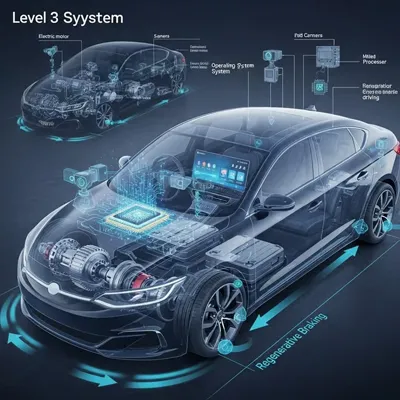
This concept led to the development of energy recovery braking systems or regenerative braking efficiency additions, which utilize the kinetic energy of the vehicle during deceleration and convert it to electrical energy that is stored in the battery. This new breakthrough allowed extending the range of vehicles as well as creating new dimensions of EV safety and braking systems.
The modern world does not see the use of advanced braking technologies in EVs as an option anymore; it is necessary to ensure not only compliance with safety requirements but also competitiveness in the market.
Regenerative Braking: The Core of Efficiency in EVs
The Centre of this revolution is the regenerative braking. The principle is radical, but easy to understand. When a driver breaks the brake pedal, the electric motor is turned on in reverse as a generator, rather than working on friction brakes. The produced electricity is reflected into the battery producing observable regenerative braking gains.
However, what is so important about regenerative braking? It is a solution to two nagging issues: range anxiety and cost-effectiveness, for both EV manufacturers and drivers. This allows the manufacturers of the cars to take out an extra few kilometers using the same battery pack by allowing their cars to achieve higher regenerative braking efficiencies. This will enable them to avoid the need to charge frequently and also cut down the overall ownership cost.
Surprisingly, driver control and safety are also improved by regenerative braking. Since energy recovery braking systems automatically provide resistance, smooth deceleration, and a wear-reduced mechanical brake component is attained. This translates to the long life of brakes and the more receptive EV safety and braking procedure.
Comparing the Best Regenerative Braking EVs in today’s Market
Not every electric vehicle has the same amount of generative performance. Others are already being perceived as the best regenerative braking EVs because of their advanced software, adjustable braking modes, and the best regenerative braking efficiency gains.
This is a brief comparison of the top competitors:
| Model | Key Feature | Why It Stands Out |
| Tesla Model 3 | Adjustable regen modes | Known for aggressive yet smooth regen, maximizing regenerative braking benefits |
| Hyundai Ioniq 5 | Paddle-shift regen control | Offers precise control over energy recovery braking systems |
| Nissan Leaf | e-Pedal system | One-pedal driving enhances EV safety and braking systems |
| Audi e-tron | Blends regen with hydraulic brakes seamlessly | Smart algorithms for regenerative braking efficiency improvements |
| Porsche Taycan | High-voltage recovery | Among luxury EVs with outstanding advanced braking technologies EVs integration |
Through these models, we can see that the future of smart braking technology on EVs would greatly depend on customization, driver experience, and compatibility with the already existing mechanical systems.
Regenerative Braking Benefits beyond Efficiency
Although the longer driving range has been discussed, the benefits of regenerative braking go way beyond that of saving energy. They touch upon the effect on the environment, the life of the vehicle, and even the sustainability of the city. One of the most attractive benefits in the eyes of a driver is the decrease in brake wear.
Brakes are also less commonly used since the deceleration load is shared significantly by the energy recovery braking systems. The result is the reduced number of replacements, which reduces the ultimate cost and waste of the environmental effects related to the production of brake pads.
One of the most attractive benefits in the eyes of a driver is the decrease in brake wear. Brakes are also less commonly used since the deceleration load is shared significantly by the energy recovery braking systems. The result is the reduced number of replacements, which reduces the ultimate cost and waste of the environmental effects related to the production of brake pads.
In cities struggling with pollution, regenerative braking is one more technology that can lower the incidence of particulate emissions compared to traditional brakes. EVs lead to cleaner air in the city when paired with efficiency gains in regenerative braking.
The advantage of safety is perhaps the most ignored one. EV safety and braking systems based on regenerative technologies result in accident prevention by providing a smoother deceleration and quick feedback. This demonstrates the fact that efficiency and safety can exist together.
The Role of Smart Braking Technology in EV Safety
Generating cannot be the end of the discussion on braking. The next jump will be the introduction of smart braking technology in EVs. Smart braking is a system that combines sensors, algorithms based on AI, and connectivity, unlike conventional systems, which work independently.
To illustrate, the adaptive braking systems can scan the traffic conditions as they happen and alter the braking force. Together with the state-of-the-art braking systems of EVs, this results in the greater application of driver assistance systems such as collision avoidance and lane-keeping.
Basically, EV safety and braking systems are developing into active protectors, rather than active mechanisms. The combination of regenerative performance and intelligent braking is establishing new standards in the industry.
Market Insights: Why Advanced Braking is becoming a Differentiator
According to the forecasts of analysts, the international market of advanced braking technologies for EVs is going to increase by half a hundred percent in the forthcoming decade. Car manufacturers are also spending a lot of money on research to perfect energy recovery braking systems and also come up with more apparent regenerative braking efficiency upgrades.
As per surveys conducted among consumers, the advantages of regenerative braking are becoming one of the factors that consumers take into account when selecting an EV. Easy drive with the intuitive one-pedal control, customizable regens, and smooth smart braking technology included in EVs make vehicles stand out in the saturated market.
With regulators increasing pressure to meet higher safety and emission standards, it is possible that manufacturers who do not focus on EV safety and braking systems cannot compete. The focus on the increased importance of braking technologies as both functional and strategic differentiators is highlighted by this dynamic.
Engineering Challenges in Regenerative Braking Efficiency Improvements
The technology is also promising, but perfect improvements in regenerative braking efficiency are not a simple task. There are several challenges encountered by engineers:
- Regeneration as a compromise to driver comfort. Excessive regeneration may be unnatural.
- Making sure that the energy recovery braking systems do not conflict with the traditional friction brakes used to stop in case of an emergency.
- Incorporating the smart braking technology in EVs without having to overburden the electronic control units of the vehicle.
In a bid to solve them, automakers are trying out high-level algorithms, predictive AI, and hybrid braking. Here, the boundary between safety and sustainability is narrowed, and the two-fold purpose of modern braking systems is noted.
Future Outlook: What Lies Ahead for EV Braking Systems
The future EV braking is bound to be active, integrating the advanced braking technologies, EVs, energy recovery braking systems, and intelligent software to produce real adaptive systems. Future models will probably provide customized braking profiles, in which drivers are allowed to choose their preferred regen strength, efficiency, and comfort combination.
It can also be anticipated that advances in materials science would provide an improvement in the durability of brake friction, and this would add to the advantage of improvement in braking regenerative efficiency. Smart braking EVs will also use 5G connection and autonomous driving to communicate with the surrounding infrastructure to foresee and respond to dangers before the perils are present.
Finally, incorporating EV safety and braking technology with AI-based innovation, this could lead to a new generation of car models that not only drive cleaner but also provide safety to their occupants in a way that has never been seen before.
Conclusion: Braking as the New Frontier of EV Innovation
The example of braking in EVs demonstrates that even minor innovations can spread into the transformations in the whole industry. Whether it is the best regenerative braking EVs that provide a wider range or the most advanced braking technologies EVs that provide high levels of safety, the industry is leading the way in propelling efficiency.
The demand for visible regenerative braking benefits as well as smarter systems will continue to increase as consumers become more informed. The manufacturers that are oriented to energy recovery braking systems, relentlessly strive to achieve a higher level of regenerative braking efficiency and adopt intelligent braking technology. EV will be ahead of the pack in defining what tomorrow's mobility will look like.
The future is open: the braking process is no longer only about stopping, but will bring the industry to a safer, smarter, and better future.
 Media Pack Download
 Newsletters
 Industrial Events