
Designing Next-Generation Autonomous Vehicle Seating for Comfort, Flexibility, and Multi-Functional Use
The steering wheel is disappearing. The dashboard is shrinking. And the humble car seat, once a fixed, forward-facing bracket bolted to the floor, is quietly becoming one of the most important pieces of engineering in the entire vehicle. As autonomous driving technology matures, OEMs and Tier 1 suppliers are discovering that Autonomous Vehicle Seating isn't a minor trim decision — it's a core design challenge that will define whether self-driving vehicles actually deliver on their promise.
For decades, seat design was constrained by a single, unavoidable fact: someone had to be watching the road. That constraint shaped everything — seat orientation, spacing, sightlines, even the shape of the cushion. Remove the driver from the equation, and every one of those assumptions falls apart. Suddenly, the cabin isn't a control station anymore. It's a room. And rooms need furniture that behaves very differently from a bucket seat bolted in place.
This shift is why Autonomous Vehicle Interior Design has become one of the most active R&D areas in mobility today, with seating sitting at the center of it.
| Also Read: Smart Seating Systems: How AI and Sensors Are Personalizing Passenger Comfort |
Why Seating Has Become the New Battleground
In a traditional vehicle, differentiation happened under the hood — horsepower, fuel efficiency, handling. In an autonomous vehicle, the driving experience is largely outsourced to software. That means the occupant experience becomes the primary battleground for brand differentiation. And nothing shapes occupant experience more directly than the seat.
Passengers in a self-driving vehicle aren't watching the road; they're working, resting, socializing, or simply decompressing. That means seating has to support an entirely new set of behaviors — reclining without restriction, rotating to face other passengers, or folding away entirely to free up cabin space for cargo, wheelchairs, or sleeping arrangements. This is the driving force behind the rise of Smart Automotive Seating, where the seat itself becomes an active, responsive component of the vehicle rather than a passive one.
From Fixed Positions to Flexible Systems
Perhaps the clearest sign of this shift is the move toward Flexible Vehicle Seating Systems. Instead of a fixed row of forward-facing seats, next-generation platforms are being built around rails, swivel bases, and reconfigurable mounting points that let seats slide, rotate, and fold on demand.
This flexibility isn't just a novelty feature — it's a response to genuine market demand. A ride-hailing fleet operator needs a cabin that can flip between a solo commuter configuration and a four-passenger conference layout within seconds. A family vehicle needs to switch between a conversational lounge setup and a rear-facing child-safe configuration. A last-mile delivery vehicle needs seating that can vanish entirely to maximize cargo volume during off-peak hours.
Modular Vehicle Seating architectures are what make this kind of rapid reconfiguration possible. By designing seats as standardized modules that share a common mounting and power interface, manufacturers can offer a single vehicle platform that serves radically different use cases — without redesigning the entire interior for every variant. This modularity also simplifies manufacturing, reduces part complexity across vehicle trims, and shortens development cycles, which matters enormously to OEMs trying to bring autonomous platforms to market faster and at lower cost.
Comfort Is Now an Engineering Discipline
Comfort used to mean foam density and lumbar support. In the autonomous era, it means something far more dynamic. Adaptive Automotive Seating systems now use pressure sensors, posture tracking, and biometric feedback to adjust cushion firmness, bolster tension, and recline angle in real time — responding not to a preset button press, but to how the occupant's body is actually behaving.
This is where AI-Based Seat Adjustment enters the picture. Rather than requiring passengers to manually tune a dozen settings, AI-driven systems learn individual preferences over time, recognize discomfort patterns (a shifting posture, tensed shoulders, prolonged stillness that signals fatigue), and make micro-adjustments automatically. A seat might gradually soften bolster pressure during a long ride, redistribute weight to reduce pressure points, or subtly shift recline angle as a passenger transitions from working to resting.
This isn't speculative technology — it's already being piloted in premium vehicle programs and is rapidly moving toward mainstream adoption as sensor costs fall and machine learning models become more efficient to run on embedded automotive hardware. The broader category of AI-Powered Automotive Seating extends beyond comfort adjustments alone, encompassing occupant detection, safety positioning ahead of predicted collision events, climate personalization at the seat level, and even health monitoring that can flag irregular heart rates or signs of driver fatigue in semi-autonomous modes.
The Interior as a Multi-Purpose Space
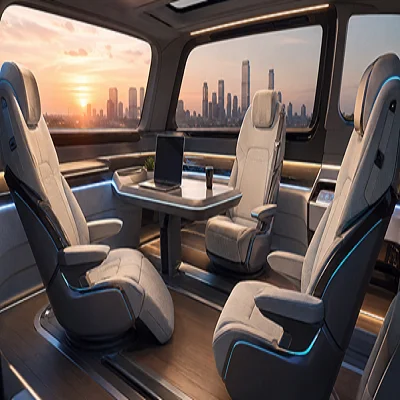
Autonomous mobility doesn't just change how people sit — it changes what the vehicle is for. A car that drives itself can become a mobile office during a commute, a private lounge for a weekend trip, or a rest space during a long-haul journey. This reality is pushing designers toward genuinely Multi-Functional Vehicle Interiors, where the seat is one component in a larger, purpose-shifting environment.
Consider a seat that integrates a fold-out worktable, wireless charging surface, and adjustable lighting for a business traveler, then reconfigures into a flat, reclined position for a passenger who wants to nap during a late-night ride. Or a seating arrangement that rotates to create a face-to-face conversation pod for a family trip, then rotates back to a forward-facing layout when the vehicle needs to accommodate additional passengers.
This is a fundamentally different design brief than anything the automotive industry has tackled before, and it requires collaboration well beyond traditional seat suppliers — bringing in expertise from furniture design, hospitality, healthcare ergonomics, and consumer electronics. The vehicles winning early market share in the autonomous space are the ones treating the cabin less like a car interior and more like a hybrid of hotel suite, wellness pod, and mobile workstation.
Why Premium Experience Is Now Table Stakes
For a long time, "premium" in automotive meant leather upholstery and heated seats. In the autonomous era, premium means something more experiential — quiet, adaptive, intelligent comfort that responds to the individual rather than forcing the individual to adapt to the vehicle.
This is why so much investment is flowing toward delivering a genuine Premium Mobility Experience across both luxury and mass-market autonomous platforms. Fleet operators, robotaxi providers, and OEMs alike recognize that occupant comfort is now a primary purchase and retention driver — arguably more influential than performance specs ever were in traditional vehicles. Riders who feel physically cared for during a trip are more likely to return to a service, recommend it, and tolerate longer travel times. For B2B buyers evaluating fleet vehicles, seating quality has become a measurable factor in rider satisfaction scores and repeat usage metrics.
Building Toward Future Mobility
None of this happens in isolation. Seating is just one thread in a much larger transformation of how vehicle interiors are conceived, engineered, and manufactured. The suppliers and OEMs leading this shift are the ones investing early in Next-Generation Car Seats — designs built from the ground up around sensor integration, modularity, and software-defined behavior, rather than retrofitted versions of legacy seat platforms.
This requires new supply chain relationships (sensor manufacturers, AI software providers, materials scientists working on lightweight adaptive foams), new testing protocols (validating comfort and safety across dozens of reconfigurable positions rather than a handful of fixed ones), and new design philosophies that treat the seat as a connected, intelligent system rather than a static mechanical assembly.
Companies developing Future Mobility Interior Solutions are increasingly structuring their R&D around a few consistent principles: seats must be reconfigurable without requiring tools or technician intervention; comfort adjustments must happen automatically and unobtrusively; safety systems must function correctly across every possible seating configuration, not just the default forward-facing position; and the entire seating system must integrate cleanly with the vehicle's broader software stack so that seat behavior can be updated and improved over time, much like any other connected feature.
The Road Ahead
The transition to autonomous mobility is often discussed in terms of sensors, software, and regulatory frameworks — and rightly so. But the vehicles that ultimately win consumer trust and market adoption will be judged just as much by how they feel to sit in as by how well they drive themselves. Seating sits at the intersection of comfort, safety, and functionality, making it one of the highest-leverage design decisions in the entire autonomous vehicle development process.
For OEMs, Tier 1 suppliers, and fleet operators evaluating where to invest, the message is increasingly clear: autonomous vehicle seating is no longer an afterthought bolted onto a proven platform. It's a strategic differentiator, a driver of occupant satisfaction, and a defining feature of what mobility will look like in the decade ahead. The companies that treat it that way now will be the ones setting the standard for everyone else to follow.
 Media Pack Download
 Newsletters
 Industrial Events