
AI-Powered Smart Cockpits: The Future of Personalized In-Car Experiences
For decades, automakers competed by building faster engines, safer chassis, and more luxurious interiors. Today, however, the battleground has shifted. The modern vehicle is no longer judged solely by horsepower or fuel efficiency—it is increasingly evaluated by the intelligence of its cabin.
Consumers now expect their vehicles to recognize their preferences, understand voice commands, predict navigation routes, adjust climate settings automatically, and even monitor their health and alertness. These expectations have accelerated the rise of the AI-Powered Smart Cockpit, transforming the car from a transportation machine into an intelligent digital companion.
For automotive OEMs, Tier-1 suppliers, software developers, semiconductor companies, and mobility providers, this evolution represents one of the largest opportunities in automotive innovation. The cockpit has become a strategic platform where hardware, software, artificial intelligence, cloud connectivity, and user-centric design converge to create entirely new business models.
Rather than simply displaying information, the Intelligent Vehicle Cockpit is becoming an adaptive ecosystem that continuously learns from drivers, passengers, road conditions, and cloud data to deliver deeply personalized experiences.
From Dashboard to Digital Experience Platform
Traditional dashboards were designed around gauges, buttons, and warning lights. Every driver received the same interface regardless of their habits or preferences.
Today's Next-Generation Vehicle Interiors tell a completely different story.
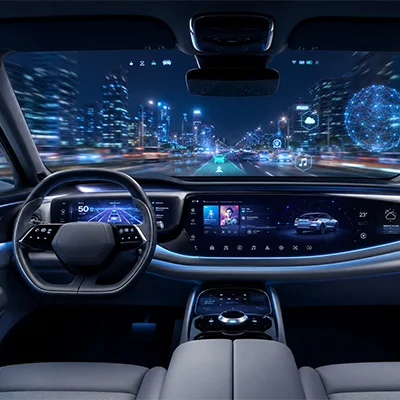
Modern cabins integrate multiple digital displays, AI assistants, augmented reality, biometric sensors, contextual navigation, gesture recognition, and cloud-based personalization into one seamless environment. The interior is no longer static—it evolves alongside the driver.
This transformation is powered by software rather than mechanical engineering alone.
The rise of the Software-Defined Vehicle allows manufacturers to continuously improve cockpit functionality through over-the-air software updates instead of waiting for the next vehicle generation. New entertainment services, AI capabilities, navigation improvements, safety features, and interface enhancements can all be deployed remotely.
For OEMs, this dramatically extends vehicle lifecycle value while opening recurring revenue opportunities through subscription services and premium digital experiences.
AI Is Redefining Automotive User Experience (UX)
Consumers rarely compare infotainment systems against other vehicles anymore. Instead, they compare them with smartphones, smart homes, streaming platforms, and AI assistants.
That comparison has fundamentally changed Automotive User Experience (UX) expectations.
Drivers expect vehicles to:
- Learn daily routines
- Predict destinations
- Recommend charging stations
- Adjust seats automatically
- Personalize music playlists
- Understand natural language
- Respond instantly
Artificial intelligence enables these capabilities by analyzing enormous amounts of behavioral and contextual data.
Instead of forcing users through complex menus, AI anticipates what they need before they ask.
Imagine entering the vehicle after a stressful workday.
Without touching a single button, the cockpit recognizes the driver, adjusts the ambient lighting, lowers cabin temperature, activates a calming playlist, suggests the fastest route home based on live traffic, and postpones non-essential notifications.
| Read More: Sustainable Automotive Interiors: How Eco-Friendly Materials Are Redefining the Future of Vehicle Design |
This isn't simply automation.
It's contextual intelligence.
For manufacturers, superior UX is rapidly becoming a stronger differentiator than traditional vehicle specifications.
The Intelligent Vehicle Cockpit Learns Every Journey
The greatest strength of an Intelligent Vehicle Cockpit lies in continuous learning.
Unlike conventional infotainment systems that follow fixed programming, AI-powered platforms build behavioral models over time.
The vehicle gradually understands:
- Frequently visited locations
- Preferred driving modes
- Seating positions
- Climate preferences
- Entertainment habits
- Charging routines
- Phone usage
- Voice patterns
- Calendar schedules
Each interaction makes future interactions more intuitive.
Machine learning algorithms also distinguish between multiple drivers within the same household, allowing every family member to receive an entirely personalized cockpit experience immediately after authentication.
This level of personalization creates emotional attachment—something automakers increasingly view as essential for customer loyalty.
Automotive AI Technology Is Moving Beyond Voice Assistants
Early automotive AI focused primarily on voice recognition.
Today's Automotive AI Technology extends far beyond conversational interfaces.
Modern AI platforms simultaneously process inputs from:
- Interior cameras
- Exterior sensors
- Radar
- LiDAR
- Microphones
- GPS
- Cloud services
- Smartphone ecosystems
- Vehicle telemetry
- Driver biometrics
These data streams are fused into a unified intelligence layer capable of making real-time decisions.
For example, AI can detect that the driver appears fatigued while traffic congestion is increasing and weather conditions are deteriorating.
Instead of merely issuing warnings, the cockpit can proactively suggest a nearby rest stop, reduce infotainment distractions, adjust cabin temperature for alertness, and notify navigation systems to optimize the remaining journey.
Such contextual intelligence significantly enhances both safety and convenience.
Automotive Digital Dashboard Becomes the New Command Center
The Automotive Digital Dashboard has evolved into one of the most sophisticated computing environments inside the vehicle.
Instead of displaying static gauges, modern dashboards dynamically reorganize information based on driving context.
During city driving, navigation and pedestrian alerts may dominate the display.
On highways, adaptive cruise control information and lane guidance become more prominent.
While charging an electric vehicle, battery analytics, charging progress, nearby amenities, and trip planning automatically take center stage.
Artificial intelligence determines what information deserves attention at any given moment, reducing cognitive overload for drivers.
The dashboard becomes less about displaying data—and more about presenting the right information at precisely the right time.
Connected Car Technology Enables Personalized Mobility
Personalization depends heavily on connectivity.
Without cloud communication, vehicles cannot continuously learn or synchronize user preferences across multiple devices.
Modern Connected Car Technology links the vehicle with smartphones, cloud platforms, smart homes, charging infrastructure, enterprise mobility services, digital payment systems, and navigation ecosystems.
This connectivity creates uninterrupted digital continuity.
Imagine a driver beginning a route on their smartphone before leaving home.
Upon entering the vehicle, navigation automatically resumes, preferred music continues playing, climate settings activate, calendar appointments synchronize, and parking reservations are already confirmed at the destination.
The transition feels effortless because the vehicle has become an extension of the user's digital lifestyle.
For mobility providers, this seamless integration is becoming a key competitive advantage.
AI in Automotive Is Driving Predictive Personalization
The future of AI in Automotive lies not in reacting to commands—but predicting intent.
Predictive AI continuously analyzes historical driving behavior alongside real-time contextual information.
Examples include:
- Suggesting alternate routes before congestion forms
- Scheduling charging based on battery usage patterns
- Recommending maintenance before failures occur
- Automatically adjusting suspension for familiar roads
- Prioritizing important calls during long commutes
- Preparing vehicle settings based on weather forecasts
This predictive intelligence minimizes driver effort while maximizing comfort.
Rather than interacting with technology, drivers simply experience smarter mobility.
Reinventing the In-Vehicle Infotainment System
Entertainment has become only one component of the modern In-Vehicle Infotainment System.
Today's platforms combine:
- Voice AI
- Streaming media
- Productivity applications
- Video conferencing
- Gaming
- Digital assistants
- Navigation
- Smart home controls
- Commerce
- Vehicle settings
The cabin increasingly resembles a connected workspace or entertainment lounge.
This evolution becomes even more significant as autonomous driving technologies mature.
When drivers no longer need to focus exclusively on driving, infotainment systems transform into productivity and leisure platforms.
Automakers therefore view infotainment not merely as a feature—but as a long-term software ecosystem capable of generating recurring revenue through subscriptions, premium applications, and digital services.
Smart Cabin Technology Makes Vehicles Emotionally Intelligent
Perhaps the most fascinating innovation is the emergence of Smart Cabin Technology.
Instead of simply responding to commands, smart cabins interpret emotional and physiological conditions.
Advanced sensors analyze:
- Facial expressions
- Eye movement
- Voice tone
- Heart rate
- Body posture
- Cabin occupancy
- Gesture patterns
Combined with AI, these insights enable adaptive environments.
If stress levels increase during heavy traffic, lighting, music, airflow, and display brightness can automatically adjust to improve comfort.
If children occupy rear seats, entertainment settings and climate zones adapt accordingly.
Luxury manufacturers are even exploring mood-based personalization that changes ambient environments throughout the journey.
The cabin is becoming emotionally responsive rather than mechanically reactive.
Driver Monitoring System Is Expanding Beyond Safety
The Driver Monitoring System initially emerged as a regulatory safety feature designed to detect fatigue and distraction.
Artificial intelligence is now significantly expanding its capabilities.
Modern monitoring systems can recognize:
- Drowsiness
- Phone distraction
- Eye closure duration
- Head orientation
- Medical distress
- Emotional stress
- Driver identity
- Seat occupancy
Future systems may integrate wearable devices, health platforms, and biometric authentication to create highly personalized safety experiences.
For fleet operators, commercial vehicles, and autonomous mobility services, driver monitoring also supports compliance, insurance optimization, and operational efficiency.
Rather than functioning as an isolated safety tool, it becomes an essential component of intelligent mobility.
Building the Connected Vehicle Ecosystem
No company can develop the intelligent cockpit alone.
The Connected Vehicle Ecosystem relies on collaboration among numerous stakeholders:
- Automotive OEMs
- Tier-1 suppliers
- AI software companies
- Cloud providers
- Semiconductor manufacturers
- Cybersecurity vendors
- Connectivity providers
- Mapping companies
- App developers
- Mobility platforms
Open software architectures are replacing closed automotive platforms, enabling third-party innovation while accelerating feature deployment.
Partnerships between automotive manufacturers and technology companies are becoming increasingly strategic because digital experiences now influence purchasing decisions as strongly as traditional vehicle performance.
The cockpit has effectively become the convergence point of multiple industries.
Business Opportunities beyond Vehicle Sales
For automotive businesses, intelligent cockpits unlock entirely new revenue streams.
Instead of relying solely on vehicle sales, manufacturers can monetize digital services throughout ownership.
Potential opportunities include:
- Premium navigation subscriptions
- Personalized entertainment packages
- AI assistant upgrades
- Enhanced driver analytics
- Insurance partnerships
- Predictive maintenance services
- Cloud storage
- Fleet intelligence
- Remote diagnostics
- Productivity applications
This recurring software revenue aligns automotive business models more closely with consumer technology companies.
The vehicle evolves into a continuously improving digital product rather than a static asset.
Challenges That Cannot Be Ignored
Despite rapid innovation, several challenges remain.
Automakers must carefully balance personalization with privacy protection.
AI systems require enormous volumes of personal data, making cybersecurity and regulatory compliance increasingly important.
Other critical considerations include:
- Data ownership
- AI transparency
- Ethical decision-making
- Cross-platform compatibility
- Functional safety
- Software validation
- Real-time processing performance
- Hardware scalability
- Global regulatory requirements
Success will depend on delivering intelligent experiences without compromising trust.
Consumers are willing to share data only when the value exchange is clear, secure, and transparent.
The Road Ahead
The next decade will redefine what people expect from vehicle interiors.
Cars will increasingly recognize their occupants, anticipate needs, personalize every journey, monitor well-being, integrate seamlessly with digital lifestyles, and continuously improve through software updates.
The AI-Powered Smart Cockpit represents far more than an advanced dashboard—it is becoming the intelligence hub of the entire vehicle.
As Automotive AI Technology, Connected Car Technology, Smart Cabin Technology, and the broader Connected Vehicle Ecosystem continue to mature, personalization will become a defining competitive advantage rather than a premium feature.
For automotive manufacturers, suppliers, software developers, semiconductor companies, and mobility innovators, the opportunity extends well beyond improving cabin comfort. The cockpit is evolving into the primary interface between humans and intelligent mobility, reshaping how vehicles are designed, monetized, and experienced.
In the era of the Software-Defined Vehicle, competitive success will increasingly depend not on who builds the most powerful engine, but on who creates the most intuitive, adaptive, and human-centric digital driving experience. The companies that master the Intelligent Vehicle Cockpit today will define the mobility experiences of tomorrow.
 Media Pack Download
 Newsletters
 Industrial Events