


Robert Bosch GmbH, Germany

About: Dr. Unmendu Senapati - Senior Automotive Technology and Programme Leader, Cross-Domain Computing / Project Management
Dr. Unmendu Senapati is a senior automotive technology and programme leader with more than 25 years of experience across ADAS, infotainment, connectivity, telematics, embedded vehicle platforms, high-performance computing, industrialisation and product delivery. He holds a PhD focused on AI-based predictive modelling and safety analysis. Having worked with Bosch and Valeo, he combines research insight with hands-on industry leadership. He is also an industry speaker and contributor on automotive electronics, software-defined vehicles, manufacturing innovation, functional safety and cross-domain technology strategy globally.
1. How is AI transforming the safety landscape of autonomous driving and Advanced Driver Assistance Systems (ADAS), and what are the most significant risks it can help mitigate?
AI is improving autonomous-driving safety by combining large volumes of sensor and vehicle data to recognise hazards, assess uncertainty and support faster, more consistent decisions. Its greatest contribution is reducing risk from delayed reactions, limited visibility, missed objects, unsafe gaps, lane departures and driver inattention. However, AI should be treated as one element of a layered safety architecture, supported by deterministic controls, functional-safety mechanisms, redundancy and continuous monitoring.
2. How can AI enable autonomous vehicles to detect and respond to unpredictable road conditions, sudden obstacles, pedestrians, and other vehicles in real time?
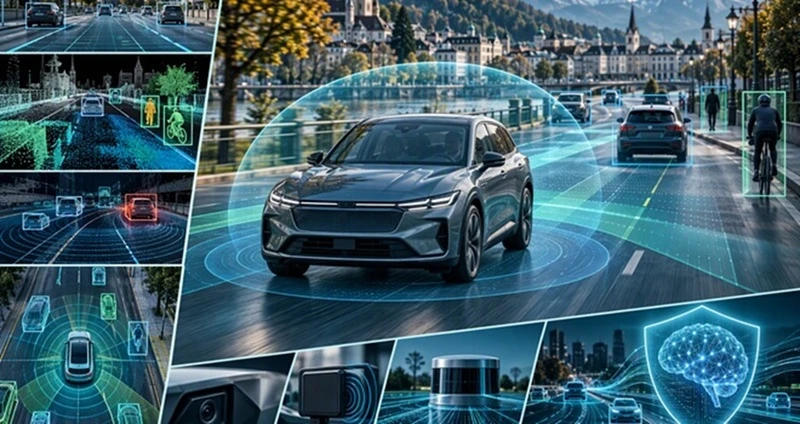
AI processes camera, radar, LiDAR, ultrasonic, map and vehicle-motion data in parallel, then tracks how objects and road conditions evolve over time. Modern perception and prediction models estimate an object's path, speed and intent, while the planning function evaluates safe braking, steering or evasive options. Reliable real-time response also requires low-latency computing, confidence scoring and a fallback behaviour when the scene is uncertain.
3. What role do machine learning and deep learning play in improving object detection, lane recognition, and environmental perception under challenging conditions such as poor lighting, fog, and heavy rain?
Machine learning improves the classification and tracking of vehicles, pedestrians, cyclists, lanes, traffic signs and free space, while deep-learning models extract complex visual and spatial features that traditional rules may miss. Performance in darkness, fog or rain can be improved through multi-sensor training, temporal information, image enhancement and data covering difficult scenarios. The system must still quantify confidence and avoid assuming that a confident output is automatically correct.
4. How can AI help address the limitations of sensors such as cameras, LiDAR, and radar to minimize perception errors and reduce the risk of accidents?
AI-based sensor fusion can compensate for the weaknesses of individual sensors: cameras provide rich semantic detail, radar measures range and relative speed robustly, and LiDAR provides accurate geometry. Cross-checking these sources helps detect inconsistent measurements, blocked or dirty sensors, glare, adverse weather and calibration drift. Safe designs should degrade gracefully, preserve essential functions where possible and initiate a minimal-risk response when perception quality falls below an acceptable threshold.
5. How can AI-powered predictive analytics anticipate potential collisions and hazardous driving situations before they occur?
Predictive analytics uses vehicle dynamics, object trajectories, driver behaviour, road geometry and environmental context to estimate how a hazardous situation may develop over the next few seconds. Instead of reacting only after a threshold is crossed, the system can build an evolving risk score, increase following distance, pre-charge braking, warn the driver or prepare an evasive manoeuvre. The prediction must remain explainable enough for validation and should be bounded by verified safety constraints.
6. What are the biggest challenges in ensuring the reliability of AI algorithms in safety-critical autonomous driving systems, particularly in rare or unexpected driving scenarios?
The hardest challenge is proving dependable behaviour across an almost unlimited number of real-world combinations, especially rare edge cases that are poorly represented in training data. Additional concerns include dataset shift, opaque model behaviour, sensor degradation, software updates and interaction between AI and conventional control logic. Reliability therefore depends on scenario-based validation, safety cases, independent monitoring, traceability, controlled updates and evidence from simulation, proving grounds and real-world fleets.
7. How can AI improve decision-making in complex traffic situations, such as navigating busy intersections, responding to aggressive drivers, or avoiding sudden road hazards?
AI improves complex-traffic decisions by considering several actors simultaneously, predicting likely movements and selecting a manoeuvre that balances safety, legality, comfort and progress. At an intersection, for example, the system can evaluate visibility, right of way, pedestrian movement, vehicle intent and escape space rather than relying on a single rule. The decision layer should remain conservative under uncertainty and use explicit safety envelopes to prevent an optimisation model from choosing an unacceptable manoeuvre.
8. How can simulation, synthetic data, and AI-driven testing help identify safety vulnerabilities and validate autonomous driving systems before they are deployed on public roads?
Simulation allows millions of repeatable scenarios to be varied safely, including weather, lighting, road layout, sensor faults and unusual behaviour by other road users. Synthetic data can strengthen underrepresented cases, while AI-driven test generation can search systematically for conditions that cause incorrect perception or unsafe planning. The strongest validation strategy combines virtual testing with software-in-the-loop, hardware-in-the-loop, proving-ground and public-road evidence, with clear coverage metrics and traceability to safety requirements.
9. What measures can automakers and technology developers take to prevent AI-related failures caused by biased training data, incomplete datasets, or unfamiliar driving environments?
Developers should build datasets that represent different regions, road types, weather conditions, object appearances and driving behaviours, then measure performance separately across meaningful operating conditions instead of relying on one average result. Data lineage, annotation quality, imbalance checks and targeted collection of failure cases are essential. Vehicles should also detect when the current environment differs from validated conditions and either reduce capability, request driver intervention or execute a minimal-risk manoeuvre.
10. How can AI improve the coordination between ADAS features such as automatic emergency braking, adaptive cruise control, lane-keeping assistance, and driver monitoring systems to create a more comprehensive safety framework?
AI can serve as a common risk-understanding layer that shares object tracks, lane models, driver state and manoeuvre intent across braking, cruise, lane support and driver monitoring. This reduces contradictory actions and helps functions respond as a coordinated system rather than as isolated features. A supervisory safety manager should arbitrate conflicts, prioritise collision avoidance, monitor actuator availability and ensure that driver warnings, control interventions and handover requests follow a consistent strategy.
11. As autonomous vehicles become more advanced, how can AI determine when a situation exceeds the system's capabilities and safely transfer control to a human driver or initiate a minimal-risk maneuver?
The vehicle must continuously compare the driving situation with its operational design domain, current sensor health, localisation quality, prediction confidence and available fallback capability. If limits are exceeded, the system should provide a clear, timely handover request and verify that the driver is able to respond. When a safe transfer cannot be completed, the vehicle should reduce risk through controlled deceleration, hazard signalling and movement to a safer position where the road environment permits.
12. How can AI-powered driver monitoring systems identify distraction, fatigue, and unsafe driver behavior, and what challenges remain in ensuring their accuracy and effectiveness?
Driver-monitoring AI can combine gaze direction, eyelid behaviour, head pose, steering interaction and other available signals to identify distraction, drowsiness or non-responsiveness. The key challenge is maintaining accuracy across eyewear, lighting, seating positions and individual behaviour while protecting privacy and avoiding excessive false alarms. A robust system should fuse several cues, adapt thresholds carefully, explain warnings clearly and connect driver state to the vehicle's assistance and handover strategy.
13. With growing concerns about cybersecurity and software vulnerabilities, how can AI help detect potential cyberattacks, prevent malicious interference, and protect the safety of connected and autonomous vehicles?
AI can support cybersecurity by learning normal patterns in in-vehicle networks, backend communication and software behaviour, then flagging unusual traffic, commands or access patterns. It can also improve vulnerability prioritisation and support faster analysis of fleet-wide anomalies. Because attackers may deliberately manipulate AI itself, these capabilities need secure software architecture, authenticated communication, protected update mechanisms, intrusion detection, incident response and separation between monitoring functions and safety-critical controls.
14. Looking ahead, what technological breakthroughs, safety standards, and industry collaborations will be essential to making AI-driven autonomous driving and ADAS safer, more trustworthy, and ready for widespread adoption?
Progress will depend on more robust multimodal foundation models, better uncertainty estimation, efficient safety-certified computing and stronger methods to verify learning-based components. Standards and engineering practice must connect functional safety, safety of the intended functionality, cybersecurity and software-update governance across the full lifecycle. Above all, automakers, suppliers, semiconductor companies, regulators, research institutes and infrastructure providers need shared scenario libraries, interoperable data definitions and transparent evidence for safety claims.
