
Why B2B Customers Choose Remanufactured Engines?
In most industrial businesses, engine failure is not a theoretical problem—it’s an operational disruption. A truck stays idle, a machine sits unused, a delivery is delayed. And behind that, there’s always the same question: replace or rebuild?
For years, the default answer was simple—buy new. It felt safer. Cleaner. More predictable.
But that default is slowly shifting.
In industries such as logistics, construction and production, the companies are beginning to scrutinize their engine expenditures. Not only the initial price, but the whole lifecycle. And in that evaluation, remanufactured engines are no longer sitting in the “backup option” category. They’re moving into the main plan.
It’s Not Just About Saving Money (But That Helps)
Let’s not pretend cost isn’t a factor—it absolutely is.
New engines are expensive. For a single vehicle, that may be manageable. For a fleet, it becomes a recurring burden. This is where cost-effective engine solutions come into the conversation.
| Also Read: Choosing a Reliable Engine Block Manufacturer for OEM or Aftermarket Needs |
Many B2B buyers first explore remanufactured engines for B2B because they are cheaper. That’s the entry point. But interestingly, that’s rarely the reason they stick with them.
Once companies start using them, the discussion changes from “this is cheaper” to “this actually works for us.”
That shift is important.
Because long-term decisions in B2B are rarely made on price alone—they’re made on consistency, availability, and how well something fits into operations.
The Real Shift: Thinking in Lifecycles
One of the biggest changes happening quietly in the background is how companies think about engines themselves.
Earlier, engines had a fairly linear journey—install, run, fail, replace.
Now, more businesses are looking at engine lifecycle extension as part of asset strategy. Instead of discarding engines after their first usable phase, they’re asking whether those engines still hold value.
In many cases, they do.
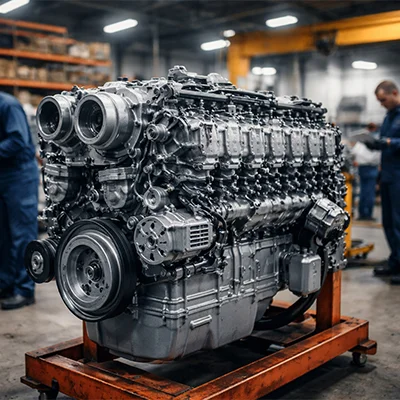
Through automotive engine rebuilding services and structured commercial engine remanufacturing, engines can be brought back to a usable state—often close to original performance levels. That changes the economics completely.
The engine does not necessarily have to be a one-time use, but rather a reusable asset.
This Trend is Silently Being lead by Fleet Operators
To find the point of this change, you just have to look at fleet operators.
They don’t always talk about it publicly, but internally, the focus is very clear: reduce cost without affecting uptime.
That’s where fleet maintenance cost reduction becomes a daily concern, not just a strategic goal.
The distinction between new and remanufactured is not merely theoretical when a fleet manager has to manage several engine replacements during a year, the difference is reflected in the budgets.
However, it is not just cost, there is another factor; time.
A new engine may take more time than anticipated, particularly amid the disruptions in the supply chains.
Remanufactured engines are also usually ready sooner and this implies that vehicles are returned to the roads at a faster rate.
This combination of low cost and shorter turn-around time slowly begins to affect purchasing decisions more than anticipated.
Reliability: The Concern That Doesn’t Count the Same Anymore
At one point remanufactured engines had issues with their reputation.
They were linked with patchwork repairs or uneven quality by people. That perception was not necessarily a complete misjudgment in other instances- there were different standards and the consequences were not always certain.
However the industry has changed.
Modern-day OEM-quality remanufactured engines are manufactured using well-organised processes. Engines are broken to bits, parts are checked separately and worn-out parts are changed. Critical tolerances are restored using precision tools.
It is not a repair project--it is a regulated reconstruction.
The reliability gap between new and remanufactured is now much smaller to many B2B buyers particularly those operating with known suppliers.
That’s why the conversation around remanufactured vs new engines for commercial vehicles is less about “risk” and more about “fit.”
Heavy-Duty Applications Are Not Holding Back
People tend to believe that remanufactured engines are better used in light or medium use.
However, that is not the case anymore.
Remanufactured units are increasingly being used in industries that are heavy engine rebuilding such as construction, mining, and agriculture. These are settings in which engines are put under pressure, long working hours, and in many cases, in tough conditions.
If remanufactured engines couldn’t handle that, adoption wouldn’t grow.
The fact that it is growing says something.
In many cases, industrial remanufactured engines are rebuilt with updated components or improved tolerances, making them better suited for current operating demands than older original builds.
Supply Chain Reality Is Playing a Role
Another factor that doesn’t get enough attention is supply chain pressure.
In the recent years, companies have been faced with delays in sourcing all their materials including raw materials, finished equipment etc. Engines are not an exception.
Waiting weeks—or longer—for a new engine is not always feasible.
This is where remanufacturing offers a practical advantage. Since it works with existing engine cores and localized facilities, availability is often better.
For a business trying to maintain continuity, that matters more than theoretical comparisons.
The Sustainability Angle Is Starting to Take Shape
All companies do not begin with sustainability. But once they begin using remanufactured engines, the environmental aspect becomes difficult to overlook.
The idea of a circular economy in automotive is simple: reuse what can be reused instead of constantly producing new.
Remanufacturing fits directly into that.
Instead of discarding an engine and building another from scratch, core components are recovered and reused. This reduces material consumption and waste.
For companies under pressure to meet ESG targets—or simply trying to operate more responsibly—this becomes an added advantage.
Interestingly, for some businesses, sustainability starts as a side benefit but eventually becomes a key reason to continue with remanufacturing.
But Why Are B2B Buyers Choosing It?
When you combine all this, then the choice is not so much about one thing as it is a matter of general compatibility.
The benefits of remanufactured engines for fleet operators and industrial users come from a mix of things:
- Lower upfront investment
- Better control over maintenance costs
- Faster replacement cycles
- Comparable performance in most use cases
- Alignment with sustainability goals
And, most importantly, less surprises after the system is implemented.
The latter is more important than some might think.
Not a Replacement for Everything—but a Strong Alternative
It’s worth saying this clearly—remanufactured engines are not going to replace new engines in every situation.
For brand-new equipment or highly specialized applications, new engines will still be the preferred choice.
But for replacements, especially in existing systems, the balance is shifting.
The conversation is no longer “Can we trust remanufactured engines?”
It’s becoming “Does it make sense to keep buying new every time?”
Where This Is Headed
In the future, the remanufactured engines will be required to increase consistently.
It is not due to one trend, but rather the combination of several pressures that include cost, availability, sustainability and operational efficiency all are pulling towards the same direction.
In the case of B2B buyers, such alignment is difficult to overlook.
And in many cases, once companies make the switch, they don’t go back.
 Media Pack Download
 Newsletters
 Industrial Events