Next-Generation In-Car Displays: The Role of AI in Enhancing Data-Driven User Experiences
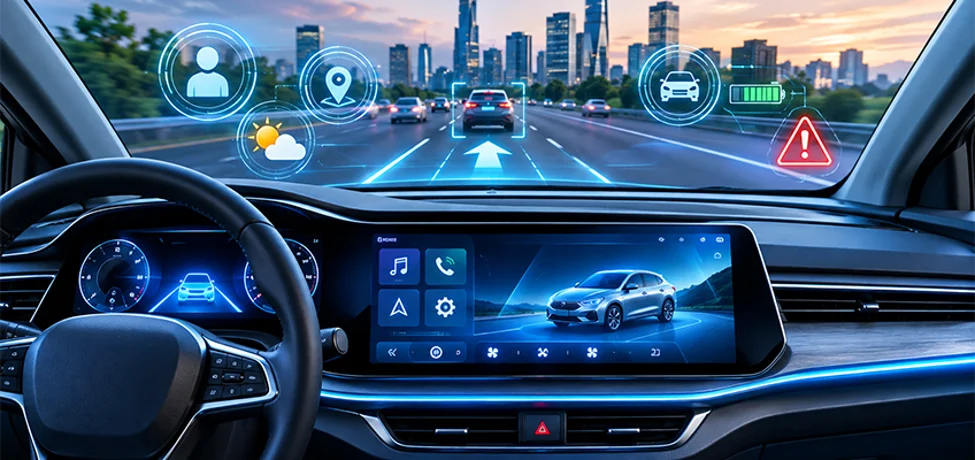
The automotive dashboard has changed dramatically over the past decade. What was once a simple arrangement of dials and gauges has become a digital interface that responds to touch, voice, and context. Drivers now use screens to navigate, control climate settings, manage media, and monitor vehicle performance, often without pressing a single physical button.
Artificial intelligence is playing a growing role in this shift. By analyzing data from the vehicle, the road, and the driver, AI helps displays become smarter, more adaptive, and more responsive to individual needs. Next-generation automotive displays are no longer defined only by size or resolution, but by how intelligently they present information.
This article explores how that transformation is taking shape, the technologies behind it, and where intelligent in-car displays are heading next.
What are AI-Powered Automotive Displays?
AI-powered automotive displays are in-car screens that use machine learning to interpret data from the vehicle, the road, and the driver, then adjust what they show and how they show it in real time.
A traditional display shows what it is told to show. An AI-driven one decides what matters right now. It might surface a navigation prompt before a complicated junction, dim the brightness as you enter a tunnel, or quietly hide a notification because it senses you are in dense traffic.
The difference is the same as that between a printed map and a passenger who knows the route and warns you about the roadworks ahead. Both give you information, but only one understands context.
How AI Applications in Automotive Displays Actually Work
The phrase “AI applications in automotive displays” can sound abstract, so let’s make it concrete. Most of the useful work falls into four areas.
Personalization. The system learns your habits. If you call the same person every evening on the drive home, that contact floats to the top. If you always set the cabin to a certain temperature on cold mornings, the display remembers. Multiple drivers can have their own layouts, and the car recognizes who is behind the wheel.
Prediction. By combining navigation data, traffic conditions, battery state, and your past behavior, the display can anticipate what you will need next. An electric vehicle might suggest a charging stop at exactly the moment your range starts to feel uncomfortable, not ten minutes after.
Natural interaction. Voice commands have moved far beyond rigid phrases. Modern systems understand conversational requests like “I’m freezing” and respond by raising the temperature. Some also combine voice with gesture or eye tracking, so the screen reacts to where you are looking.
Driver awareness. Cameras and sensors can detect signs of drowsiness or distraction. The display responds with a gentle alert, a suggested break, or a simplified interface that asks less of your attention. This is where AI-based in-car user experience becomes a safety feature, not just a convenience.
Why Data Is the Real Engine Behind the Screen
Every smart display runs on data. That is what makes the experience feel personal instead of generic.
A data-driven automotive user experience draws from many sources at once: vehicle sensors, GPS, weather feeds, traffic services, driver preferences, and even the health of the car’s own components. The screen turns that flood of raw information into something a human can understand in a glance.
This is where real-time data visualization in automotive displays matters most. Numbers on their own are useless at 100 km/h. A well-designed display translates them into shapes, colors, and motion that your brain processes almost instantly. A shrinking ring shows battery range. A soft glow warns of a vehicle in your blind spot. An augmented reality arrow appears to float over the actual road, pointing to your exit.
The goal is never to show more data. It is to show the right data, at the right moment, in the right amount. Good design here is mostly about restraint.
The Rise of the Intelligent Cockpit
Displays no longer work alone. They are part of what engineers call intelligent automotive cockpit technology, a connected environment where the screens, audio, lighting, seats, sensors, and software all coordinate.
In practice, it feels like the whole interior is paying attention. When you get in, the cluster, the center screen, and the passenger display wake up with your settings. When you start a navigation route, the ambient lighting might subtly shift to signal an upcoming turn. When a child in the back seat is watching a video, the front screens adjust so the driver is not distracted.
At the center of this is AI-driven automotive HMI, the human-machine interface. HMI is simply the point where you and the car meet. For years that meant buttons and knobs. Now it means a layered mix of touch, voice, gesture, and gaze, all coordinated by software that learns what works best for you.
The best HMI feels almost invisible. You do not think about how to ask the car for something. You just ask, and it understands.
Smart Automotive Display Systems: What Is Changing on the Surface
The hardware itself is evolving quickly, and it shapes what AI can do.
Pillar-to-pillar screens now stretch across the whole dashboard. Curved and free-form panels follow the contours of the cabin instead of sitting in a rectangular box. Head-up displays project information onto the windshield so your eyes stay on the road. Some concepts even turn side windows or panoramic roofs into transparent information surfaces.
These smart automotive display systems are also getting better at the basics. Higher brightness keeps screens readable in direct sunlight. Anti-glare coatings cut reflections. Adaptive refresh rates save power. Haptic feedback gives your fingertip a small physical response, so you can confirm a tap without looking down.
All of this raises a fair question for designers. With so much capability available, what should the screen actually do? The answer, increasingly, is whatever the AI judges is useful at that moment, and nothing more.
Behind the Glass: Automotive Display Manufacturing
It is easy to focus on the software and forget that every display is a physical object that has to survive years of heat, cold, vibration, and sunlight.
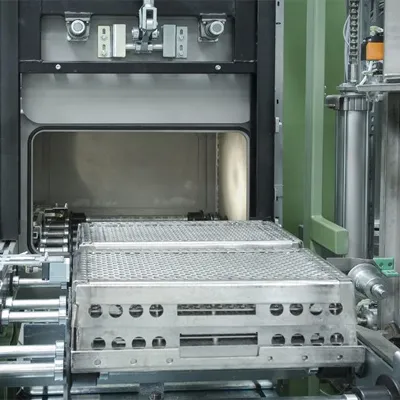
Automotive display manufacturing is far more demanding than making a screen for a phone or a TV. A car interior can swing from freezing winter mornings to sun-baked summer afternoons where a dashboard surface becomes extremely hot. The display must keep working, stay clear, and not warp, for ten years or more.
Manufacturers also have to deal with larger and more complex shapes. A curved, pillar-to-pillar assembly involves precise bonding of multiple layers, tight tolerances, and rigorous testing. Safety matters too. Components must behave predictably in a crash and meet strict standards for materials and emissions inside the cabin.
This is why so much attention goes to the materials around the screen itself.
Why Engineering Plastics Matter More Than You Think
Engineering plastics for automotive displays play a quiet but essential role. They form the housings, bezels, frames, light guides, cover lenses, and structural supports that hold everything together.
Compared with traditional materials, high-performance plastics offer a rare mix of strengths. They are light, which helps reduce vehicle weight and, for electric cars, extend range. They can be molded into complex, curved shapes that metal or glass struggle to match. They resist heat, chemicals, and impact. And they can be engineered with specific finishes, from a deep piano-black gloss to a soft matte texture that cuts glare.
Certain grades also offer excellent optical clarity, dimensional stability, and low moisture absorption, all of which matter when a display has to stay perfectly aligned through years of temperature swings. Others are formulated for flame retardancy or to avoid interfering with the sensors and antennas packed behind the dashboard.
In short, the screen gets the attention, but the right plastic keeps it looking and working like new. As displays grow larger, curvier, and more integrated, material science becomes just as important to the experience as the algorithms.
The Challenges Nobody Should Ignore
It would be dishonest to paint only the bright side. A few real challenges deserve attention.
Distraction. A more capable screen is also a more tempting one. Designers must balance richness with safety, and regulators are paying close attention to how much interaction is acceptable while driving.
Privacy. Personalization requires data, and data raises questions. Drivers deserve to know what is collected, where it goes, and how to switch it off. Trust is part of the user experience.
Reliability. Software bugs that are annoying on a phone can be serious in a car. Systems need to fail gracefully and keep essential information visible no matter what.
Cost and complexity. Advanced displays, sensors, and processing power add expense. Bringing intelligent features to mainstream vehicles, not just luxury models, will take smart engineering and scale.
The Future of Intelligent In-Car Displays
So where does this go next? A few directions look likely.
Augmented reality will become more common, blending navigation and hazard warnings directly into your view of the road. Displays will grow more context-aware, reacting not just to the driver but to every passenger. Generative AI will make conversations with the car feel natural, letting you ask complex, open-ended questions and get helpful answers.
As vehicles become more autonomous, the cabin itself will change. When the car handles the driving, the display shifts from a tool for the driver into an entertainment, productivity, and wellness space. Over-the-air updates will keep improving the experience long after the car leaves the showroom.
The future of intelligent in-car displays is not about screens that shout for attention. It is about screens that understand when to speak and when to stay quiet.
Frequently Asked Questions
What is the role of AI in automotive displays?
AI helps displays interpret vehicle, road, and driver data so they can personalize layouts, predict needs, support voice and gesture control, and monitor driver attention for safety.
How does AI improve the in-car user experience?
It reduces effort. By learning your habits and reading the situation, the system shows relevant information at the right time and handles routine tasks so you can focus on driving.
What materials are used in automotive displays?
Besides the display panel itself, manufacturers use engineering plastics for housings, bezels, light guides, and cover components because they are lightweight, moldable, durable, and heat resistant.
Are AI-powered displays safe?
They can improve safety through driver monitoring, simplified interfaces, and timely alerts, provided they are designed to minimize distraction and fail gracefully.
What is an intelligent cockpit?
It is an interior where displays, audio, lighting, sensors, and software work together, using AI to create a coordinated, personalized environment.
Final Thoughts
The car dashboard has come a long way from a speedometer and a fuel gauge. Today it is a living interface that learns, adapts, and communicates. AI gives it intelligence, data gives it context, thoughtful HMI design gives it manners, and advanced materials and manufacturing give it the durability to last.
The best next-generation displays will not be the flashiest ones. They will be the ones that quietly make every drive a little easier, safer, and more personal.
 Media Pack Download
 Newsletters
 Industrial Events