Sustainable Materials in Automotive Manufacturing: From Concept to Commercial Adoption
Quick answer: what are sustainable materials in automotive manufacturing?
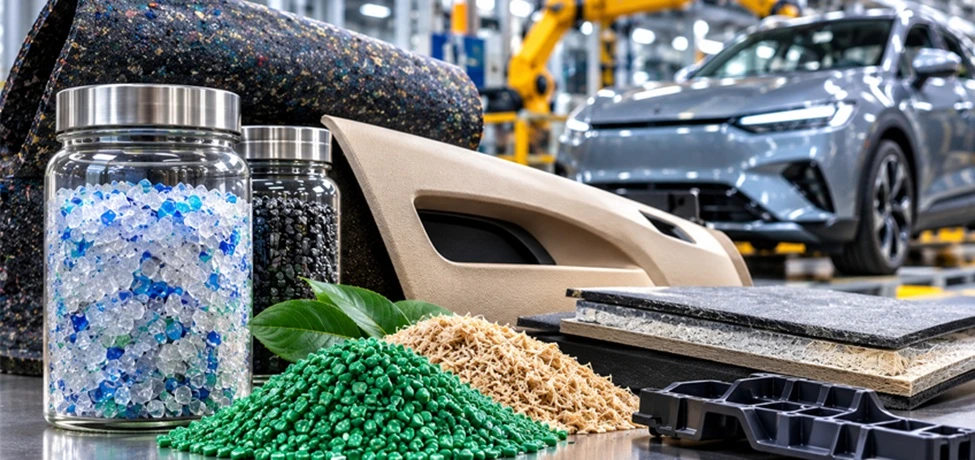
Sustainable materials in automotive manufacturing are materials that cut a vehicle's environmental footprint across its life: recycled plastics, bio-based polymers, natural fibres, recycled metals and low-carbon alternatives. They matter because a car's footprint is not just tailpipe emissions. Material extraction, processing and end-of-life disposal add up to a large share. Today the most commercially advanced options are recycled plastics (interior trim, underbody shields, wheel-arch liners) and bio-based plastics (seat fabrics, soft-touch surfaces, some under-the-hood parts).
Key takeaways
- Recycled plastics are already in production cars; bio-based polymers are following, mostly in interiors first.
- Cost, consistency and certification, not technology, are the biggest barriers to adoption.
- Regulation (especially in Europe) and OEM net-zero targets are pushing demand faster than supply can respond.
- A circular economy in automotive plastics depends on design for disassembly, better sorting and closed-loop partnerships.
- Suppliers that can prove traceability and stable quality will win the next wave of contracts.
Why are carmakers switching to sustainable materials now?
For years, "green materials" meant a showcase concept car with pineapple-leaf upholstery and a press release. Nice to look at, but nobody ordered it at volume.
That has changed, and three forces are the reason.
Regulation. In Europe, end-of-life vehicle rules are being tightened, with proposals that include minimum recycled plastic content in new vehicles. Other regions are watching and building their own versions. Even where rules are not final, OEMs plan as if they will be.
Corporate targets. Most large automakers have published net-zero or carbon-reduction commitments that include supply-chain (Scope 3) emissions. Materials are a big chunk of that. You cannot hit those targets by electrifying the powertrain alone.
Buyers. Customers, especially fleet and corporate buyers, increasingly ask what a vehicle is made of. A credible sustainability story is becoming part of the sales pitch.
Which sustainable materials are used in cars today?
Here is a plain-language snapshot of the main categories:
|
Material type |
Typical automotive use |
Maturity |
|
Recycled polypropylene (PP) |
Wheel-arch liners, underbody shields, battery housings, trim |
Commercial |
|
Recycled PET |
Seat fabrics, carpets, acoustic insulation |
Commercial |
|
Recycled nylon (PA) |
Engine covers, air-intake parts, fabric |
Early commercial |
|
Bio-based polyamides and polyurethanes |
Foams, connectors, cable ties, soft-touch |
Early commercial |
|
Natural fibre composites (flax, hemp, kenaf) |
Door panels, parcel shelves |
Commercial in niche |
|
Bio-PET, bio-PP, PLA blends |
Interior trim, textiles |
Emerging |
The pattern is clear. Non-structural, non-safety-critical parts go first. Structural and under-the-bonnet components follow slowly because the qualification bar is much higher.
Recycled plastics in automotive manufacturing: how do they work in practice?
Automotive recycled plastic materials usually come from two streams: post-industrial scrap (offcuts from factories) and post-consumer waste (bottles, packaging, old appliances, and increasingly end-of-life vehicles).
Post-industrial material is cleaner and easier to control. Post-consumer material is more abundant, but it is messier: mixed polymers, contamination, colour variation and odour. Much of the technical work in this field is about taming that mess through better sorting, washing, compounding and additive packages.
The result is usually a blend, for example a compound with 20 to 50 percent recycled content, engineered to hit the same mechanical targets as virgin resin. Think of it less as swapping one ingredient and more as re-writing the recipe.
Bio-based plastics in automotive applications: hype or real?
A bit of both, honestly.
Bio-based plastics in automotive applications are made fully or partly from renewable feedstocks such as castor oil, sugar cane, corn or cellulose. Some are chemically identical to their fossil-based twins (so-called drop-in polymers), which makes qualification much smoother. Others are new chemistries that need fresh testing.
The real value is the lower carbon footprint of the feedstock. The honest caveat is that "bio-based" does not automatically mean "biodegradable" or "better in every way." A car part must survive heat, UV, vibration and a decade of use, so durability comes first and the label comes second. Land use and feedstock competition with food crops are also fair questions, which is why waste-based and second-generation feedstocks are getting attention.
What is the circular economy in automotive plastics?
The circular economy in automotive plastics means keeping plastic in use for as long as possible and feeding it back into new parts instead of landfill or incineration.
In a car, that takes four practical steps:
1. Design for disassembly. Fewer mixed materials, standard fasteners, clear polymer labelling.
2. Collection and dismantling. Recovering plastic parts from end-of-life vehicles before shredding.
3. Sorting and reprocessing. Producing consistent recycled granules that meet automotive specs.
4. Re-entry. Qualifying the recycled material for new parts, ideally of similar value (closed loop).
Most of the industry is still stuck at step two. Cars are shredded, and the plastic fraction that comes out is low-grade. Fixing this bottleneck is arguably the single biggest unlock for circularity.
What are the challenges of sustainable materials adoption?
The challenges of sustainable materials adoption are rarely about whether the idea works. They are about whether it works every time, at volume, at an acceptable price.
- Consistency. Recycled batches vary. A production line needs the thousandth part to match the first.
- Qualification time. Automotive validation can take years: crash, fatigue, heat ageing, fogging, odour, emissions. Every new material restarts the clock.
- Supply security. Automakers need guaranteed volumes across global plants. Recycled feedstock supply is fragmented and uneven.
- Regulatory and safety constraints. Certain parts face strict flammability, chemical and safety requirements.
- Data and traceability. Claims of recycled content need proof, usually through certification and mass-balance or chain-of-custody systems.
- Aesthetics. Customers will not accept visible streaks or odd smells in a premium interior.
What is the cost of recycled plastics in automotive manufacturing?
This is the question procurement teams ask first, so here is the honest answer: it depends, and it moves.
The cost of recycled plastics in automotive manufacturing is shaped by a few things:
- Grade and quality. Automotive-grade recycled resin needs extra cleaning, compounding and testing, which can erase the saving over virgin material.
- Virgin resin prices. When oil and virgin polymer prices climb, recycled material looks more attractive. When they drop, the gap narrows or reverses.
- Supply and demand. High-quality recycled feedstock is limited, and as more industries chase it, prices firm up.
- Volume and contracts. Long-term supply agreements reduce volatility and often improve pricing.
- Hidden costs. Extra testing, tooling tweaks and higher scrap rates in early production can add up.
A useful way to think about it is total cost of ownership, not price per kilo. Include avoided regulatory risk, carbon accounting benefits and the marketing value of a verified recycled-content claim. On that basis, the business case is stronger than the raw resin price suggests, especially for parts where recycled grades already perform well, such as underbody components and liners.
How do you source sustainable materials for automotive use?
Sustainable material sourcing for automotive works best when it is treated as a partnership, not a purchase order. A practical approach:
1. Start with the part, not the material. Pick components with moderate performance demands and high volume, such as liners, covers and carpets.
2. Demand traceability. Ask for certifications, recycled-content verification and clear feedstock origin.
3. Dual-source where possible. Protect against supply shocks without compromising the spec.
4. Co-develop with suppliers. Share performance targets early so compounders can tune formulations.
5. Plan for the end of life. Choose polymers and designs that can be recycled again, not just recycled once.
How do you scale sustainable materials in manufacturing?
Scaling sustainable materials in manufacturing is where most pilot projects stall. A few patterns separate programmes that scale from those that fizzle:
- Pilot on one platform, then replicate. Prove the material on a single model, document everything, then standardize the specification across platforms.
- Build a shared material library. Pre-approved sustainable grades shorten future validation.
- Invest in the recycling side. OEMs that partner with recyclers and dismantlers secure better feedstock and tighter quality.
- Use digital tracking. Material passports and batch-level data make audits and claims far easier.
- Align engineering, procurement and sustainability teams. Many projects fail because each group optimizes for a different goal.
Sustainable polymers for automotive components: what is coming next?
Three developments are worth watching.
Chemical recycling can break plastics down to building blocks and rebuild them to near-virgin quality, which may open the door to higher-spec parts. It is energy-intensive and still scaling, so its real footprint benefit needs careful scrutiny.
Mono-material design reduces the number of different polymers in an interior, making recycling far simpler.
Smarter compounds blend recycled and bio-based content with fillers and additives to reach performance targets that earlier generations could not.
Frequently asked questions
What are the most common sustainable materials used in cars?
Recycled polypropylene and PET, natural fibre composites, bio-based foams and recycled metals such as aluminium and steel are the most widely used.
Are recycled plastics safe for car parts?
Yes, when they are qualified to the same standards as virgin materials. Automotive-grade recycled compounds go through mechanical, thermal, emissions and odour testing before approval.
Are bio-based plastics the same as biodegradable plastics?
No. Bio-based means made from renewable sources. Biodegradable means it can break down biologically. A car part is usually designed to last, so most bio-based automotive plastics are not biodegradable.
Are recycled plastics cheaper than virgin plastics?
Not always. Basic recycled grades can be cheaper, but automotive-grade material often costs the same or more once cleaning, compounding and testing are included.
What is the biggest barrier to adopting sustainable materials?
Consistent quality and secure supply at scale, followed by long validation timelines and cost.
How does the circular economy apply to automotive plastics?
It keeps plastic in use by designing cars for easier disassembly, recovering parts at end of life and reprocessing them into new vehicle components.
The bottom line
Sustainable materials have moved from concept cars to production lines, but the journey from idea to commercial adoption is still a slog of testing, sourcing and cost negotiation. The winners will be the manufacturers and suppliers who treat sustainability as an engineering and supply-chain discipline, not a marketing line: start with the right parts, secure traceable feedstock, design for the next life of every component and build partnerships that last longer than one model cycle.
If you work in this space, the practical next step is simple. Audit your current vehicle platform, pick three high-volume plastic parts and ask your suppliers what recycled or bio-based options they can qualify this year.
 Media Pack Download
 Newsletters
 Industrial Events