

Sustainable Alternatives Driving Eco-Friendly Auto Manufacturing
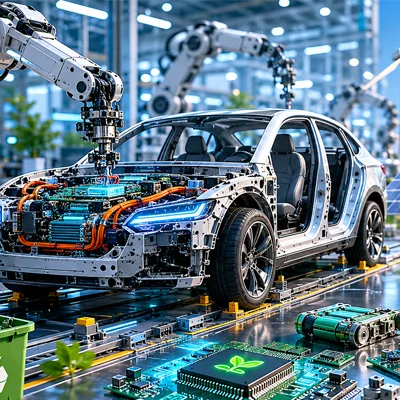
Visit an auto factory today and you'll see a significant difference from the past production lines. Modern cars are not just constructed of mechanical parts. From safety equipment to panel displays, battery performance to navigation, it's nearly every aspect of a car that is affected by electronics.
The change has brought fresh challenges for the automotive sector, but also new environmental issues. To manufacture advanced electronics, energy, water, metals, chemicals, and complex manufacturing processes are needed. A car has become more and more connected, software-driven and, as a result, under pressure from car manufacturers to give more thought to sustainability.
That's why, in the industry, talks regarding Automotive Electronic Components are gaining momentum. Today, car makers are not just seeking to enhance car performance. They are also working to minimize waste, factory emissions, and the ease of the recycling of electronic systems.
The concept of Eco-Friendly Auto Manufacturing doesn't stop at making electric vehicles. Contains cleaner supply chains, environmentally-friendly factories, responsible electronics throughout the life cycle, and power-saving electronics.
This is not a one-off event. Most companies are taking incremental changes and improvements that are realistic and feasible given the production cost, customer needs and government policies.
Increasing use of electronics in vehicles
Mechanical systems were more important in older cars. Modern vehicles operate very differently. Today it would be nothing unusual for a mid-range vehicle to have dozens of sensors, processors and electronic control units.
Features like:
- Reverse parking cameras
- Touchscreen infotainment systems
- Battery monitoring
- Driver assistance features
- Smart lighting systems
all rely on electronics.
Digital systems are even more critical to EVs. If it wasn't for electronic controls, the battery management and charging system would not work.
The more dependent the manufacturers get, the more they are looking to Sustainable Automotive Electronics that can help maintain vehicle performance without adding an unwanted environmental burden.
Previously, electronics designs had focused primarily on functionality and cost. Now, companies are also considering energy usage, durability, and recyclability.
That change is slowly influencing how components are designed and manufactured.
Sustainability Goes to the Factory Floor
The question of car sustainability was for the most part only an issue of tail pipe emissions for many years. With the advent of the day, companies are now looking at the entire manufacturing process.
This includes:
- Factory electricity usage
- Water consumption
- Transportation emissions
- Production waste
- Material sourcing practices
Semiconductor production and component building uses a lot of resources, so now that's part of the discussion, too, as far as electronics manufacturing is concerned.
Suppliers are investing in Green Automotive Component Technologies capable of improving efficiency and cutting waste and emissions to reduce environmental impact.
Some factories are starting to install renewable energy systems. Others are upgrading older machines to energy efficient equipment. In certain cases, businesses are making modifications to the manufacturing line in order to lessen the amount of materials wasted in the manufacturing process.
Not radical per se, but a series of elements that are aiding in reducing the footprint of large-scale production.
Automotive electronics increasingly are becoming energy-efficient
Today, the influence of electronics on energy efficiency in vehicles is evident. This is even more critical in electric vehicles, as battery range is critically dependent on power management.
This is driving continued growth in the market for Energy-Efficient Automotive Electronics.
There are a number of systems in modern cars that have been engineered specifically to save energy where it is not required, such as:
- LED lighting
- Smart battery management systems
- Efficient charging systems
- Low-power processors
- Intelligent climate controls
In electric vehicles, reducing power loss from electronics can help extend driving range.
Software also plays an important role here. In some vehicles, energy use can be automatically controlled, based on driving conditions, battery conditions, or traffic.
These systems are often operating in the background for many drivers, but over time, these systems help to improve efficiency.
Semiconductor manufacturing is in more trouble
Semiconductors are used extensively in modern vehicles. Chips regulate the vehicle's safety systems, displays, charging, navigation and connectivity.
But, semiconductor manufacturing consumes a lot of resources. A significant amount of electricity, water and chemicals is needed in manufacturing plants.
As the demand for chips in the automotive industry has increased, automotive manufacturers are becoming more attentive to Sustainable Semiconductor Manufacturing.
Several semiconductor companies are now introducing cleaner production methods such as:
- Renewable energy-powered facilities
- Water recycling systems
- Reduced chemical waste operations
- Energy-efficient manufacturing equipment
It is not only chipmakers who are attempting this; companies are also developing processors that require less power to perform more computing functions.
The significance of this is that the number of semiconductors in an EV is much higher than that in older vehicle models. Advanced safety systems and connected driving features are increasing chip demand even further.
Without cleaner production methods, rising semiconductor demand could create additional environmental strain.
The recycling of automotive electronics items is gaining the spotlight
Electronic waste is a growing problem in many industries, including the automotive industry.
As more of this electronic equipment is being embedded in modern vehicles, it is not always a simple task to recycle.
This has increased interest in Recyclable automotive electronics.
Some manufacturers are restructuring parts to be more easily disassembled at the end of a vehicle's life. Others are reducing the use of hazardous materials inside electronic systems.
Current efforts include:
- Recyclable circuit board materials
- Reusable metal parts
- Simplified electronic structures
- Modular component designs
Some companies are operating refurbishment programmes in which components of electronic equipment can be repaired and reused, instead of scrapped.
The recycling of automotive electronics is a task, but progress is being made in the industry.
Low-Carbon Vehicle Parts are backing to cleaner manufacturing
These days, auto makers are attempting to cut down on emissions associated with their manufacturing process, not just while they're on the road.
This has increased interest in Low-carbon vehicle components.
Suppliers are approaching this in different ways. Some are switching factories to renewable electricity. Some are working to enhance logistics systems, with a view to cutting emissions from transport.
Electronics manufacturers are also also helping, with design of smaller, lighter, less material-intensive systems.
Light-weight components lead to better fuel efficiency and battery efficiency, as the use of less energy by the lighter vehicles.
Many factories are also introducing monitoring systems that help identify unnecessary energy consumption during production.
EV Electronic Control Systems Are Critical for Electric Vehicles
Electric vehicles rely heavily on advanced digital systems for daily operation.
Modern EV electronic control systems manage functions such as:
- Battery monitoring
- Charging operations
- Thermal management
- Motor control
- Power distribution
These systems provide real-time monitoring of the vehicle performance and adapt the operations as needed.
Thermal management systems, for instance, keep batteries within safe temperature ranges and battery management software lessens power loss.
With global EV growth, reliable control systems will play an even more critical role.
The growth of smart automotive electronics is rapidly increasing
Each year, vehicles are getting more connected. Real-time data can now be used in many systems to boost efficiency and enhance the performance of the vehicles.
This has increased demand for Smart automotive electronics.
Smart systems support sustainability in practical ways. Navigation software can help drivers avoid traffic congestion, reducing unnecessary fuel or battery consumption. Predictive maintenance tools can identify problems before larger failures occur.
Additional benefits include:
- Reduced idle time
- Better traffic management
- Remote software updates
- Improved energy monitoring
But factories are getting smarter, too. Sensors and automation systems can help manufacturers minimize down time, increase efficiency and decrease production waste.
Many of these improvements are incremental and can save money when used on a large production level.
In the context of EV production, the role of sustainable automotive electronics will be highlighted
The role of sustainable automotive electronics in EV manufacturing is becoming more important as electric vehicle production continues growing.
The electronics industry plays a vital role in almost all critical systems of EVs, such as charging, battery management, safety systems, and connectivity.
Sustainable electronics assists manufacturers to:
- Improve energy efficiency
- Reduce power loss
- Extend component lifespan
- Support recycling efforts
- Lower manufacturing emissions
Auto manufacturers also are watching more closely at what suppliers do for sustainability. Cleaner production manufacturers of electronics are becoming more powerful players in automotive supply chains.
Conclusion
The automotive industry is evolving much more than just vehicles. Sustainability is now impacting a variety of factory operations, manufacturing of electronic systems and recycling of materials.
The growing role of Automotive Electronic Components has made electronics part of the industry’s larger environmental strategy. Energy-Efficient Automotive Electronics, Recyclable automotive electronics and cleaner semiconductor production and smarter EV systems are small steps towards more responsible production methods, as manufacturers make gradual progress.
Eco-Friendly Auto Manufacturing is in the process of changing the future of the auto industry, and the process will likely take some time.
 Media Pack Download
 Newsletters
 Industrial Events