


How Much Air Does a Busy Auto Shop Really Need?
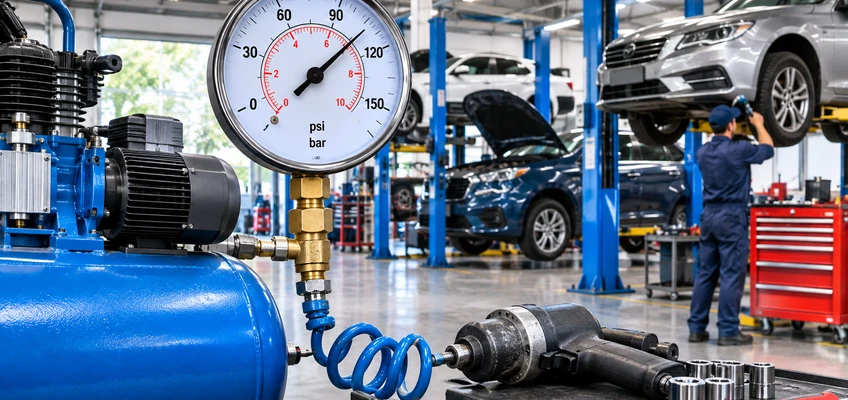
Choosing an air compressor for an auto shop starts with the work happening on the floor. It’s important to consider how much air the shop uses, how often its tools run and whether demand is likely to grow when choosing the right industrial air compressor for car repairs.
What Determines an Auto Shop’s Air Demand?
Every shop has different compressed air needs. A small repair shop may use air-powered tools for short periods, but when it’s busy, it may need to use impact wrenches, sanders and other equipment simultaneously. Each tool contributes to the shop’s total air demand.
Two measurements help determine the right compressor for an auto shop. These include cubic feet per minute (CFM), which measures how much air an air compressor delivers and pounds per square inch (PSI) to calculate air pressure. Tools can only work properly when both requirements are met.
Air demand also depends on the type of work the shop handles. The more tools a shop uses and the more often they run, the more air it needs. That’s why the number of service bays alone cannot determine the right compressor size. The equipment in use and its operating patterns provide a better starting point.
How Much CFM Do You Need for An Automotive Repair Facility?
A facility can estimate its air needs by checking its tools, working conditions and expected growth. The first step is to calculate the combined demand. Each tool’s air consumption is listed in the manufacturer’s specifications. Adding the CFM requirements for tools that are likely to run simultaneously gives the shop a practical estimate.
A spray gun may require 8 CFM, while a high-demand tool like a sandblaster requires 20 CFM. Requirements vary depending on the tool, brand and usage frequency. A facility might need anywhere from 50 CFM to 200 CFM, depending on whether it is a smaller auto shop or a larger body shop with many bays.
Load matters, too. Paint spray guns run continuously, while tile service requires an intermittent tool load. A four-bay shop with tire machines and paint spray guns might need around 60 CFM with headroom. If demand fluctuates between shifts, owners should base their decision on a measured demand profile from a compressed air audit, not an estimate.
Once the CFM requirements are added, shops must account for pressure losses. Air loses pressure as it moves through pipes, filters, dryers and regulators. The compressor must supply sufficient air at a high enough pressure to meet the equipment's needs at the point of use. Then, the facility needs to plan for changes in demand.
Which Compressor Configuration Is Best for the Workload?
The main compressor types auto shops use are as follows:
- Reciprocating or piston compressors: May be enough for smaller shops that use air tools now and then.
- Rotary screw compressors: Deliver a continuous air supply to help shops that use several air tools at once.
- Centralized compressed air systems: Larger repair shops and automotive plants may need a system that supplies compressed air to multiple workstations simultaneously.
When deciding which size air compressor to buy for automotive tools, facilities should focus on the airflow the compressor can deliver at the required pressure. Horsepower and tank size alone don’t show whether a system can meet demand.
Top 3 Air Compressor Providers for Automotive Facilities
The following providers offer compressor equipment for automotive service or industrial applications.
1. Chicago Pneumatic
Chicago Pneumatic offers automotive facilities a range of compressors backed by technical support and original replacement parts. Its CPVS 40-50 PM D models feature an IE4 permanent magnet motor, a touch-screen controller and a compact design. The range was also a finalist for Plant Engineering’s 2023 Product of the Year.
Since Chicago Pneumatic participates in the Compressed Air and Gas Institute’s Performance Verification Program, the performance data of its selected compressor models is independently verified.
Key Features
- The CPVS 40-50 PM D range provides energy savings of up to 45%.
- The ES4000T controller features operating controls and monitoring features.
- Professional Series piston compressors have maintenance packages and access to original replacement parts.
2. Ingersoll Rand
Ingersoll Rand serves both automotive repair shops and vehicle manufacturing facilities. Its two-stage electric reciprocating compressors include models designed for automotive service and body shops, with selected units rated for 100% continuous duty.
For automotive manufacturing, the company also supplies oil-flooded compressor systems and services that assess air leaks, system performance and energy use. Its PackageCARE and PlannedCARE programs support planned maintenance and compressor management.
Key Features
- Selected two-stage electric models provide up to 175 psig operating pressure and are rated for continuous duty.
- Oil-flooded compressor systems for automotive manufacturing and electric vehicle production are available.
- System assessments and planned maintenance services.
3. Brabazon
Family-owned Brabazon has seven branches and has served select states in the Midwest for around half a century. Its factory-trained technicians respond to emergency repair requests in under two hours on average, and arrive in vans stocked with OEM-grade parts.
For most shops, it recommends the Sullair enclosed rotary screw in the 10-15 HP class, which has an integrated refrigerated dryer, a filter train in the spray wall and a receiver at the booth. These features ensure it runs quietly enough for customer-facing shops and won’t need cooldown downtime during busy periods.
Key Features
- The company has been an authorized Sullair dealer since 1984, making it among the most experienced Sullair partners in the Midwest.
- Real people, not robots, staff the 24/7 emergency air compressor repair hotline.
- Each technician must complete in-house training and supplemental instruction annually.
Why Were These Air Compressor Providers Chosen?
Equipment variety and quality are not the only factors to consider when purchasing an air compressor. Strong customer service, expert technical support and post-sale service reliability are equally important.
Each of these providers meets several criteria, including product range, application experience and supporting compressed air equipment. They provide value-adding service offerings, such as preventive maintenance plans, installation and regular calibration.
Some provide emergency repair services, while others offer convenient support portals. Either way, shops receive expert-driven assistance, helping them minimize equipment downtime during busy periods.
Frequently Asked Questions
Here are commonly asked questions about air compressors for auto shops.
What size air compressor is best for automotive tools?
The compressor must supply enough CFM at the PSI required by the tools. The final choice depends on operating hours, pressure losses and air quality.
How much CFM does a typical auto repair shop need?
This depends on the tools in use and how many run simultaneously. A 50 CFM to 200 CFM may be enough for most shops. That said, it’s essential to check manufacturer specifications to establish a starting point.
Is a rotary screw compressor suitable for a busy auto shop?
A rotary screw compressor is a good choice for a shop that needs a steady supply of air throughout the day. They run quietly and are built for continuous, all-day operation without needing cooling downtime.
Keep the Air Flowing at the Right Capacity
The right air compressor must deliver enough air at the required pressure, support the shop’s daily workload and leave room for future needs. That means auto shops need to calculate airflow carefully to make sure tools operate properly and no energy is wasted.
 Media Pack Download
 Newsletters
 Industrial Events


Author Bio:

Megan Vitanza
Marketing Strategist
Megan Vitanza is a marketing strategist, loving mother, wife, bookworm and gamer. She spends her days researching and producing content for her manufacturing clients as Senior Digital Media Consultant at WebFX. In her off hours she enjoys baby snuggles and cozying up with a good book. In her off hours she enjoys baby snuggles and cozying up with a good book.

