Breaking Barriers to Sustainability: Strategies for Integrating New Materials Within Organizations
The Short Answer
Sustainable materials integration succeeds when companies treat it as an organizational challenge, not just an engineering one. The winning formula has six parts: start with a business case, pilot small, involve suppliers early, validate against real performance and cost data, build cross-functional ownership, and design for the circular economy from day one.
If you only have 30 seconds, that’s the article. If you have five minutes, keep reading. The details are where projects live or die.
Why Great Materials Still Die in the Lab
- Picture a familiar scene. An engineer finds a bio-based composite that cuts a door panel’s weight and carbon footprint. The lab results look great. Everyone nods in the meeting. Then nothing happens for 18 months.
- Procurement says the supplier is too small. Quality worries about batch consistency. Finance sees a higher unit price. Legal wants new compliance paperwork. The material isn’t the problem. The organization is.
- This is the quiet truth behind sustainable materials integration: the science is often ready before the company is. That’s good news, because organizational barriers are fixable.
What Is Sustainable Materials Integration?
Sustainable materials integration is the process of moving a lower-impact material, such as a recycled, bio-based, or low-carbon alternative, from the idea stage into regular production. It covers testing, supplier qualification, cost modeling, regulatory approval, and employee training, not just the material choice.
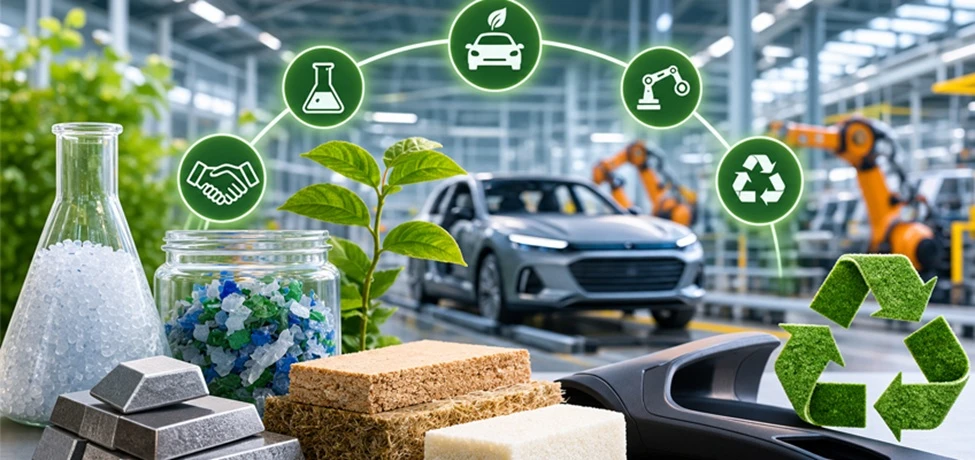
In the auto industry, this means everything from recycled plastics in interiors to bio-based foams in seating to low-carbon steel and aluminum in structural parts.
The Five Barriers That Actually Block Progress
Before fixing anything, name what’s in the way. In most organizations, it’s one or more of these:
1. Cost perception. New materials often carry a premium at low volumes, and teams compare that price to a mature material that has had decades to get cheaper.
2. Performance doubt. Engineers are trained to be cautious. “Will it survive heat, crash loads, and ten years of use?” is a fair question.
3. Supply uncertainty. A great material from a supplier who can’t scale is a risk, not a solution.
4. Siloed teams. R&D, sourcing, manufacturing, and sustainability often have different goals and different bosses.
5. Missing data. Without credible life-cycle numbers, sustainability claims turn into opinions, and opinions lose budget fights.
Six Strategies for Integrating New Materials
1. Build the business case before the technical case
Sustainability teams often lead with the planet. Finance leads with the P&L. You need both.
Frame the benefit in terms leadership already tracks: total cost of ownership, regulatory exposure, customer demand, brand value, and supply security. Recycled content, for example, can reduce dependence on volatile virgin material markets. Lightweight bio-based parts can support efficiency goals. Make the case in the language of the room.
2. Start with a pilot, not a revolution
Nobody approves a company-wide material switch on the strength of a slide deck. Pick one component, one platform, one plant. Choose something visible but low-risk, such as an interior trim part, an underbody shield, or a non-structural bracket.
A small win does three things. It generates real data, it builds internal confidence, and it gives skeptics something concrete to examine instead of something abstract to resist.
3. Bring suppliers in early
Sustainable supply chain management is where most integration efforts are won or lost. Treat suppliers as co-developers, not order-takers.
- Share your targets and timelines openly.
- Ask about their capacity, certifications, and traceability.
- Build dual sourcing into the plan so you aren’t betting on one source.
- Explore long-term agreements that let suppliers invest in scale.
When a supplier understands where demand is heading, they can plan capacity. When they’re surprised by it, they can’t.
4. Validate with real data
Credibility comes from testing and measurement. Run mechanical, thermal, durability, and aging tests. Pair them with a life-cycle assessment that follows recognized standards, so your claims survive scrutiny from customers, auditors, and regulators.
Be honest about trade-offs. A material that cuts carbon but shortens service life may not be a win. Your engineers will trust you more if you show the weak spots yourself.
5. Create shared ownership across functions
Integration stalls when sustainability is “someone else’s KPI.” Fix that structurally:
- Form a cross-functional team with members from R&D, sourcing, quality, manufacturing, and finance.
- Give the team a shared goal and a shared scorecard.
- Hold short, regular check-ins instead of big quarterly reviews.
- Train frontline teams, because the operator running the line knows things the spec sheet doesn’t.
6. Design for the circular economy from the start
Circular economy in automotive thinking asks a different question: not just “what is this made of?” but “what happens when this car’s life ends?”
Design for disassembly. Reduce the number of mixed materials that can’t be separated. Choose materials with established recycling routes. Plan for take-back and reuse where it’s realistic. Decisions made at the design stage lock in most of a product’s end-of-life options, so this is the cheapest moment to get it right.
Where New Materials Are Making Real Progress
Recycled materials in automotive manufacturing
Recycled materials in automotive manufacturing are moving from the margins into the mainstream. Recycled plastics appear in under-hood components, carpets, and trim. Recycled aluminum and steel reduce the energy burden compared to virgin production. The main hurdles are consistent quality and secure feedstock, which is why supplier partnerships matter so much.
Bio-based automotive materials
Bio-based automotive materials, including natural-fiber composites, plant-derived foams, and bio-based polymers, offer lighter weight and a lower fossil-resource footprint in the right applications. They’re a strong fit for interior panels and cushioning. Moisture behavior, odor, and long-term durability need careful testing, so pilots are especially useful here.
Low-carbon manufacturing materials
Low-carbon manufacturing materials target the emissions baked into production itself. Steel and aluminum made with cleaner energy or lower-emission processes are examples. Because these materials often behave like their conventional counterparts, they can be one of the easier swaps from an engineering standpoint. The challenge is availability and price, which makes long-term sourcing agreements valuable.
Green Manufacturing Strategies That Support Material Change
New materials work best inside a broader system. Effective green manufacturing strategies include:
- Process efficiency: reducing scrap, rework, and energy use on the line.
- Cleaner energy: powering plants with renewables where possible.
- Material tracking: using digital tools to trace recycled content and supplier data.
- Waste loops: feeding production offcuts back into the process.
Think of it as a package. A better material in an inefficient process only gets you part of the way.
Common Mistakes to Avoid
- Chasing headline materials instead of the ones that fit your products and supply base.
- Skipping the supplier conversation until after the design is frozen.
- Overclaiming. Vague “eco-friendly” labels invite greenwashing criticism. Be specific and measurable.
- Ignoring people. Technical change fails without internal buy-in.
- Waiting for perfect. A good pilot now beats a flawless plan next year.
A Simple 90-Day Starting Plan
- Days 1 to 30: Map your highest-impact materials and identify two or three pilot candidates.
- Days 31 to 60: Engage potential suppliers, request samples and data, and build a rough cost model.
- Days 61 to 90: Launch one pilot, define success metrics, and set a review date.
It isn’t glamorous, but it’s how sustainable material innovation becomes routine.
Frequently Asked Questions
What are sustainable automotive materials?
They are materials with a lower environmental impact across their life cycle, such as recycled metals and plastics, bio-based polymers and fibers, and low-carbon steel and aluminum.
Why is it hard to adopt eco-friendly manufacturing materials?
The most common barriers are cost perception, performance concerns, supply limits, siloed teams, and a lack of reliable life-cycle data.
How do you start integrating sustainable materials?
Make a business case, choose a low-risk pilot component, involve suppliers early, validate with testing and life-cycle data, and assign cross-functional ownership.
What is the role of the circular economy in automotive?
It aims to keep materials in use longer by designing vehicles for disassembly, reuse, and recycling, reducing waste and reliance on virgin resources.
Are recycled materials as good as virgin materials?
It depends on the material and the application. Many recycled metals perform comparably, while recycled plastics need careful quality control. Testing for each use case is essential.
Final Thoughts
The organizations making real progress aren’t necessarily the ones with the biggest sustainability budgets. They’re the ones that treat integration as a team sport: engineers, buyers, suppliers, and leaders pulling in the same direction.
Start small. Share what you learn. Keep going. Sustainable materials integration is a series of well-run pilots that add up to a different way of building things.
 Media Pack Download
 Newsletters
 Industrial Events