

AI-Enabled Risk Reduction in Autonomous Driving and ADAS

Abstract
Artificial intelligence is becoming a critical safety layer for advanced driver assistance and automated driving. It can improve perception, predict hazardous situations, coordinate vehicle functions and support safer transitions when operating limits are reached. Yet AI also introduces uncertainty rooted in data coverage, model behaviour and changing environments. This paper proposes a layered assurance approach that integrates multi-sensor perception, predictive risk assessment, constrained decision-making, driver monitoring, minimal-risk manoeuvres, cybersecurity and continuous field learning. It argues that safety cannot be demonstrated by model accuracy alone. Trustworthy deployment requires traceable evidence across the full lifecycle, combining ISO 26262 functional safety, ISO 21448 Safety of the Intended Functionality, ISO/PAS 8800 AI-specific assurance, ISO/SAE 21434 cybersecurity engineering and relevant UNECE requirements. The practical objective is an AI-enabled system that not only performs well, but also recognises uncertainty, remains inside verified safety boundaries and degrades safely when confidence or capability becomes insufficient.
Keywords: artificial intelligence; autonomous driving; ADAS; sensor fusion; uncertainty; SOTIF; functional safety; driver monitoring; cybersecurity; scenario-based validation.
Key Messages
- AI creates safety value when it converts heterogeneous sensor data into timely, uncertainty-aware decisions, not when it merely improves average detection accuracy.
- Functional safety, intended-functionality safety, AI assurance and cybersecurity must form one integrated safety case rather than four disconnected compliance activities.
- A production system needs an independent safety supervisor, explicit operational design domain monitoring, controlled degradation and a minimal-risk strategy.
- Simulation and synthetic data are powerful for edge-case discovery, but they must be connected to software-, hardware-, proving-ground and road-level evidence.
- Post-deployment monitoring is part of the safety lifecycle because roads, behaviour, sensors, software and threat conditions continue to change.
1. Introduction
Road-vehicle safety is moving from isolated assistance functions towards increasingly integrated systems that perceive the environment, predict how a scene may evolve and select or support a driving action. Current driver-assistance technologies already include warnings, automatic emergency braking, lane support and adaptive cruise functions, while higher automation asks the system to perform a larger share of the dynamic driving task. NHTSA describes this progression as a continuing evolution intended to deliver greater safety benefits, while also stressing that the highest consumer automation currently available still requires full driver engagement.
This transition changes the nature of risk. Traditional automotive software is largely specified as explicit logic with known inputs, outputs and failure modes. AI-based perception and prediction learn statistical patterns from data. They can improve performance in complex scenes, but they can also fail because the training set did not sufficiently represent an object, weather condition, road geometry or behaviour. A system may therefore be free of a conventional hardware or software fault and still make an unsafe interpretation. ISO 21448 addresses this category through Safety of the Intended Functionality (SOTIF), including hazards arising from specification or performance insufficiencies.
The central proposition of this paper is that AI should be engineered as a bounded safety contributor. The AI component should provide richer perception and prediction, quantify uncertainty, and support a constrained decision process. It should not have unrestricted authority. A separate supervisory layer should enforce verified safety constraints, evaluate system health and operating-domain compliance, and manage degradation or a minimal-risk manoeuvre when confidence becomes inadequate.
2. Risk Landscape for AI-Based Driving Functions
2.1 Perception and environmental uncertainty
A camera can provide semantic richness, radar can provide robust range and relative-velocity information, LiDAR can provide spatial geometry, and ultrasonic sensing can support near-field awareness. Each modality also has limitations. Glare, darkness, fog, heavy precipitation, occlusion, road spray, faded lane markings, unusual object appearance, multipath reflections, dirt and calibration drift can degrade performance. The safety challenge is not simply to combine sensors, but to detect disagreement and determine whether remaining evidence is sufficient for the requested function.
2.2 Prediction and interaction uncertainty
Traffic participants do not follow deterministic scripts. Pedestrians may stop or turn, cyclists may enter a lane, and drivers may merge aggressively. Prediction models must produce multiple plausible trajectories with probabilities or confidence ranges rather than one apparently certain future. The vehicle should preserve escape space and avoid plans that become unsafe if another participant selects a less likely but still credible action.
2.3 Functional insufficiency without component failure
An emergency-braking function can be technically operational yet fail to recognise an unusual obstacle. A lane-support algorithm can run as designed yet infer the wrong lane in construction markings. These are intended-functionality risks, not necessarily component faults. ISO 21448 explicitly covers functions in which situational awareness is safety-relevant and derived from complex sensors and processing algorithms, including emergency intervention and driving-automation functions.
2.4 Human-system interaction
At assisted and conditionally automated levels, risk depends on the relationship between the system and the driver. Poorly timed warnings, ambiguous mode indication, unnoticed disengagement, overtrust and an unrealistic handover demand can turn a manageable limitation into a hazardous event. NHTSA’s human-factors guidance emphasises design consistent with driver limitations, capabilities and expectations. Driver monitoring and HMI design must therefore be treated as safety mechanisms, not convenience features.
2.5 Cybersecurity and software change
Connected vehicles rely on internal networks, cloud services, diagnostics and software updates. A compromised message, unauthorised command or manipulated update can affect perception, planning or actuation. UNECE identifies UN Regulation No. 155 for cybersecurity and No. 156 for software updates in its automated and connected vehicle reference framework. AI-based anomaly detection can support defence, but it cannot replace secure architecture, authentication, access control, protected update mechanisms and incident response.
3. A Layered AI Safety Architecture
A defensible architecture separates performance optimisation from safety authority. The proposed structure consists of seven interacting layers. Each layer produces evidence and health information for the independent safety supervisor.
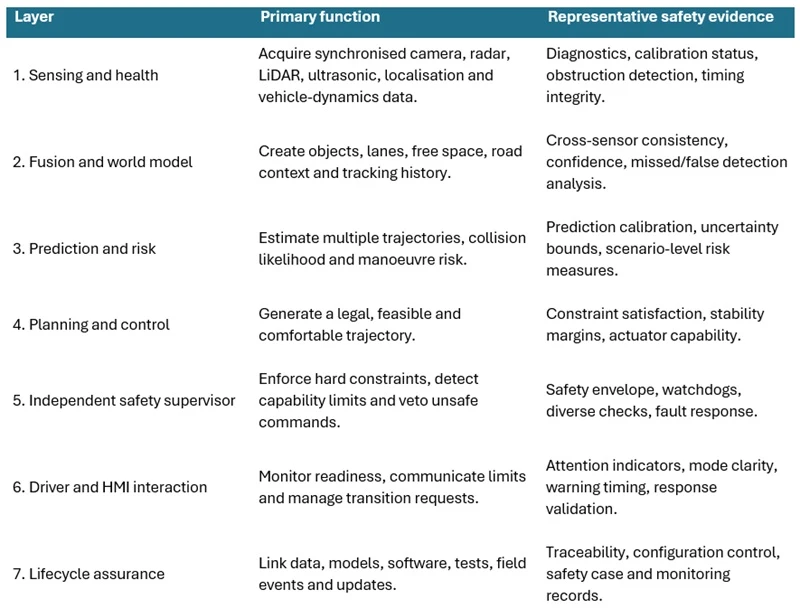
Figure 1. Conceptual layered architecture for AI-enabled risk reduction.
3.1 Uncertainty-aware perception
The world model should expose confidence and uncertainty rather than a single object list. Useful outputs include object-class confidence, position covariance, track stability, lane confidence, visibility status, sensor-health state and the degree of agreement between modalities. Safety logic can then distinguish between a positive detection, an uncertain detection and missing evidence.
3.2 Predictive safety analytics
Risk estimation should combine relative motion, road geometry, vehicle dynamics, environmental conditions and alternative actor behaviours. Rather than waiting for one threshold such as time-to-collision, the vehicle can progressively increase following distance, precondition braking, limit acceleration or create lateral space as uncertainty grows.
3.3 Constrained decision-making
An optimisation model may search for efficient and comfortable actions, but verified constraints must define what is permissible. Examples include collision-avoidance envelopes, road-boundary limits, friction-dependent braking margins, legal constraints, actuator limits and minimum driver-readiness conditions. The safety supervisor should be able to reject or modify a proposed action.
3.4 Capability and ODD monitoring
The system should continuously compare the current scene with the validated operational design domain. Relevant dimensions include road type, speed range, weather, visibility, lane quality, map availability, sensor health and fallback capability. When the vehicle approaches a boundary, it should reduce functional scope before safety margin is exhausted.
3.5 Minimal-risk strategy
If a safe handover cannot be completed, the system needs a context-aware minimal-risk strategy. Depending on capability and surroundings, this can involve controlled deceleration, hazard signalling, remaining in lane, moving towards a safer position or stopping. The strategy must account for traffic behind the vehicle, road geometry and available control authority.
4. Safety Lifecycle and Standards Integration
No single standard covers the full AI-driving risk landscape. A practical programme should build one assurance argument using complementary sources: ISO 26262 for fault-driven E/E malfunction risk; ISO 21448 for functional insufficiencies and triggering conditions; ISO/PAS 8800 for AI-specific safety engineering; ISO/SAE 21434 and UNECE R155 for cybersecurity; UNECE R156 for software-update management; and applicable type-approval provisions for automated functions. ISO/PAS 8800:2024 specifically addresses road-vehicle safety and artificial intelligence and describes the application of ISO 26262 concepts to AI systems and their interaction with system-level safety activities.
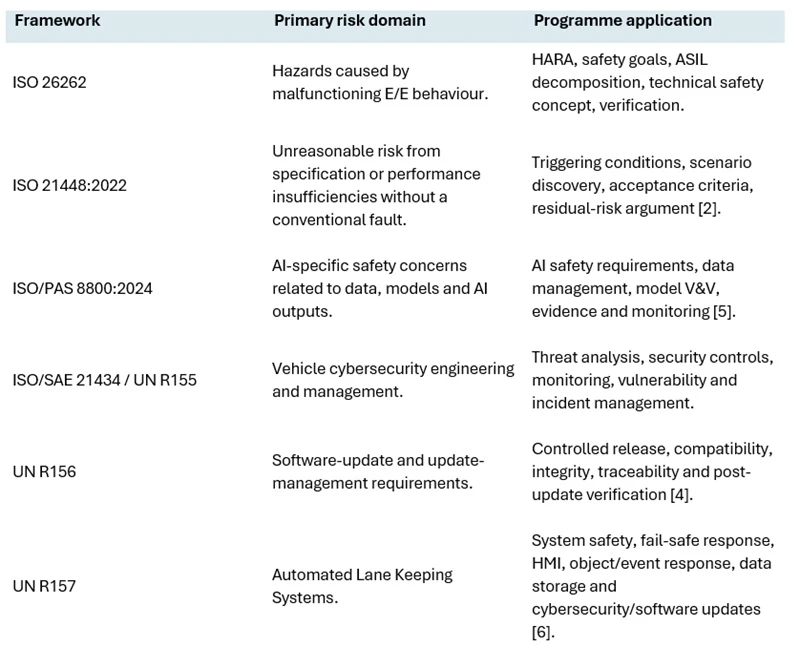
The standards should not be mapped only at the document level. Every safety claim should link to architectural controls, implementation artefacts, test evidence and operational monitoring. For example, the claim “the system will not continue automated operation outside validated perception capability” should trace to ODD definitions, sensor-health logic, uncertainty thresholds, transition behaviour, fault injection, scenario tests and field-monitoring triggers.
5. Validation: From Model Accuracy to Safety Evidence
5.1 Scenario-based verification
Aggregate accuracy is an inadequate release criterion because a model can achieve strong average performance while failing in a safety-critical slice. Evaluation should be organised around scenarios and safety-relevant factors: road geometry, object type, occlusion, illumination, precipitation, speed, sensor degradation, actor interaction and system state. NHTSA’s ADS testable-cases framework identifies modelling, simulation, track testing and open-road testing as complementary methods and explicitly considers operational design domains and tactical maneuver competencies.
5.2 Data and model assurance
- Define the intended domain and required data coverage before collection begins.
- Maintain lineage from source and consent status through annotation, transformation, training, evaluation and release.
- Analyse performance by safety-relevant slices rather than reporting only one global metric.
- Test corrupted inputs, partial sensor loss, calibration error and disagreement between modalities.
- Assess calibration of confidence outputs so that stated confidence corresponds to observed reliability.
- Use out-of-distribution and novelty indicators to trigger degraded behaviour, not to claim certainty about unfamiliar scenes.
- Control the model, dataset, toolchain and parameter versions as one release configuration.
5.3 Simulation and synthetic data
Simulation enables repeatable testing of dangerous and rare situations without exposing road users. Parameter variation and search-based test generation can intensify scenarios until the system approaches a safety boundary. Synthetic data can strengthen coverage of rare object poses, weather or sensor artefacts, but a synthetic-to-real gap can create false confidence. Consequently, synthetic results should be correlated with measured sensor behaviour and representative physical tests.
5.4 A staged evidence chain
1. Model level: Dataset checks, offline metrics, confidence calibration, robustness and explainability studies.
2. Software level: Closed-loop software-in-the-loop scenarios, fault injection and regression testing.
3. Compute level: Hardware-in-the-loop timing, numerical behaviour, thermal/loading limits and interface faults.
4. Vehicle level: Proving-ground manoeuvres, sensor degradation, HMI and fallback testing.
5. Road and fleet level: Controlled operational exposure, event review, leading indicators and update feedback.
The objective is not to claim that every road situation has been tested. It is to demonstrate a systematic reduction of known risk, a credible method for discovering unknown hazardous scenarios, and bounded behaviour when the system encounters uncertainty.
6. Driver Monitoring, Handover and Trust Calibration
Driver monitoring can combine gaze, eyelid behaviour, head pose, steering interaction and other available signals to assess whether the driver is attentive and able to respond. The system should fuse multiple cues because individual indicators can be unreliable under eyewear, lighting variation, seating position or natural behaviour. Privacy, proportionality and purpose limitation must be addressed because in-cabin sensing can process sensitive behavioural information.
A transition request should communicate what is happening, why intervention is needed and what action is expected. Timing should reflect the complexity of the scene and the driver’s measured readiness rather than a fixed countdown alone. Equally important, the system must avoid overloading the driver with technical uncertainty. HMI should translate machine-level confidence into a clear capability state and an appropriate action.
Trust should be calibrated, not maximised. Overtrust can lead to misuse and weak supervision; undertrust can cause users to disengage from beneficial assistance. Consistent mode indication, visible boundaries and predictable fallback behaviour support an accurate mental model of what the system can and cannot do.
7. Cybersecurity and Safe Software Evolution
AI expands the attack surface through datasets, model files, sensor interfaces, cloud services and continuous-learning pipelines. Threats can include manipulated inputs, unauthorised model replacement, poisoned training data, extraction of proprietary models or adversarial use of diagnostic access. AI may assist anomaly detection by learning normal communication and operational patterns, but detection outputs require independent verification and response controls.
Safety and cybersecurity teams should share assets, interfaces, assumptions and change-impact analysis. A software update that improves perception can alter timing, resource usage, object lists or confidence behaviour and therefore needs both cybersecurity assurance and safety regression. UNECE’s framework explicitly groups cybersecurity and software-update regulations with automated-driving reference documents.
8. Operational Monitoring and Continuous Assurance
Release is not the end of the safety argument. The road environment, vehicle configuration, software dependencies and cyber threats evolve. A field-monitoring process should capture safety-relevant events without collecting unnecessary personal data. Useful signals include ODD exits, confidence degradation, sensor disagreement, safety-supervisor interventions, transition requests, minimal-risk manoeuvres, repeated false warnings, update failures and cybersecurity anomalies.
Monitoring should use predefined triggers for investigation and action. A trigger may lead to a focused data review, scenario reproduction, model correction, threshold adjustment, software update, restricted operation or customer communication. Changes must preserve configuration traceability so engineers can connect each field event to the exact sensor, model and software versions in the vehicle.
9. Implementation Roadmap for OEMs and Tier-1 Suppliers
1. Define the safety concept. Specify the function, ODD, roles of driver and automation, hazardous events, acceptance criteria and fallback principles.
2. Build a shared scenario taxonomy. Connect regulations, safety analyses, customer functions, field events and test catalogues using consistent scenario attributes.
3. Architect for uncertainty. Make confidence, sensor health, timing integrity and model limitations visible to safety supervision.
4. Separate AI performance from safety authority. Use constrained planning, diverse monitoring, independent veto paths and verified fallback logic.
5. Industrialise data governance. Assign ownership for data specification, lineage, annotation quality, representativeness, privacy and release configuration.
6. Integrate validation environments. Maintain traceability across model tests, SIL, HIL, proving-ground, road and fleet evidence.
7. Combine safety, cybersecurity and update governance. Use one change-impact process and one release evidence package.
8. Operate a closed-loop assurance process. Convert field anomalies into reproducible scenarios, corrective actions and controlled updates.
10. Discussion
The main engineering trade-off is between capability and provability. Larger models and richer sensor sets may improve nominal performance, but they can increase computational load, interface complexity, data dependence and difficulty of verification. Conversely, an excessively conservative system may remain safe yet deliver little user value or generate frequent disengagement. The appropriate solution is not maximum AI authority. It is calibrated authority: AI proposes, predicts and adapts within an envelope whose hard limits are independently enforced.
A second trade-off concerns centralised computing. Cross-domain vehicle computers can share perception, driver state and manoeuvre intent across ADAS and cockpit functions, reducing duplication and enabling coordinated behaviour. They can also create stronger common-cause and resource-contention concerns. Time, memory, communication and update partitioning must therefore be engineered as safety properties.
Finally, regulation and standards are evolving. UNECE’s 2026 draft ADS regulation proposes an outcome-focused safety-case approach and a lifecycle safety-management capability, with an intended level of safety in mixed traffic at least equivalent to that of a competent and careful human driver. This direction reinforces the need for structured claims, arguments and evidence rather than reliance on a single test score or mileage figure.
11. Conclusion
AI can reduce risk in autonomous driving and ADAS by improving environmental perception, anticipating hazards, coordinating functions and recognising when operating conditions exceed capability. Those benefits are credible only when uncertainty is visible and bounded. A trustworthy system needs multi-sensor fusion, calibrated prediction, constrained planning, independent safety supervision, driver-state awareness, minimal-risk behaviour, secure software and continuous lifecycle monitoring.
The decisive shift is from feature-level performance to system-level assurance. Model accuracy, simulation mileage or road exposure cannot independently establish safety. OEMs and suppliers need a traceable safety case connecting hazards, ODD assumptions, datasets, models, architecture, validation evidence, cybersecurity controls, software updates and field operations. When these elements are integrated, AI becomes not an uncontrolled decision-maker, but a disciplined safety layer capable of strengthening human and vehicle decision-making while respecting verified boundaries.
References
[1] National Highway Traffic Safety Administration (NHTSA). “Automated Vehicle Safety.” Vehicle Safety Topics. Available at: https://www.nhtsa.gov/vehicle-safety/automated-vehicle-safety (accessed 20 October 2026).
[2] International Organization for Standardization. ISO 21448:2022, Road vehicles — Safety of the intended functionality. Geneva: ISO, 2022. https://www.iso.org/standard/77490.html
[3] National Highway Traffic Safety Administration. “Published Reports and Documents.” Includes Human Factors Design Guidance and A Framework for Automated Driving System Testable Cases and Scenarios. https://www.nhtsa.gov/automated-vehicles-safety/published-reports-and-documents (accessed 20 October 2026).
[4] United Nations Economic Commission for Europe (UNECE). “Reference documents: Automated and connected vehicles.” Includes UN Regulations Nos. 155 and 156 and ADS validation guidance. https://unece.org/transport/road-transport/reference-documents (accessed 20 October 2026).
[5] International Organization for Standardization. ISO/PAS 8800:2024, Road vehicles — Safety and artificial intelligence. Geneva: ISO, 2024.
[6] United Nations Economic Commission for Europe. UN Regulation No. 157, Uniform provisions concerning the approval of vehicles with regard to Automated Lane Keeping Systems, Revision 1, 27 March 2025. https://unece.org/sites/default/files/2025-06/R157r1e.pdf
[7] United Nations Economic Commission for Europe. Proposal for a new UN Regulation on uniform provisions concerning approval of motor vehicles with regard to Automated Driving Systems, ECE/TRANS/WP.29/GRVA/2026/3 and WP.29-198-09, March 2026. https://unece.org/sites/default/files/2026-03/WP.29-198-09e_0.pdf
[8] International Organization for Standardization. ISO 26262:2018, Road vehicles — Functional safety. Geneva: ISO, 2018.
[9] International Organization for Standardization and SAE International. ISO/SAE 21434:2021, Road vehicles — Cybersecurity engineering. Geneva/Warrendale, 2021.
[10] National Highway Traffic Safety Administration. “Automated Driving Systems.” Guidance resources including AV 2.0, AV 3.0 and AV 4.0. https://www.nhtsa.gov/vehicle-manufacturers/automated-driving-systems (accessed 20 October 2026).
 Media Pack Download
 Newsletters
 Industrial Events



Author Bio:

Dr. Unmendu Senapati
Product Manager, Robert Bosch GmbH | Germany
Dr. Unmendu Senapati is a senior automotive technology and programme leader with more than 25 years of experience across ADAS, infotainment, connectivity, telematics, embedded vehicle platforms, high-performance computing, industrialisation and product delivery. He holds a PhD focused on AI-based predictive modelling and safety analysis. Having worked with Bosch and Valeo, he combines research insight with hands-on industry leadership. He is also an industry speaker and contributor on automotive electronics, software-defined vehicles, manufacturing innovation, functional safety and cross-domain technology strategy globally.

