
AI-Driven Innovation in End-to-End Vehicle Seating Systems
For most of automotive history, the seat has been treated as a static, mechanical object - foam, fabric, springs, and a frame. It moved forward and back, reclined a little, and if you paid extra, it warmed up in winter. That era is ending. AI in automotive seating is turning what used to be a passive comfort item into an active, data-driven system that senses, learns, and responds to the person sitting in it.
This shift isn't happening in one place. It's happening across the entire lifecycle of the seat - from how it's designed, to how it's built on the factory floor, to how it behaves once it's inside a moving vehicle. That's why the industry increasingly talks about AI-driven vehicle seating systems as an end-to-end story, not a single feature bolted onto an existing product.
Why Seating Became an AI Problem
Seats sit at an odd intersection in a vehicle. They're structural (they have to protect you in a crash), they're mechanical (they move, adjust, and support weight), and they're deeply personal (everybody's body, posture, and comfort preferences are different). For decades, manufacturers solved this with adjustable levers and, later, motorized presets. But presets are a blunt instrument - they assume a handful of "average" body types and driving conditions, which never really existed for everyone.
AI automotive seating solves a different problem: instead of asking the driver to adjust the seat to fit a fixed set of rules, the seat itself learns what a specific body needs, in real time, and adjusts continuously. That's a fundamentally different design philosophy, and it's why so much R&D investment has moved into this space over the past few years.
What Does "Smart" Actually Mean in a Seat?
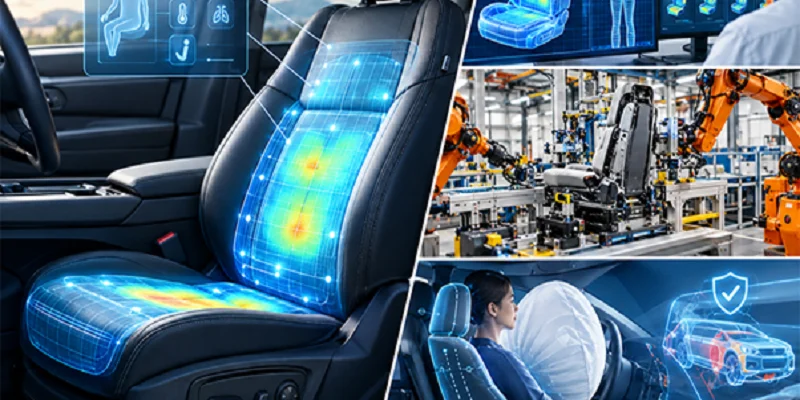
When people hear smart seating systems automotive engineers are building today, they usually picture something vague - "a seat with sensors." In practice, it's more specific than that. A modern intelligent seat typically combines several layers working together:
- Pressure-mapping sensors embedded in the cushion and backrest that build a real-time picture of weight distribution
- Biometric sensing - heart rate, breathing patterns, and sometimes skin temperature - to infer fatigue, stress, or discomfort
- Posture-tracking algorithms that flag slouching, uneven weight loading, or signs of long-trip stiffness
- Machine learning models trained on large datasets of driver behavior to predict what adjustment will actually help, rather than guessing
- Actuators and micro-motors that make small, continuous adjustments instead of one big repositioning
None of these components is new on its own. What's new is the orchestration - an AI layer that takes input from all of them and makes a coherent decision, the same way a good physical therapist would look at your whole posture rather than just one joint.
From Comfort Feature to Safety System
It's tempting to file this under "nice-to-have comfort tech," but that undersells what's actually happening. AI in vehicle seating systems is increasingly framed as a safety technology, not just a luxury one.
Consider drowsy driving. A seat with pressure and posture sensors can detect the subtle shifts in weight distribution that happen when someone is fighting to stay awake - long before a driver-facing camera would catch closed eyes or a dashboard alert would trigger. Some systems can respond by adjusting lumbar support, triggering a seat vibration, or even nudging cabin temperature and ventilation to keep the driver alert.
The same logic applies to crash protection. Intelligent vehicle seating systems can use real-time occupant data - weight, seating position, posture - to fine-tune airbag deployment timing and force, and to adjust seatbelt pretensioners a fraction of a second before impact based on how someone is actually sitting, not a generic assumption baked in at the factory. That's a meaningful upgrade from static safety calibration.
The Manufacturing Side: Where AI Quietly Does the Heaviest Lifting
The consumer-facing features get most of the attention, but arguably the bigger transformation is happening upstream, in the factory. AI automotive seat manufacturing is reshaping how seats get built long before they ever reach a showroom floor.
Design and Simulation
Engineers used to rely heavily on physical prototypes and crash-test dummies to validate seat design - expensive, slow, and limited in how many variations you could realistically test. AI-powered simulation tools now model thousands of virtual body types, seating postures, and crash scenarios before a single physical prototype gets built. This doesn't just save money; it lets designers explore comfort and safety trade-offs that would have been impractical to test by hand.
Quality Control on the Line
Automotive seat manufacturing with AI has also transformed quality inspection. Computer vision systems now scan stitching, foam density, frame welds, and upholstery alignment at a speed and consistency no human inspector could match. These systems catch micro-defects - a loose thread, an inconsistent seam, a slightly misaligned bracket - that might otherwise slip through and surface as a warranty claim months later.
Predictive Maintenance and Supply Chain
AI in automotive seat manufacturing extends beyond the assembly line itself. Predictive maintenance models monitor the machines that build seats, flagging a stamping press or a foam-molding unit before it fails, rather than after a costly unplanned shutdown. On the supply side, AI-driven demand forecasting helps manufacturers manage the dizzying number of seat variants - different trims, materials, colors, and configurations - without drowning in excess inventory or missing a shipment deadline.
Put together, this is why the phrase "end-to-end" matters. The intelligence isn't confined to the finished product; it runs through design, production, and the in-vehicle experience as one connected system.
Personalization: The Feature Drivers Actually Notice
Ask a driver what they want from a smart seat, and "AI" isn't usually the first word out of their mouth - "comfort" is. That's really the point of AI-powered automotive seating: the technology is mostly invisible when it's working well. The seat just seems to know what you need.
In practice, this looks like:
- Recognizing individual drivers (via key fob, phone pairing, or even facial or weight recognition) and automatically loading their preferred position
- Adjusting lumbar and bolster support dynamically during a long drive, rather than locking into one static setting
- Learning over time - the more you drive, the more precisely the system tunes itself to your preferences
- Coordinating with climate control, so seat heating or cooling responds to biometric feedback, not just a manual dial
- Adjusting for passenger safety, automatically recalibrating child-seat-adjacent settings or detecting an improperly buckled occupant
This is also where personalization starts blurring into wellness. Some premium systems now include "active sitting" modes that make micro-adjustments throughout a drive specifically to reduce the stiffness and fatigue that come from sitting still for hours - something no traditional seat could do, because a traditional seat has no idea how long you've been sitting or how your posture has drifted.
The Challenges Nobody Skips Past
It's worth being honest about the friction points, because they're real and they're shaping how quickly this technology reaches mainstream vehicles rather than just flagship models.
Cost. Sensor arrays, actuators, and onboard compute all add expense, which is why the most advanced systems tend to debut in premium vehicles first before trickling down.
Data privacy. A seat that tracks your weight, posture, heart rate, and driving habits is collecting genuinely sensitive biometric data. How that data is stored, who can access it, and whether it's shared with insurers or third parties are questions automakers can't dodge forever.
Reliability over a vehicle's lifetime. A seat needs to keep working for 10-15 years in a wide range of temperatures and conditions. Adding electronics and sensors means adding potential failure points, so durability testing has to keep pace with the added complexity.
Standardization. Every automaker is building its own version of this technology, often with different sensor suppliers and different AI models. That fragmentation makes it harder for regulators to set consistent safety benchmarks - and harder for consumers to compare systems across brands.
Where This Is Heading
The trajectory is fairly clear even if the exact timeline isn't. AI automotive seating is moving from a differentiator in luxury trims toward a baseline expectation, the same way backup cameras or automatic emergency braking did. As sensor costs fall and AI models get more efficient to run on embedded automotive hardware, expect to see:
- Seats that coordinate with broader cabin AI systems - climate, lighting, infotainment, even scent - to build a unified, personalized environment
- Tighter integration between seating data and advanced driver-assistance systems (ADAS), where posture and alertness data directly influence how aggressively safety systems intervene
- Shared-mobility applications, where seats in ride-share and autonomous vehicles need to rapidly re-personalize for a new occupant every few minutes
- Manufacturing that becomes even more automated, with AI handling not just inspection but adaptive assembly - adjusting build parameters in real time based on material variability
The Bottom Line
AI-driven vehicle seating systems represent one of those quiet but significant shifts in the automotive industry - not flashy in the way autonomous driving headlines are, but arguably more immediately felt by every single person who gets into a car. The seat is no longer just something you sit on; it's becoming a sensor, a safety system, and a personalization engine all at once.
From the factory floor, where AI automotive seat manufacturing is tightening quality and cutting waste, to the cabin, where intelligent vehicle seating systems are learning individual bodies and driving patterns, the common thread is the same: AI is turning seating from a fixed, one-size-fits-all component into a responsive system built around the person using it. That's a small-sounding change with genuinely large implications for comfort, safety, and how we think about the car interior as a whole.
 Media Pack Download
 Newsletters
 Industrial Events